Whether you are a company manager, a foreign entrepreneur, or an investor, sooner or later you might face an issue of debt collection in Poland. You might find yourself either as a creditor intending to quickly recover what is owed or a debtor intending to control liquidity or debt collection expenses. Below we present the most common questions and answers concerning debt collection in Poland.
Types of debt collection in Poland
There are two types of debt collection in Poland:
- amicable (extrajudicial) and
- judicial debt collection.
These processes are different, but they also share certain common features. Creditors wanting to recover an outstanding payment should remember that in many cases they may need to use the amicable method of debt collection before seeking a court's intervention. Debt collection procedure in Poland can be initiated against natural persons and legal persons, such as companies and partnerships, as well as associations, foundations, sports clubs and other entities conducting business activity.
How does debt collection work in Poland?
Debt collection works similarly as in any other jurisdiction. Claims may be recovered via amicable methods by the collection lawyers or be pursued in court in regular litigation or in fast-track injunction procedures. In some cases, it is also possible to initiate proceedings in electronic writ-of-payment procedure (e-court), which may significantly speed up the process, particularly where the claim remains uncontested.
In accordance with the applicable law, the debtor will be charged with statutory interest for late payment, as well as reasonable debt recovery costs.
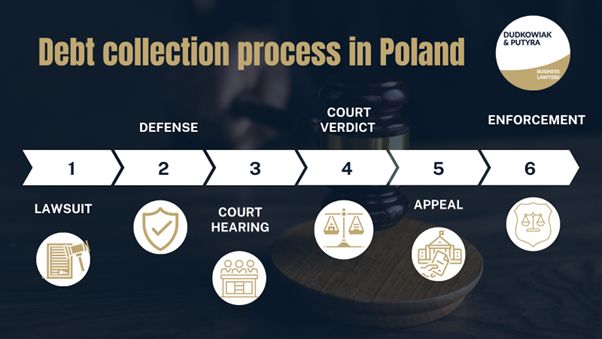
How to start - debt collection process?
Before executing any transaction or making any decision on initiating court proceedings against a debtor in Poland, a creditor should first research of the debtor's financial situation and assets.
Debtor due diligence in Poland differs depending on whether the debtor is:
- a commercial company (and/or partnership) or
- a natural person - a consumer, a sole proprietor.
Corporate debtor verification in Poland
In the case of commercial companies which are required to submit annual financial statements, the research of the financial situation can be made based on the reporting documentation uploaded to the open-access government search engine available at eKRS.
Using this tool, you can access the financial statements and performance reports for previous years. These documents will give you a picture of the potential partner's or debtor's financial situation. Provided you know how to read financial statements, they can tell you if a company has any valuable assets, what is the value of its liabilities and what were its profits over the recent years. Failure to draw up these documents by a company despite being required to do so can be a major red flag for a creditor.
Another portal where details about a company available in the database of the National Court Register can be downloaded (EMS) can be a useful source of information about a debtor. Section 4 of the company's record may contain information about outstanding taxes, payments to the Social Insurance Institution (ZUS) or other creditors and may tell you if the debtor's assets were frozen as a result of bankruptcy or restructuring proceedings relating to the debtor. This information can be accessed by anybody for free.
Individual debtor verification in Poland
Researching the financial and assets situation of a natural person, including one running a sole proprietorship, is more challenging, because they are not required to disclose information about their affairs in any publicly available portal.
One useful source is a commercial credit information bureau (Biuro Informacji Gospodarczej – BIG), such as Krajowy Rejestr Długów (KRD), ERIF or BIG InfoMonitor, which collect information on outstanding debts reported by businesses and financial institutions.
Public information regarding insolvency, restructuring and enforcement proceedings is available through the National Register of Debtors (Krajowy Rejestr Zadłużonych – KRZ), an official online system operated by the Ministry of Justice.
This portal can indicate if any enforcement proceedings, restructuring, or bankruptcy filings exist in relation to a potential business partner or debtor. It may also show information about partners in partnerships who may be liable for the partnership's debts without limitation with all their assets.
All such information can be extremely helpful in verifying the financial situation and credibility of potential business partners and debtors alike.
You should also remember about other, less official tools to research the debtor's financial situation in Poland. These include:
- Online research,
- Credit Reference Agency,
- National Debts Register,
- Detective services,
- Requesting information from courts with jurisdiction over a debtor's seat or address on whether bankruptcy or restructuring proceedings are pending with respect to the debtor or researching a debtor under enforcement
Note: Due to data protection and privacy laws (e.g., GDPR), publicly accessible information about a natural person's finances is limited compared to corporate data. Therefore, combining multiple sources and, where appropriate, obtaining consent from the debtor can improve the reliability of your due diligence.
Do I have to send a demand for payment to the debtor?
The first and essential element that opens the extrajudicial stage of debt collection is sending a notice of default to the debtor.
The role of the demand for payment in extrajudicial debt collection is essential for two reasons:
- First of all, it shows the debtor that the creditor takes the required steps to recover the payments owed and can serve as an incentive to either pay the debt or start out-of-court negotiations.
- Second of all, if the creditor takes the matter to court, the notice of default is a proof that they attempted to solve the dispute amicably and indicates the date when the claim became due and payable (in the case of debts with unspecified payment dates).
A debtor's response to the notice in which they, for instance, offer to pay the debt in installments, but do not challenge its existence, is strong evidence that the debtor admitted the claim. This, in turn, is crucial in determining that the limitation period on the claim has been interrupted and can facilitate the creditor to obtain an order for payment without undue delay.
Note: As of 2026, sending a demand for payment is mandatory before reporting the debtor to commercial debt registers, and strongly advised before initiating legal proceedings, to avoid potential dismissal for procedural omissions.
Out of court settlement with debtor
If the creditor decides to reach an agreement with the debtor over the payment of a debt, they may enter into a so-called out-of-court settlement whereby the parties agree the terms of payment based on mutual concessions. The most common solutions include:
- payment in instalments,
- postponement of the payment date,
- giving up a portion of interest by the creditor, etc.
You should remember that an out‑of‑court settlement, although legally binding, still cannot serve as direct grounds for enforcement by a court bailiff without an enforceable title (e.g., a court judgment or a notarial deed with submission to enforcement). If the debtor defaults on the settlement, the creditor still has to file a court action (unless appropriate security was agreed).
For this reason, if you are about to execute an out-of-court settlement, you should consider using appropriate security arrangements, such as a
- blank promissory note,
- a suretyship provided by a third part
- a notarial act containing the debtor's voluntary submission to enforcement (art. 777 of the Polish Code of Civil Procedure) limited to the amount specified in the settlement.
With any of these in place, your chances of recovering money in the case where the debtor becomes insolvent or defaults on due payments are much higher.
Debt Collection Law Firm or Agency
In the event that the debtor refused to pay or ignored the notice of default, you can always turn to a debt collection agency or a law firm specializing in debt recovery.

However, bear in mind that these agencies and firms take a percentage of the debt they help recover and are not authorized to seize a debtor's assets or bank accounts (these powers are available to debt enforcement officers only). Their services principally involve reminding the debtor about the overdue payments by calling him and sending official letters.
Selling overdue debt
One of increasingly popular solutions is the assignment of a debt on a debt exchange. This way the creditor can sell a debt and recover at least a portion of the money owed to them.Such assignments must be documented clearly and comply with data protection rules, especially when involving consumer information, following the updated Polish enforcement and GDPR‑aligned practices.
Are there public debt registers in Poland?
Yes - business creditors can list their debtor in the National Debts Register (e.g., Krajowy Rejestr Długów – BIG, ERIF, KRD). Such listings are widely used in practice and can significantly undermine a debtor's credit credibility among business partners and financial institutions. This can prove a strong incentive for the debtor to pay what they owe as soon as possible.
In many cases, letting the debtor know that you intend to report their details to a reputable credit information bureau or register will be enough to encourage payment.
Both businesses and, in certain circumstances, consumers may report debtors to commercial debt registers, provided the statutory conditions are met.
In order to list a debtor, the claim must be due and payable. For business debtors, the minimum outstanding amount is PLN 500; for consumers, PLN 200. The payment must be overdue for at least 30 days and preceded by a written warning of the intended listing.
Before reporting a debtor's details to the register, you must always send a formal notice of default to the debtor first and be able to prove that you did so - otherwise the listing may be contested as unlawful under data protection and credit reporting regulations.

How to pursue a debt collection case in the court?
If the extrajudicial debt collection methods fail, the creditor can pursue their claims in the court of law. Debt collection - litigation is an element of the Polish civil procedure. Debt collection - litigation involves two opposing parties:
- the claimant, namely the party who seeks from the court a specific determination indicated in the pleading initiating the proceedings - the statement of claim - and
- the defendant, namely the party who requests the court to dismiss the claimant's claim (dismissal of the action).
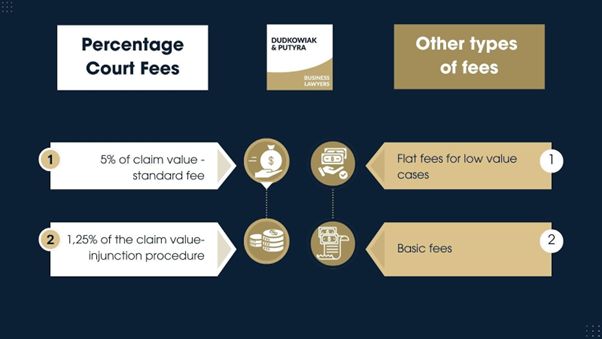
If the creditor decides to lodge their claims in court, they must be prepared to pay a court fee for starting their court case. The amount of the court fee in payment actions depends on the value in controversy.
In many straightforward cases, a creditor may also use the electronic writ‑of‑payment procedure (e‑court/online order for payment), which allows quicker proceedings without a full trial if the debtor does not contest the claim. This option is available under the Polish Civil Procedure Code and has become common in commercial debt cases.
Regardless of the chosen route, the creditor should be ready to present evidence and documentation supporting the claim, such as invoices, contracts, correspondence, and proof of attempts to collect the debt amicably. If the claim is uncontested and properly documented, the court may issue an order for payment efficiently.
What are the court fees for debt collection?
There are three types of court fees:
- fixed fees,
- basic fees, and
- percentage fees.
As a general rule in commercial proceedings, parties are expected to present all claims and evidence at an early stage of the proceedings. Late submissions may be disregarded by the court unless the party demonstrates that it was not possible to present them earlier or that the need to invoke them arose at a later stage.
Can I file a lawsuit to collect a debt?
In order to claim a debt in court, you need to prepare a lawsuit. A lawsuit is a document initiating litigation and it must satisfy certain conditions. A copy of a correctly drafted lawsuit shall be provided to the opposing party and the legal proceedings can begin. Just like any other pleading, a lawsuit (statement of claim) must specify the details of the court to which the document is submitted, details and addresses of the parties and their attorneys (if any) and the type of the pleading.
In practice, the statement of claim may also be filed electronically via the court's e‑filing system (e‑sąd / e‑court), which is increasingly used in Polish civil courts.
Moreover, a statement of claim should also set out with precision the remedy sought by the claimant, that is what are their requests that the court should award in the final ruling. Apart from payment of overdue amounts from the defendant, in the statement of claim the claimant may seek the award of late-payment interest accrued from a specific date or the award of costs of litigating the case. The statement of claim can also set out the evidence that the court should take. This part opens the statement of claim and is referred to as the particular of claim.
The request for remedy should be accompanied by reasons explaining why the relief should be awarded, so that the court can decide if there is merit in the claimant's claims. To that end, in the causes of action section of the document the claimant should set out the facts that justify their claims (e.g. the litigants executed a sale contract on a specific date, the claimant handed over the purchased item to the buyer, but the buyer failed to pay). In the statement of claim, the claimant should also provide evidence to demonstrate that their claims (requests for relief) are justified.
In simple actions for payment, it is usually sufficient to provide copies of invoices, bills, documents confirming that the claimant kept their end of the transaction (e.g. proof of delivering the purchased item, wire transfer confirmation, etc.) with the statement of claim.
If the circumstances of the case are more complex and the claimant expects the defendant to challenge the existence of the claim or its value, the claimant may want to consider applying to the court (in the statement of claim) to admit and take evidence from witnesses to support the alleged facts. In some cases, proving the value of the claim asserted by the claimant may require expert evidence, that is an opinion issued by an expert in a given filed. An expert's opinion may be necessary, for instance, when the claimant wants to prove that they suffered losses of specific value in consequence of inappropriate performance of a contract by the defendant.
Is it possible to claim injunctive relief?
Granting of security for a claim is possible in any civil case. The court may issue an order to secure a claim both before filing a lawsuit and during the proceedings. In an motion for injunctive relief, a party must make its claim more plausible. The party must also give prima facie evidence of a legal interest in securing the claim.
Courts relatively often grant security for a claim. Proceedings for granting security usually take place without the participation of the other party. For this reason, often the other party learns of the granting of security only from the content of the court's order. An order granting injunctive relief may be challenged by a dissatisfied party.

Security orders allow the plaintiff to form a relationship with the defendant at an early stage of the dispute. Hence, injunctive relief is a valuable tool for the plaintiff, but represents a major risk for the defendant
What is the late payment interest for overdue claims in Poland?
In Poland, statutory interest for late payment is regulated by the Civil Code (Article 481 §2). If the parties have not agreed on a different interest rate, statutory interest for delay is calculated as the sum of the reference rate of the National Bank of Poland (NBP) and 5.5 percentage points.
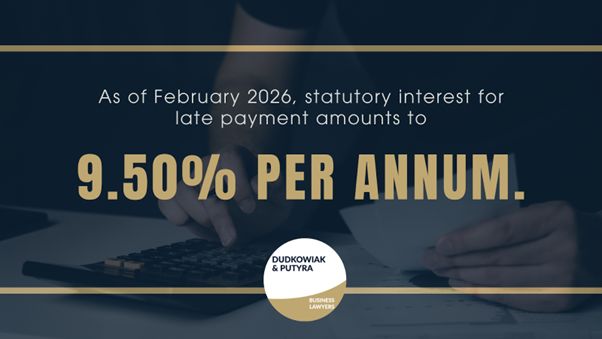
As of February 2026, the NBP reference rate amounts to 4.00%, which means that statutory interest for late payment is currently 9.50% per annum.
This rate is variable and automatically changes whenever the NBP reference rate is adjusted by the Monetary Policy Council.
Under Polish law, the maximum statutory interest for delay may not exceed twice the statutory interest rate. As of February 2026, the maximum interest for late payment therefore amounts to 19.00% per annum.
It should also be noted that different rules apply to commercial transactions between businesses. In such cases, statutory interest for late payment is governed by the Act on Counteracting Excessive Delays in Commercial Transactions, which provides for higher rates (currently 12% or 14% per annum, depending on the status of the debtor).
How do the evidence proceedings work?
In commercial disputes, the plaintiff is obliged to present all claims and evidence in the statement of claim, and the defendant in the response to the statement of claim. Claims and evidence presented at a later stage will be disregarded by the court, unless the party makes it plausible that it was not possible to invoke the claims and evidence earlier or that the need to invoke them arose later. In that event, further claims and supporting evidence should be presented within two weeks from the date on which their invocation became possible or the need to invoke them appeared.
Does a debt collection case always involve a hearing in court?
Sometimes the court ends the case with an order for payment without the participation of the parties and sometimes court decides that the case should go to trial. During the trial, the parties provide statements to the court in respect of individual facts of the case, the court admits and takes evidence (e.g. from witnesses) and interrogates the litigants.
In principle, the court's goal is to close of the case during the first hearing, however, in many cases a trial is spread over several hearings, especially where the litigants applied to take evidence from witnesses. The case in court ends with a verdict.
How long does it take for a final judgment to be issued?
In the event of an appeal against the first‑instance judgment, only the judgment of the second‑instance court is considered final. Typical timelines in practice in 2026 are as follows:
- First instance: usually 1–3 years, depending on the court's workload and complexity.
- Second instance (appeal): typically 6–18 months, with longer durations often seen in larger cities with heavier caseloads.
These timelines are consistent with current civil procedure patterns in Poland - though actual duration can vary significantly based on case complexity, court backlog, and whether the case proceeds via simplified or ordinary proceedings.
How enforcement of judgement works in Poland?
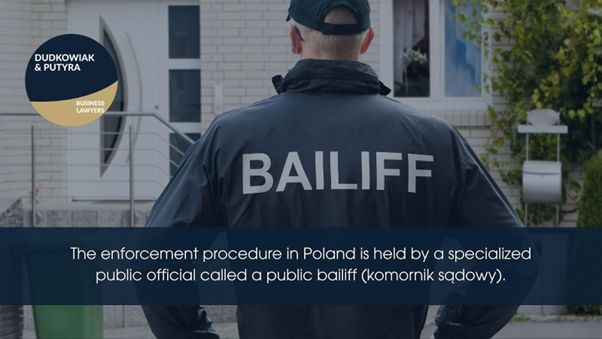
The enforcement procedure in Poland is held by a specialized public official called a public bailiff (komornik sądowy).
The debt enforcement takes place upon an application filed by the creditor. The process must be accompanied by the relevant enforcement order. This is nothing more than a court decision that is final.
Once such a judgment has become final, the creditor may apply for an enforcement clause, i.e. for an enforceable title. The application for an enforcement clause is submitted to the court, which, in the clause procedure, determines whether the judgment is final and enforceable by way of compulsion and then grants the enforcement clause in question.
The next step is to draw up an enforcement application and submit it to the bailiff. In the request, it is mandatory to indicate from which assets of the debtor we want the enforcement proceedings to be conducted. Enforcement may be carried out from:
- the debtor's bank accounts,
- movables belonging to the debtor,
- remuneration for work,
- pensions or annuities paid monthly to the debtor by the Social Insurance Institution,
- tax overpayment, which the tax office will not return to the debtor but will pass it on to the bailiff,
- property rights, such as the right to divide or distribute property,
- debtor's claims against a third party,
- real estate owned by the debtor,
- other assets from which it will be possible to obtain sums to satisfy the creditor.
In practice, bailiff enforcement requests can now also be initiated electronically via the court/bailiff portal, and the bailiff may request information from public databases (e.g., land and mortgage registers, vehicle registers) to identify assets without the creditor having full prior knowledge.
Search for debtor assets
If we do not have knowledge of the debtor's assets, bank accounts held by the debtor, receivables, we do not know whether the debtor is working or receiving Social Security benefits, then we may commission a public bailiff to search for the debtor's assets for remuneration. The bailiff, after we have received an advance for the costs he or she will have to incur, will take action himself or herself and establish the debtor's assets. Such a procedure may lead to a quicker and more efficient conclusion of the enforcement proceedings.
Conclusion
Navigating debt collection in Poland requires a structured approach, beginning with proper due diligence and amicable efforts, and, if necessary, proceeding to judicial enforcement. Understanding local procedures-from demand letters to court proceedings and bailiff enforcement-can significantly improve the chances of successful recovery. Whether you are a creditor or debtor, engaging experienced legal counsel can help protect your interests and streamline the process in line with current legal standards.
The content of this article is intended to provide a general guide to the subject matter. Specialist advice should be sought about your specific circumstances.