Welcome to the second edition of the e-Bulletin (Volume VIII) brought to you by the Employment, Labour and Benefits practice group of Khaitan & Co. This e-Bulletin covers regulatory developments, case law updates and insights into industry practices that impact businesses from a sector agnostic standpoint.
Labour Codes: Story So Far
In this section, we help you in understanding the developments that have taken thus far on the implementation of the 4 labour codes on wages, social security, industrial relations, and occupational safety, health, and working conditions, which received the Presidential assent between the years 2019 and 2020. The Government of India has, through a series of notifications dated 21 November 2025, brought into effect the 4 labour codes. We have covered this aspect in detail in our ERGO.
The codes consolidate and consequently replace 29 Central labour laws and bring about a more cohesive and modern framework for compliance. The consolidation exercise in the form of the labour codes does bring with it certain changes in the earlier labour law regime. The digitization of procedures (relating to registration and intimations) and the concept of deemed registration (in case authorities do not register the establishment within the specified timeline) are seen as a positive impact on the ease of commencing business as well as the ease of doing business. Similarly, the substitution of prosecution-oriented framework with facilitation process, whereby an employer would be given an opportunity to rectify any non-compliance, heralds an important change in the approach of the government.
While the Central Government has recently re-notified the draft Central rules under the 4 labour codes, in the absence of finalization and enforcement of Central / state rules, schemes, and notifications, the transition is still in the process of unfolding. Set out below are the updates that we have seen on the labour codes front, recently:
- Issuance of FAQs: The Central Government has released the FAQs on labour codes, and we have covered this aspect in detail in our ERGO. Further, clarifications have been put forth by other authorities including the Employees' State Insurance Corporation, through multiple circulars referring to the definition of 'wages' and emphasizing the requirement of the employers to register additional employees who may potentially be covered because of the revised definition of 'wages'. Recently, the Central Government specifically also released FAQs to the Code on Social Security, 2020 (SS Code).
- Clarification on Gratuity: The Institute of Chartered Accountants of India has released a set of FAQs addressing key accounting implications arising from the implementation of the new labour codes. These FAQs note that any increase in gratuity liability due to the new labour codes must be recognised as an expense in the profit and loss account for the interim financial statements/results for the period ending 31 December 2025, in line with the applicable accounting standards.
- Issuance of Rules: In the past year, several key industrialised states such as Haryana, Delhi, Maharashtra, Gujarat, Andhra Pradesh, Telangana, Tamil Nadu, Bihar, and Karnataka released draft rules under some or all of the labour codes for public consultation. As of now, 2 out of a total of 36 states and union territories are yet to publish draft rules on the Code on Wages, 2019 (Wages Code) and Industrial Relations Code, 2020 (IR Code) and 1 state has not released draft rules on Occupational Safety, Health and Working Conditions, 2020 (OSH Code) and SS Code. Further, states such as Gujarat, Uttar Pradesh and Mizoram appear to have released final rules under some of the labour codes. In the month of February 2026, the governments of Tripura, Andhra Pradesh, Rajasthan, Haryana and Gujarat have released the draft rules pursuant to the labour codes.
- Issuance of Compliance Handbook: The Ministry of Labour and Employment (MoLE) has released a compliance handbook for employers under the 4 labour codes. The purpose of this handbook is to assist establishments in comprehending and offering guidance on the compliances to be undertaken vis-à-vis their statutory obligations under the new labour law framework.
Regulatory Updates
In this section, we bring to your attention, important regulatory developments in the form of notifications, orders, bills, amendments, etc. witnessed in the past one month in the context of employment and labour laws.
Amendments introduced to the IR Code
The Ministry of Law and Justice introduced the Industrial Relations Code (Amendment) Act, 2026 (IR Amendment Act) which was published in the Official Gazette on 16 February 2026. The IR Amendment Act has amended Section 104 of the IR Code (Repeal and Savings), to (a) expressly include a provision stating that the following erstwhile legislations: i) the Trade Unions Act, 1926, ii) the Industrial Employment (Standing Orders) Act, 1946 and iii) the Industrial Disputes Act, 1947 (ID Act), stand repealed from 21 November 2025 (enforcement date of labour codes); and (b) clarify the continuation of the tribunals and statutory authorities set out under the erstwhile legislations, despite the repeal of the aforementioned erstwhile legislations, until the legal machinery under the new labour codes are in motion.
Separately, even the MoLE had issued notifications on 2 February 2026, setting out the aspects concerning amendments to the IR Code as set out above.
Haryana promulgates the Haryana Shops and Commercial Establishments (Amendment) Act, 2025
The government of Haryana has promulgated the Haryana Shops and Commercial Establishments (Amendment) Act, 2025 (Haryana S&E Amendment Act), which was published in the Official Gazette on 5 February 2026. The Haryana S&E Amendment Act amends the Haryana Shops and Commercial Establishments Act, 1958 (Haryana S&E Act) and is deemed to have come into force with effect from 12 November 2025. The Haryana S&E Amendment Act was earlier published as an ordinance, subsequently introduced as a bill and has now been enforced as a statute in effect. We have covered these aspects in detail in our ERGO dated 18 November 2025 which may be accessed here.
Introduction / proposal of amendments to shops and establishment legislations
In the past one month, multiple states have introduced certain amendments / proposed amendments to their respective applicable shops and establishment legislations. Set out below is a short summary of these updates:
Gujarat: The government of Gujarat published the Gujarat Shops and Establishments (Regulation of Employment and Conditions of Service) Bill, 2026 (Gujarat S&E Bill) in the Official Gazette on 11 February 2026. The Gujarat S&E Bill amends the Gujarat Shops and Establishments (Regulation of Employment and Conditions of Service) Act, 2019. We have covered the detailed aspects as set out in the corresponding ordinance which was issued prior to the issuance of the Gujarat S&E Bill, in detail, in our ERGO dated 29 December 2025 which may be accessed here.
Rajasthan: The government of Rajasthan has introduced the Rajasthan Shops and Commercial Establishments (Amendment) Bill 2026 (Rajasthan S&E Bill) on 16 February 2026. The Rajasthan S&E Bill seeks to amend the Rajasthan Shops and Commercial Establishments Act, 1958 and increases the a)
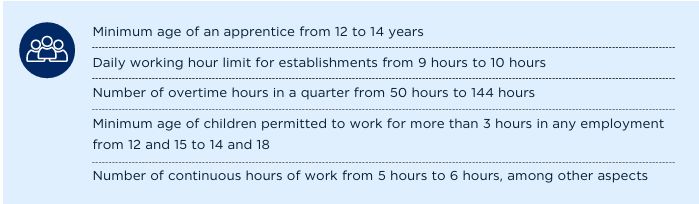
Uttar Pradesh: The government of Uttar Pradesh has brought into effect the Uttar Pradesh Dookan Aur Vanijya Adhishthan (Sanshodhan) Adhiniyam, 2025 (UP S&E Act), effective 19 November 2025, after the Governor accorded their consent to the amendment on 1 January 2026 post ratification of the amendment by the state legislature. The UP S&E Act has amended the Uttar Pradesh Dookan Aur Vanijya Adhishthan Adhiniyam, 1962. The amendment in its bill stage was analysed by us in our ERGO which may be accessed here.
Tripura: The government of Tripura has introduced the Tripura Shops and Establishments (Eighth Amendment Ordinance, 2026 (Tripura Ordinance), amending the Tripura Shops and Establishments Act, 1970 (Tripura S&E Act). The Tripura Ordinance a) permits the shops and commercial establishments
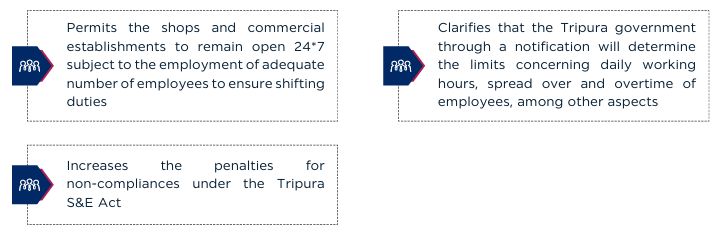
Himachal Pradesh: The government of Himachal Pradesh has introduced the Himachal Pradesh Shops and Commercial Establishments (Amendment) Act, 2025 (HP S&E Amendment Act), which was published in the Official Gazette on 16 February 2026. The HP S&E Amendment Act amends the Himachal Pradesh Shops and Commercial Establishments Act, 1969 (HP S&E Act), and has increased the
- Number of overtime hours in a quarter from 50 hours to 144 hours
- Threshold for registration requirement set out under the HP S&E Act to establishments employing 10 or more employees
Andhra Pradesh issues notification regarding exemption of IT and ITES establishments
As per the notification dated 14 February 2026 published in the Official Gazette, the Government of Andhra Pradesh has modified an earlier notification issued by the government dated 25 March 2025, which had exempted the Information Technology Enabled Services (ITES) and Information Technology (IT) establishments from certain provisions of the Andhra Pradesh Shops and Establishments Act, 1988.
Previously, the exemption was subject to certain specific conditions, which has now been modified to include
| Availability of the grievance redressal mechanism under the IR Code for cases of employment termination of the workers despite the exemption of Section 47 of the Andhra Pradesh Shops and Establishments Act, 1988 (under the earlier circular) |
The manner of handling complaints for violation of labour laws which may be forwarded to the relevant authorities and inspections may be appropriately conducted, among other aspects. |
Case Updates
In this section, we share important judicial decisions rendered in the past one month from an employment and labour law standpoint.
Existing labour courts will continue to be the adjudicatory mechanism, notwithstanding the enactment of the new labour codes: Kerala High Court
In the case of M K Suresh Kumar and Another v the Union of India and Others, Writ Petition (Civil) Number 824 of 2026, the Kerala High Court noted that the labour courts and forums under the erstwhile labour legislations will continue to function even after enactment of the new labour codes.
In the present case, the petitioner had challenged the relevant notification by the Government of India, wherein it was clarified that the existing labour courts, industrial tribunals and national tribunals under the erstwhile ID Act, would continue to adjudicate the present as well as the new cases. The petitioner claimed that the referenced notification was ultra vires the provisions of the IR Code and thus pleaded that the same cannot be sustained in law. Additionally, the petitioner along with other arguments also referenced Section 51(1) of the IR Code which prescribes the transfer of all pending cases to the newly formed tribunals and highlighted that allowing adjudication of disputes before the existing forums was rather in violation of the provisions of the IR Code. On the contrary, the respondent argued that transfer of pending cases to new forums is not feasible as the new forums have not been constituted and it would be against public interest to abruptly halt the functioning of the existing forums.
In this regard, the High Court concluded that the existing forums would continue to be the primary adjudicatory mechanism and will sustain till the new tribunals are constituted as prescribed under the IR Code. Additionally, the High Court also clarified that the referenced notification was not ultra vires to the provisions of the IR Code.
Constitution of welfare boards is essential and a condition precedent for levy and collection of cess: Supreme Court
In the case of Prakash Atlanta v National Highway Authority of India, Civil Appeal Number 4513 of 2025, the Supreme Court held that that constitution of welfare boards is essential and a condition precedent for levy and collection of cess under the erstwhile Building and Other Construction Workers (Regulation of Employment and Conditions of Service) Act, 1996 and the erstwhile Building and Other Construction Workers' Welfare Cess Act, 1996, along with the SS Code and OSH Code. We have covered this case in detail, which may be accessed here.
Principal employer must give precedence to former contract workers when employing regular workman: Supreme Court
In the case of M/S Premium Transmission Private Limited v Kishan Subhash Rathod and Others, Special Leave Petition (Civil) Number 12192 of 2023, the Supreme Court of India opined that principal employers must give preference to former contract workers at the time of employing regular workmen for the work performed by the erstwhile contract workers.
In the present case, the appellant had discontinued the contract with the contract workers (respondent) and had initiated the hiring of new regular employees for performing similar roles. Aggrieved by this decision, the respondent filed an industrial dispute before the Industrial Court. The respondents were also seeking interim relief under Section 33A of the erstwhile ID Act (conditions of service to remain unchanged during pendency of proceedings), highlighting that the appellant had modified the conditions of their services, during the pendency of a proceeding, which was against the provisions of Section 33(1) of the erstwhile ID Act. The Industrial Court granted interim relief to the respondents, highlighting breach of Section 31(1) of the erstwhile ID Act. Based on this decision, the appellant approached the Bombay High Court, which further rejected their plea.
The Supreme Court held that Section 33(1) of the erstwhile ID Act cannot be invoked when the existence of the relationship between the management and workmen is itself in contention. The Supreme Court observed that in cases wherein, the principal employer has full supervision over workman, and the arrangement between the parties is a sham, the workman would be entitled to back wages and benefits, in parity with the regular employees. Further, the Supreme Court observed that principal employers are required to give preference to former contract workers and provide subsequent relaxation in their qualification requirements, at the time of recruiting them as regular workers.
Labour courts are strictly bound by the terms of reference under Section 10(4) of the ID Act: Kerala High Court
In the case of Lunar Rubbers v Kerala Head Load Timber Workers and Factory Workers Union and Others, Writ Petition (Civil) Number 1003 of 2020, the Kerala High Court observed that labour courts cannot go into the legality of closure when the reference by the appropriate government is limited to the justification of retrenchment.
In the present case, the petitioners decided to close their unit and accordingly the workmen were provided with applicable compensation and gratuity under the erstwhile ID Act. However, the respondent claimed that the closure was not genuine as employment of only few workmen was terminated, and other workmen were transferred to sister entities of the petitioner. Upon failure of conciliation, the government referred the dispute to the labour court, limiting the issue to the legality of the retrenchment of workmen. Subsequently, the labour court held that the termination of workmen was unjustified and examined the genuineness of the closure, thereby directing the reinstatement of the workmen.
The High Court held that under Section 10(4) of the erstwhile ID Act, an adjudicating authority is strictly bound by the terms of reference and that in this present case as retrenchment had already taken place, the labour court could not have assessed whether the closure was genuine or a sham, unless the reference itself highlighted this for adjudication. Thereby, the High Court held that the labour court's decision was beyond its jurisdiction which in the instance was strictly confined to the points of dispute specifically referred, with no exception to enlarge the dispute based on its own assessment. Accordingly, the High Court quashed the orders of the labour court and directed the appropriate government to make a fresh reference in this regard.
9-Judge bench to hear reference over expression of 'industry' under the erstwhile ID Act: Supreme Court
In the case of State of UP v Jai Bir Singh, Civil Appeal Number 897 of 2002, the Supreme Court held that a 9-judge bench will be constituted with effect from 17 March 2026, to consider the correctness of the judgement rendered by the 7-judge bench in the case of Bangalore Water Supply and Sewerage Board v A. Rajappa, (1978) 2 SCC 213 (Bangalore Water Supply).
In the present order, the Supreme Court mentioned that the 9-judge bench will re-consider the interpretation of the expression 'industry' as defined under Section 2(j) of the erstwhile ID Act, as pronounced in Bangalore Water Supply. The constituted 9-judge bench will also assess whether the IR Code will have an impact on the interpretation of the expression 'industry'.
Further, the 9-judge bench is also proposed to provide clarifications to various pending questions, including whether the social welfare activities undertaken by the government departments can be considered to be "industrial activities" for the purpose of Section 2(j) of the erstwhile ID Act. This is an evolving development, and we will be covering the update of this judgement in the course of the next editions of this e-bulletin.
Maternity leave cannot be combined with medical leave: Kerala High Court
In the case of Susan K John v National Board of Examinations in Medical Sciences and Others, Writ Petition (Civil) Number, 48652 of 2025, the Kerala High Court observed that maternity leave is a right and cannot be clubbed with other regular medical leaves.
In the present case, the petitioner who is a doctor joined a specialisation course in the institution and had earlier availed maternity leave. However, the petitioner in the same year was also diagnosed with a serious medical condition. The relevant rules of the medical institution prescribed that a candidate's absence cannot be equivalent to one year, which will result in cancellation of their candidature. Consequently, the petitioner filed the present petition.
The High Court, in this case, noted that this was a unique situation and that such rigid rules cannot be applied in such severe and extraordinary circumstances. Further, the High Court also noted that the rule of leave of absence not exceeding one year, cannot be held to be justifiable in this case. The High Court further noted that the rationale for seeking leave beyond the restricted period of one year is not due to any wilful misconduct of the petitioner but rather something which was beyond her control. Thereby, the High Court held that the referenced rules cannot be applied wherein a candidate encountered maternity leave and a life-threatening illness in the same year.
Industry Insights
In this section, we delve into interesting human resources related practices and/or initiatives as well as industry trends across various sectors in the past one month.
India Inc focuses on empathy-driven policies to retain employees
Amid growing focus on work life balance, India Inc is witnessing an increase in organisations redesigning their employee beneficial policies, to support an employee through different life challenges. Companies have realised that for retention of employees especially younger workforce and for achievement of higher levels of productivity, the company policies need to provide more flexibility to its employees.
With empathy as a key driver, companies have started to provide bereavement leaves, part-time working models, support programs for retiring employees, among other initiatives, to cater to the emotional wellbeing of an employee. Organisations are adopting policies focusing on mental well-being of the employee such as policies mandating employees to leave workplace on time, caregiver leave as well as menstrual leave, among other initiatives.
We hope the e-Bulletin enables you to assess internal practices and procedures in view of recent legal developments and emerging industry trends in the employment and labour law and practice landscape.
The content of this document does not necessarily reflect the views / position of Khaitan & Co but remain solely those of the author(s). For any further queries or follow up, please contact Khaitan & Co at editors@khaitanco.com.
The content of this article is intended to provide a general guide to the subject matter. Specialist advice should be sought about your specific circumstances.