
1. Marketing Authorization Approval Process
1.1 Registration Pathways and Timelines
There are two main registration pathways for medicinal drugs in Thailand.
- Full assessment: The standard evaluation pathway, in which the Thai FDA conducts a complete, independent review of the entire drug registration dossier—including quality (CMC), nonclinical, and clinical modules—without relying on any prior assessment by a stringent regulatory authority. The full dossier is evaluated by a panel of six external experts (two quality module experts, two nonclinical module experts, and two clinical module experts).
- Abbreviated assessments: Three types of abbreviated assessments are available. These include:
- Abridged assessment: Available when the applicant submits the drug registration dossier together with an unredacted assessment report from at least one stringent regulatory authority (SRA) recognized by the Thai FDA (e.g., US FDA, EMA Centralized System, MHRA, Swissmedic, TGA, Health Canada, and Japanese PMDA). The dossier must be submitted within two years of SRA approval, and the product must have the same indication, dosage regimen, administration method, and target population. The number of reviewing experts is reduced from six to four (two quality experts, one nonclinical expert, and one clinical expert).
- WHO/SRA Collaborative Registration Procedure (CRP): The most expedited pathway, available for products listed in the WHO Prequalification list or approved by a stringent regulatory authority. Under the CRP, the Thai FDA relies significantly on the assessment already performed by the reference SRA or WHO, conducting a focused review rather than a full independent evaluation. The application dossier may be prepared in either ASEAN Common Technical Dossier (ACTD) or ICH-CTD format.
- ASEAN Joint Assessment Procedure: A collaborative pathway in which the MA application is simultaneously submitted to participating national medicines regulatory authorities (NRAs) within the ASEAN region. The NRAs jointly conduct the assessment and prepare a consolidated report; each NRA then makes its own independent regulatory decision in accordance with national requirements, taking the joint report and any country-specific considerations into account.
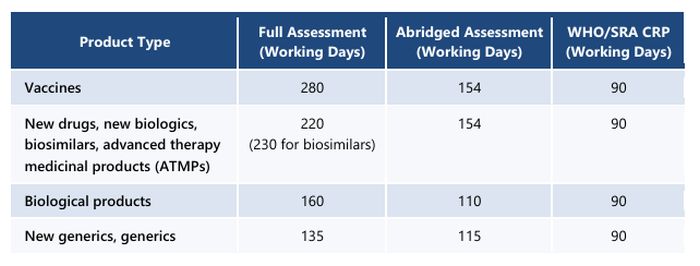
The review timeline for obtaining drug marketing authorization in Thailand varies by product type and assessment pathway:
1.2 Fees
The fees relating to drug applications are set out in the Drug Act B.E. 2510 (1967), the Ministry of Public Health Regulation on Official Fees Related to Drugs B.E. 2566 (2023), and the MOPH Notification on Government Fees to Be Collected from a Drug Applicant B.E. 2568 (2025). Key fees include:
- Application/filing fee for modern drug dossier registration: THB 1,000 (for generics) to THB 2,500 (for new drugs, vaccines, and new biologics)
- Technical document evaluation of modern drug dossier registration: THB 39,000–196,500 (for generics/biosimilars) to THB 395,000 (for new chemical entities, new biological entities, and human vaccines)
- MA license fee: THB 2,000
Full fee exemptions apply in certain cases, including drugs researched, developed, or manufactured in Thailand; drugs that strengthen the health system or address drug shortages; and orphan drugs.
1.3 Validity
The MA license is valid for seven years and is renewable.
2. Postmarketing Surveillance
2.1 Pharmacovigilance Obligations
After a medicinal drug has received its MA license and been launched on the market, the marketing authorization holder (MAH) must fulfill a series of pharmacovigilance obligations. The Ministerial Regulation on Registration of Drugs (October 25, 2012) establishes the legal foundation for these activities, requiring drug manufacturers and importers to report adverse drug reactions. The Thai FDA has also issued guidance in the form of the FDA Notification on Guidelines for Drug Safety Monitoring (Pharmacovigilance) and Good Pharmacovigilance Practice (GVP) Thailand.
Key obligations of MAHs include:
- Safety monitoring and reporting: MAHs must continuously monitor the safety of their products, including collecting, evaluating, and reporting adverse drug reactions (ADRs) and adverse events following immunization (AEFIs) to the Health Product Vigilance Center (HPVC) of the Thai FDA.
- Risk management: MAHs must develop and implement risk management plans (RMPs) to identify, characterize, and minimize risks associated with their products.
- Inspections and audits: MAHs should be prepared for pharmacovigilance inspections and audits by the Thai FDA.
- Safety communication: MAHs must communicate safety information effectively to healthcare professionals, patients, and the public, including updating product information and issuing direct healthcare professional communications (DHPCs) when required.
- Personnel and resources: MAHs must appoint qualified, well-trained personnel and maintain adequate resources to support an effective pharmacovigilance system.
- Data management and confidentiality: MAHs must establish a robust pharmacovigilance data management system ensuring complete, accurate, traceable, and secure records of all pharmacovigilance activities.
2.2 Reporting Timelines
- Serious adverse events resulting in death: notify within 1 business day; submit a complete report within 7 calendar days; follow-up report within 15 days.
- Other serious adverse events: report within 15 calendar days; follow-up report within 30 days.
- Nonserious adverse events: report within 2 months (applicable for new drugs approved and marketed within the first two years of initial license approval, vaccines, donated drugs, and certain herbal products). MAHs must also submit an annual report of imported drugs and quantities distributed to clinics and wholesale pharmacies to the Thai FDA by March 31 of the following year.
3. Other Authorization Requirements
In addition to the MA license, companies operating in Thailand’s pharmaceutical market must obtain the appropriate licenses for manufacturing, importing, distributing, and storing medicinal products.
- Drug manufacturing: It is not permitted to produce a modern drug in Thailand without a manufacturing license from the Thai FDA. Applicants must meet qualifications including Thai residency (or equivalent business registration), appropriate premises and equipment, and qualified pharmacists on staff. The manufacturing license fee is THB 8,000. The license remains valid until December 31 of the year of issue and must be renewed annually. Manufacturers must comply with GMP standards harmonized with PIC/S guidelines.
- Drug import: A drug import license is required before importing and placing a drug product on the Thai market. The applicant must have a responsible pharmacist and a storage facility at the registered business address. The import license fee is THB 10,500, and the license must be renewed annually by December 31.
- Drug wholesale and distribution: A wholesale license is required to sell drugs to retail license holders, other wholesale license holders, hospitals, and licensed medical practitioners. The wholesale license fee is THB 2,000 (THB 500 application fee plus THB 1,500 license fee). Drug wholesalers must comply with Good Distribution Practice (GDP) standards. A GDP certificate is required for renewal of the drug import license.
- Drug storage: Business operators and pharmacists must maintain inventory reports and follow standard operating procedures for good storage and distribution practice.
4. Exemptions from Marketing Authorization Requirements
Manufacturing license and wholesale license requirements under the Drug Act do not apply to:
- Ministries, public bodies, and departments with duties to prevent or treat disease; the Thai Red Cross Society; and the Government Pharmaceutical Organization;
- The production of drugs based on a prescription issued by a physician or dentist for a specific patient, or by a veterinarian for a specific animal;
- The sale of herbal drugs (other than dangerous drugs), common household drugs, drugs sold by physicians or dentists to their patients, and drugs sold by veterinarians to their patients; • Individuals carrying medicine into Thailand for personal use (limited to a 30-day supply); and
- Importation by ministries, public bodies, and departments with disease prevention and treatment responsibilities, the Thai Red Cross Society, and the Government Pharmaceutical Organization.
Medicines imported into Thailand may also be exempted from product registration if used for research, analysis, exhibition, or charitable purposes. This exemption is limited to drug manufacturers, drug importers, governmental bodies responsible for disease prevention and treatment, the Thai Red Cross Society, and the Government Pharmaceutical Organization.
5. Data Protection
5.1 Data Exclusivity
Thailand provides limited data exclusivity protection under the Drug Act B.E. 2510 (1967) (as amended) and the Trade Secrets Act B.E. 2545 (2002) (as amended). Originator companies may receive protection for undisclosed test data submitted for marketing approval, typically for up to five years. The Thai FDA treats the pharmaceutical registration dossier for new chemical entities as a trade secret for five years from the date of notification, safeguarding the confidentiality of marketing approval data.
5.2 Patent Linkage
Thailand has not established a formal patent linkage system between patent status and drug marketing authorization. The Drug Act requires applicants to declare relevant patent or petty patent information during registration, but this declaration is for information purposes only; manufacturers may apply for registration regardless of the patent status of the reference product. Patent holders may pursue enforcement through civil litigation under the Patent Act.
6. Freedom of Information
Freedom of information in Thailand is governed by the Official Information Act B.E. 2540 (1997), which sets out the types of information that state agencies must publish or disclose and the rights of citizens to request information. In the pharmaceutical context:
- Data on clinical trials and marketing authorization assessment reports are not publicly disclosed.
- Approval information, post-approval changes, and product status (whether withdrawn or currently authorized) are available on the Thai FDA website. Compliance inspection reports and MA assessment reports are not accessible to the public.
- Information about reviewing experts is confidential; expert comments are reprinted by the health authority with identifying information concealed.
The Thai FDA’s default position is nondisclosure of regulatory dossiers and drug approval data, treating such information as provided by private parties without any intention of public disclosure and therefore typically exempt from disclosure under the Official Information Act. Over the past decade, the Thai FDA has rarely received requests under the Official Information Act for drug registration dossiers, and all such requests have been rejected; the courts have consistently upheld the Thai FDA’s nondisclosure decisions. If disclosure is ever contemplated, the pharmaceutical company concerned will be notified in advance and given an opportunity to object. Even if a requester appeals and the Information Disclosure Tribunal issues a decision in favor of disclosure, the sponsor retains the right to seek judicial review before the Administrative Court.
7. Parallel Trade
Importing pharmaceutical products that have already been authorized in other jurisdictions generally still requires full compliance with Thai regulatory requirements. Anyone wishing to import and place a drug on the Thai market must obtain a drug import license and Thai FDA registration for the product. An exception applies for personal use—the Drug Act allows individuals to carry up to a 30-day supply of medicine into Thailand for personal medical conditions.
The content of this article is intended to provide a general guide to the subject matter. Specialist advice should be sought about your specific circumstances.
[View Source]