

The application concerns shipping documentation processing operation that spawns intelligent generation subprocesses. The Board of Appeal (BoA) held that the claimed subject matter is not technical.
Here are the practical takeaways from the decision: T 1851/22 of December 12, 2025, of the Technical Board of Appeal 3.5.01.
Key takeaways
The presence of algorithmic steps conceived by a computer programmer, rather than by a business person, is not sufficient to confer technicality to the claimed subject-matter, since computer programs are not inventions and are excluded as such from patentability under Article 52(2)(c) and (3) EPC.
The mere automation of administrative steps on generic computer means does not lend technicality to the steps per se.
The invention
The BoA summarized the invention as follows:
1. The application concerns the generation of shipping documentation. Known systems, although partially automated, are said to require a degree of user interaction. At various steps, users are required to enter or select information and are presented with advices, warnings or error messages they must resolve. All this must generally be completed before the system starts the generation of the shipping label, and this may render the overall process slow and tedious (see description, [0005], [0006]).
2. To overcome these problems, when the user starts the documentation generation process, one or more of verifications, checks, warnings or the like (collectively referred to as advices) are suspended, and a default configuration is used in respect of various configuration factors which would normally be entered by the user ([0008], [0009], [0035]). The user then selects one or more orders for which the documentation generation subprocess must be started ([0038], [0039]). For the selected orders, the system determines whether critical issues concerning the suspended advices or the current default configuration are present and, if so, tries to solve them ("failure state mitigation processing"). For example, if the postage funds are insufficient, the system may initiate a postage fund refill operation ([0048], [0049]). The system proceeds to generate the documentation only if either no issues were detected or all the detected issues were resolved ([0051], [0052]).
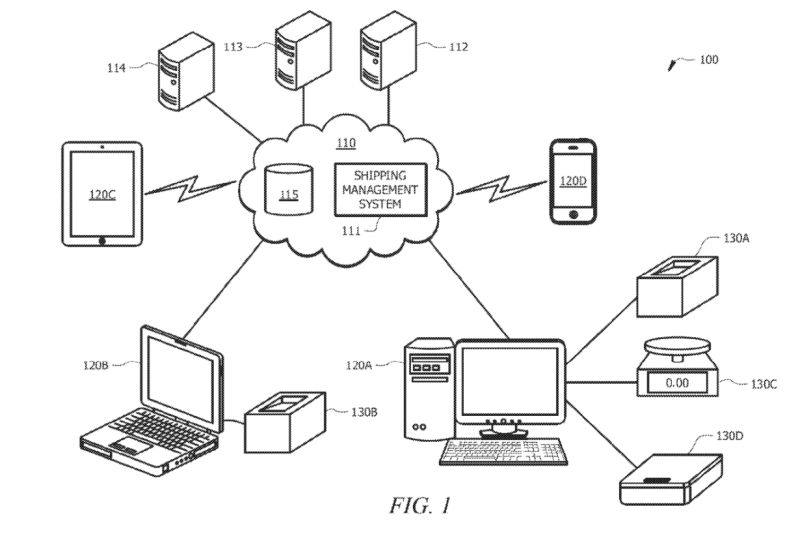
Fig.1 of EP3427202
-
Claim 1 of the third auxiliary request reads as follows:
1. A method for generating shipping documentation, the method comprising: receiving (201) user selection of an intelligent generation shipping processing mode of a shipping management system (111); suspending notification of all shipping management system advices for generation of the shipping documentation in the intelligent generation shipping processing mode, wherein the suspended shipping management system advices comprise a warning; defaulting, without user selection or input, one or more configuration factors for generation of the shipping documentation in the intelligent generation shipping processing mode; receiving (205) user selection of one or more orders (303) for shipping documentation processing using the intelligent generation shipping processing mode of the shipping management system (111); populating a documentation queue (304) of the shipping management system (111) with an instance representing an intelligent generation subprocess adapted to autonomously generate the shipping documentation for the one or more orders (303); and spawning (206) the instance of the intelligent generation subprocess to autonomously generate (207) the shipping documentation for the one or more orders (303) using the defaulted one or more configuration factors, wherein operation of the instance of the intelligent generation subprocess comprises: determining (211) if a critical issue is present with respect to a suspended advice of the shipping management system advices or a configuration factor for the shipping documentation by analysing the suspended shipping management system advices to determine advices of a nature indicating that autonomous shipping documentation processing should not or cannot be performed and/or analysing the one or more configuration factors to determine if parameters for the generation of the shipping documentation are missing or otherwise incompatible with generation of shipping documentation, the critical issue indicating that shipping documentation processing should not or cannot be performed; initiating failure state mitigation processing if the critical issue is determined to be present for the shipping documentation, wherein the failure state mitigation processing is configured to autonomously resolve the critical issue; generating the shipping documentation for the one or more orders (303) and updating (218) the instance of the intelligent generation subprocess to show a state for at least one documentation generation milestone if the critical issue is not present or the critical issue was autonomously resolved by the failure state mitigation processing; and updating the instance of the intelligent generation subprocess to show a failure state for the intelligent generation subprocess and ending further processing to generate the shipping documentation by the instance of the intelligent generation subprocess when the critical issue is present and could not be autonomously resolved by the failure state mitigation processing.
Is it patentable?
The BoA started with the assessment of the third auxiliary request, being the highest ranking auxiliary request.
According to the BoA, the mere generation of shipping documentation (i.e., a dataset) does not have a technical significance and is not used for a technical purpose:
5. Claim 1 defines a method for generating shipping documentation. The method does not imply the production of a physical document or the display of the documentation to the user but the mere generation of a dataset which, in itself, does not have a technical significance and is not used for a technical purpose.
Moreover, the following steps of claim 1:
- populating a documentation queue (304) of the shipping management system (111) with an instance representing an intelligent generation subprocess adapted to autonomously generate the shipping documentation for the one or more orders (303)
- spawning (206) the instance of the intelligent generation subprocess to autonomously generate (207) the shipping documentation for the one or more orders (303) using the defaulted one or more configuration factors
are interpreted as defining the load ("populating" step) and the executing ("spawning" step) of a software module (the "intelligent generation subprocess") on generic computer means.
The remaining steps in claim 1 were also found to be not technical:
7. None of the remaining steps involves any technical consideration concerning, for example, the machine on which they are implemented or any underlying technical process. In particular, in the absence of any technical detail, the Board regards the "shipping management system advices", the "configuration factors", the conditions used to determine the presence of critical issues and the manner in which such issues are resolved as non-technical, administrative requirements. Pursuant to the well-established Comvik approach, they may be considered as requirements provided to the skilled person for implementation.
The appellant argued that while the "notional business person" might come up with the abstract idea of automating the generation of shipping documentation, they would not be able to define "new devices, infrastructure or protocols necessary, such as those defined in the independent claims". Moreover, at least defining when the failure state mitigation processing was initiated (i.e. in response to a critical issue arising from a suspended advice or defaulting a configuration factor) implied technical considerations. However, the BoA did not agree:
10. This is not, however, sufficient to lend technicality to these steps. The presence of algorithmic steps conceived by a computer programmer, rather than by a business person, is not sufficient to confer technicality to the claimed subject-matter, since computer programs are not inventions and are excluded as such from patentability under Article 52(2)(c) and (3) EPC. Such steps have a technical character only in so far as they involve technical considerations, for example concerning the implementing machine or a controlled technical device or process, and may contribute to the assessment of inventive step only if they solve a technical problem by providing a technical effect.
11. The definition of critical issues, that is, issues indicating "that shipping documentation processing should not or cannot be performed" (see claim 1), is considered part of the underlying non-technical requirements. It follows directly from this definition that these issues must be overcome in order to produce the documentation. Furthermore, even if it were considered technical, the choice of the point in time at which the state mitigation processing is initiated (i.e. after the issue has been identified and before the documentation is generated) would be self-evident and could not support an inventive step.
Furthermore, the appellant argued that the technical problem solved was "how to reduce the occurrence of failures in an automated computer process".
However, the BoA did not agree:
14. The Board disagrees with this formulation. The alleged reduction in the occurrence of failures in the generation of the shipping documentation is achieved, if at all, through non-technical, administrative steps. Here again, the mere automation of these steps on generic computer means does not lend technicality to the steps per se.
In the end, the BoA concluded that the subject-matter of claim 1 does not involve an inventive step (Article 56 EPC).
The content of this article is intended to provide a general guide to the subject matter. Specialist advice should be sought about your specific circumstances.
