- with readers working within the Advertising & Public Relations, Aerospace & Defence and Property industries
- within Government, Public Sector, Litigation and Mediation & Arbitration topic(s)
This is part of a series of articles discussing recent orders of interest issued in patent cases by the United States District Court for the District of Massachusetts.
In InMode Ltd. v. BTL Industries, Inc. d/b/a BTL Aesthetics, No. 24-cv-12955-PBS, Judge Saris issued an order construing disputed claim terms in a patent directed to non-invasive, non-ablative methods for remodeling or tightening vaginal tissue using radiant energy. Two of those terms are as follows:
Select Disputed Claim Terms
1. “Heating the target tissue”

The Court rejected both parties’ proposed temperature limitations as improper. The Court explained that the claims do not, on their face, impose any temperature restrictions. Additionally, the Court noted that temperature limitations are expressly recited in various dependent claims and that, under the doctrine of claim differentiation, the independent claims are presumed to be broader. Furthermore, neither party demonstrated that the specification clearly intended to limit “heating the target tissue” to anything beyond its plain language.
Therefore, the Court construed “heating the target tissue” as “making the target tissue hotter.”
2. “Remodeling the therapeutic zone of target tissue”
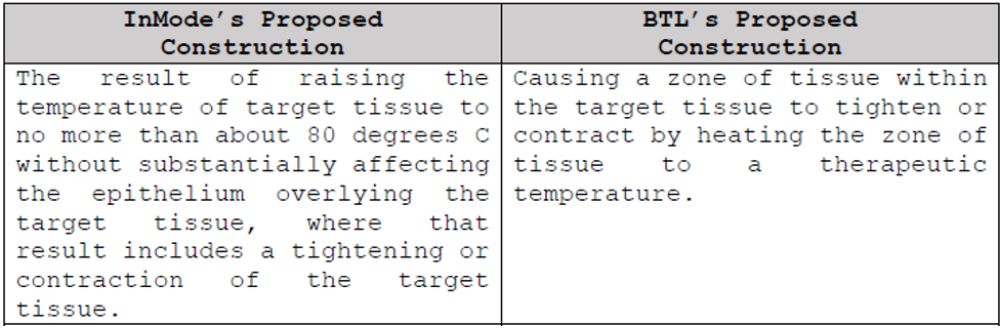
The Court noted the parties’ agreement that “‘remodeling’ effectively means tightening or contracting the target tissue” and rejected InMode’s proposal to add the limitation “without substantially affecting the epithelium overlying the target tissue” as unsupported by the intrinsic record and in tension with dependent claims that recite epithelium maintenance as a separate step.
Accordingly, the Court agreed with BTL and construed “remodeling the therapeutic zone of target tissue” as “causing a zone of tissue within the target tissue to tighten or contract by heating the zone of tissue to a therapeutic temperature.”
The content of this article is intended to provide a general guide to the subject matter. Specialist advice should be sought about your specific circumstances.
[View Source]