

The EU Pay Transparency Directive (Directive 2023/970/EU) required Member States to transpose its provisions into national law by 7 June 2026. As summer draws to a close, the picture across the EU remains mixed: a handful of Member States have completed transposition, several more have advanced draft legislation, while others have yet to initiate the formal legislative process. Below is a brief snapshot of where things stand.
Member States that have Transposed
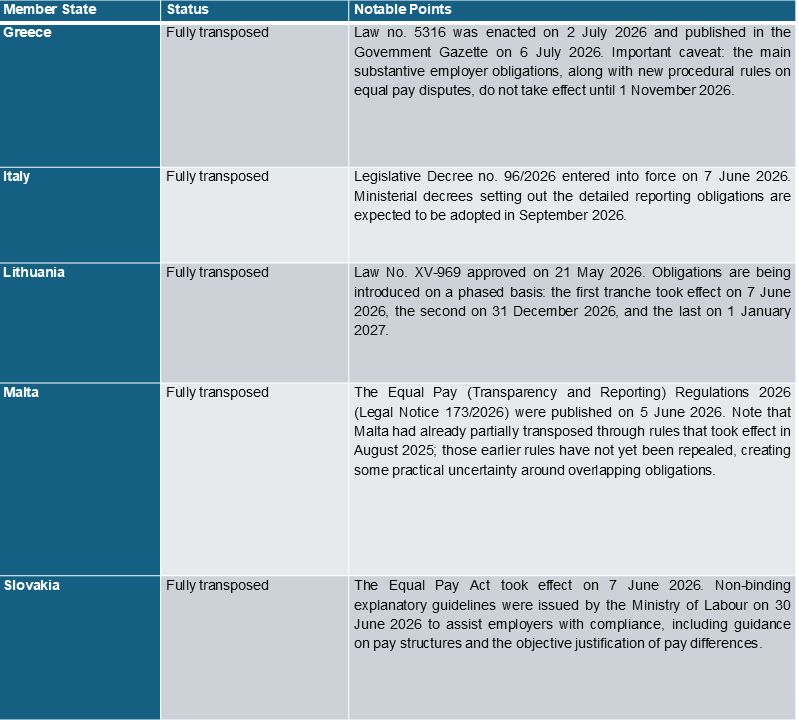
The Broader EU Picture
Beyond the five Member States that have completed transposition, the majority of EU jurisdictions missed the 7 June 2026 deadline. Progress varies considerably: some — including Spain, France, the Netherlands, Finland and the Czech Republic — have advanced draft legislation and are targeting transposition by early 2027 at the latest. Others, such as Belgium, Estonia and Poland, have achieved only partial transposition to date. A smaller number of Member States have not yet published any draft transposing legislation, and Sweden has formally confirmed that it does not intend to transpose the Directive at all. Infringement proceedings from the European Commission remain a real prospect for those that continue to fall behind.
The Position in Cyprus
Cyprus also missed the 7 June 2026 transposition deadline. An initial draft law — formally titled "The Law on Strengthening the Application of the Principle of Equal Pay Between Men and Women for the Same Work or Work of Equal Value, through Pay Transparency and Enforcement Mechanisms, 2026" — was published in 2025 (with a second draft issued early 2026) and represents a substantive starting point for transposition. Parliamentary elections took place on 24 May 2026, and the post-election transition that followed ultimately meant the transposition deadline was not met.
In a recent statement, Labour Minister Marinos Mousiouttas confirmed that the bill for harmonisation with Directive 2023/970/EU on equal pay and pay transparency is expected to be submitted for approval by the Council of Ministers in September 2026 and, subsequently, to be submitted to the House of Representatives for voting. The bill has already been discussed with employers' organisations and trade unions and the draft has been forwarded to the Legal Service for legislative review. The Minister also confirmed that, based on the current draft, the first deadline for employers to submit data on the gender pay gap is 6 June 2027.
It should be noted that the current draft contains certain deviations from the Directive and these will be relevant for employers to consider once the law is enacted.
We are monitoring developments closely and will keep our clients informed as matters progress.
What Should Employers Be Doing?
Regardless of the transposition status, we encourage employers with operations in Cyprus to begin preparing now. Reviewing your existing pay structures, conducting internal pay audits, drafting and updating relevant policies and procedures, and preparing the underlying documentation needed to implement the Directive's requirements — while ensuring alignment with its core principles of transparency in recruitment, pay reporting and equal pay for work of equal value — will place your organisation in a stronger position as obligations start to take effect.
Please feel free to reach out to our team to discuss how the Directive may affect your organisation's operations in Cyprus or elsewhere.
The content of this article is intended to provide a general guide to the subject matter. Specialist advice should be sought about your specific circumstances.
[View Source]