

The Australian Financial Complaints Authority (AFCA) published its Approach to General Insurance Claims Handling in August 2026. The Approach explains how AFCA will assess claims-handling complaints. It makes clear that:
- complainants may be awarded costs arising from unreasonable delay by an insurer, even where those costs exceed the policy limits; and
- AFCA may award compensation for non-financial loss.
Delay and financial-loss compensation
The Approach reinforces that insurers must comply with their legislative obligations, including the duty of utmost good faith, and handle claims honestly, fairly and efficiently. AFCA considers that this requires claims to be handled “reasonably promptly”.
The General Insurance Code of Practice (GICOP) provides standard claims-handling timeframes. However, AFCA emphasised that meeting GICOP’s standard four-month timeframe for claim decisions does not, by itself, establish that a claim was handled reasonably or that the insurer met its legislative obligations. AFCA cited a broken-window claim as an obvious example of a claim that should be decided much sooner.
AFCA’s examples of reasonable claims handling emphasise clear, regular communication; processes tailored to the claim; support for vulnerable claimants; fair, reasoned decisions; and responsive internal dispute resolution. Depending on the circumstances, even GICOP’s 20-business-day update interval may be insufficient. Template communications sent at predetermined intervals may not, without more, demonstrate reasonable conduct.
What is “reasonable” will depend on the circumstances. As insurers increasingly use AI and automated decision-making, particularly for low-value or straightforward claims, AFCA may expect decisions to be made sooner where the available information permits.
AFCA has also confirmed that policy caps will not apply where an insurer’s unreasonable handling of a claim causes financial loss. This may increase an insurer’s exposure beyond the contractual policy benefit. In practical terms, compensation may include costs or losses incurred by an insured because of delays within the insurer’s control. The Approach includes case studies illustrating when such increased costs may be awarded, including where an unreasonable delay exposed the insured to higher building costs resulting from changes to building codes.
Non-financial loss
AFCA also clarifies that it will “commonly” award compensation for non-financial loss where:
- the insurer handled the claim unreasonably; and
- this has resulted in the complainant suffering an unusual degree of interference, inconvenience or delay.
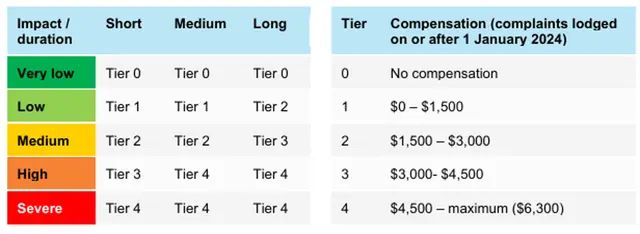
The amount awarded will depend on the severity of the impact on the complainant. Compensation will be considered only where that impact “exceeds the normal degree of inconvenience a person would experience when having a problem”. AFCA also updated its Approach to the Award of Non-Financial Loss in August 2026, introducing a grading mechanism with a maximum award of $6,300 for complaints lodged on or after 1 January 2024.
With insurers facing increasing claim volumes as the summer storm season approaches, and with rising complaint volumes and increasing operational complexity, AFCA registration and case management costs—together with the potential for non-financial loss awards—are placing further cost pressure on insurers.
Cash settlements
Since claims handling and settling became a regulated financial service under the Corporations Act 2001 (Cth), cash-settlement practices have remained a significant source of complaints to AFCA.
In the Approach, AFCA makes it clear that:
- discretion may not automatically give an insurer a unilateral right to decide how to settle a claim;
- any decision to make a cash settlement must be consistent with the insurer’s legislative obligations of fairness and utmost good faith;
- the scope of works must fairly reflect the repairs necessary; and
- the quote must be fair, capable of being acted on by the complainant and include a builder’s margin.
When assessing a cash settlement, AFCA may apply a contingency of between 5% and 25%, depending on the circumstances. This reflects the transfer to the insured of the risk that the final cost may exceed the original quote, as well as the loss of the benefit of having the insurer responsible for the quality of the works and materials.
Contractors and agents
Consistent with the regulatory framework for financial services licensees, AFCA’s Approach confirms that an insurer remains responsible for the conduct of contractors and agents engaged to manage claims. That responsibility cannot be delegated or avoided through outsourcing.
Key takeaways for claims, IDR and EDR teams
- Reasonable claims handling practices are not one-size-fits-all, and GICOP compliance is not an automatic defence. Insurers should review their claims processes against the broader standards of utmost good faith and should not assume that GICOP timeframes are reasonable in every case.
- Policy limits and exclusions may not cap compensation for loss caused by claims-handling failures. Where unreasonable claims handling delays cause an insured further loss, AFCA will not apply policy sub-limits, sums insured or exclusionary clauses to compensation orders. Insurers, brokers and underwriters should factor this expanded exposure into their risk and reserving frameworks.
- Cash settlements must include a contingency and all policy benefits. Cash-settlement offers should account for all applicable policy benefits, including temporary accommodation, debris removal and professional fees, where enlivened by the claim and policy.
The practical point is simple: delay creates exposure. The longer a claim takes, the more it may cost following an adverse AFCA decision if the insurer cannot reasonably justify the delay.
We have extensive practical experience in designing and reviewing claims-handling frameworks, vulnerable-consumer processes, and IDR and EDR case management. Please contact us if we can assist you in assessing the impact of AFCA’s Approach on your claims and complaints operations.
The content of this article is intended to provide a general guide to the subject matter. Specialist advice should be sought about your specific circumstances.
[View Source]