
- within Litigation and Mediation & Arbitration topic(s)
- in Canada
Duane Morris Takeaway: The final trend in our DMCAR series outlines how the California Private Attorneys General Act (PAGA) inspired more representative lawsuits than any other statute in America over the past three years. According to the California Department of Industrial Relations, the number of PAGA notices filed in 2025 approached 9,900, which surpasses the 9,464 PAGA notices in 2024.
DMCAR co-editor Jennifer Riley outlines this trend in the following video:
The so-called PAGA reform legislation passed in 2024 by California lawmakers seemingly did little to nothing to curb interest in these cases.
The PAGA created a scheme to "deputize" private citizens to sue their employers for penalties associated with violations of the California Labor Code on behalf of other "aggrieved employees," as well as the State. A PAGA plaintiff may pursue claims on a representative basis, i.e., on behalf of other allegedly aggrieved employees, but need not satisfy the class action requirements of Rule 23.
Thus, the PAGA provides the plaintiffs' class action bar a mechanism to harness the risk and leverage of a representative proceeding without the threat of removal to federal court under the CAFA and without the burden of meeting the requirements for class certification.
The PAGA's popularity in recent years, however, also flows from its status as one of the most viable workarounds to workplace arbitration agreements. Thus, it presents one of the most pervasive litigation risks to companies doing business in California.
1. The Growth Of PAGA Notices Continues
According to data maintained by the California Department of Industrial Relations, the number of PAGA notices filed with the LWDA has increased exponentially over the past two decades.
The number grew from 11 notices in 2006, to 1,606 in 2013, and then underwent three sizable jumps – to 4,530 in 2014, to 5,732 in 2018, and to 7,464 in 2023, each coinciding with a significant shift in the legal landscape regarding arbitration. In 2024, notices exceeded 9,464 for the first time and, in 2025, the number of PAGA notices reached a new all-time high of approximately 9,981.
Employers saw the largest single year increase in 2014, when the number of notices increased from 1,605 in 2013 to 4,532 notices in 2014, an increase of 182%.
The most significant drop in the past two decades occurred in 2022, when notices fell from 6,502 in 2021 to 5,817 in 2022, before their resurgence in 2023 and continued growth in 2024 and 2025. The following chart illustrates this trend.
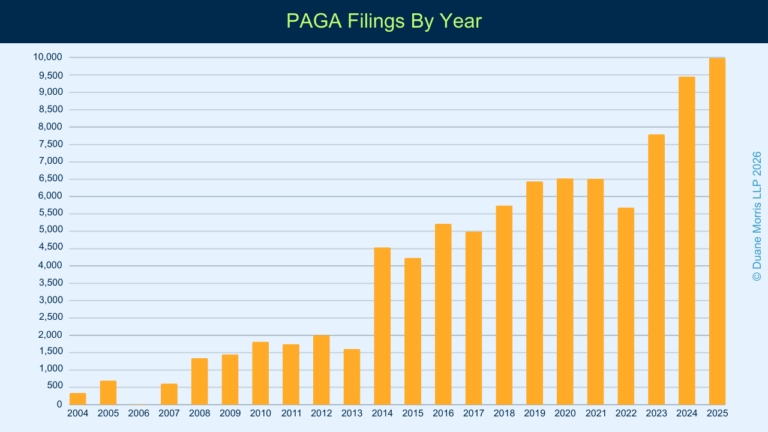
These numbers closely tie to the shifting impact of workplace arbitration programs, in that each of the major shifts coincides with the timing of a significant expansion or pull back in the law governing the enforcement of arbitration agreements.
PAGA reform seemingly has had little to no impact on the growth on PAGA filings. On June 18, 2024, Governor Newsom announced that labor and business groups had inked a deal to alter the PAGA in return for removing the referendum to repeal the PAGA from the November 2024 ballot. The California Legislature quickly moved to approve two bills (AB 2288 and Senate Bill 92). The alterations included reforms to the penalty structure, new defenses for employers, changes to the PAGA's standing requirements, and a new "cure" process for both small and large employers, among other changes. These reforms affect all PAGA notices filed on or after June 19, 2024, with some exceptions. As noted above, however, PAGA reform did little to quell PAGA filings.
2. Could PAGA Activity Skyrocket?
As noted above, the PAGA emerged as one of the most popular tools of the plaintiffs' class action bar in recent years due to its potential immunity from workplace arbitration agreements. The California Supreme Court is poised to consider the viability of so-called "headless" PAGA actions in 2026 – i.e., actions that lack or disclaim any individual PAGA claim (often because the plaintiff signed an arbitration agreement covering such claim) and seek to pursue only the representative PAGA component on behalf of other allegedly aggrieved employees.
The growing adoption of arbitration programs led the plaintiffs' class action bar to identify various workarounds, and the PAGA emerged as one of the most viable in 2016 when the California Supreme Court issued its decision in Iskanian v. CLS Transportation Los Angeles, 59 Cal.4th 348 (Cal. 2014). In that case, the California Supreme Court held that representative action waivers in arbitration agreements are "contrary to public policy and unenforceable as a matter of state law." Id. at 384. In so holding, Iskanian essentially immunized PAGA claims from arbitration and permitted plaintiffs to pursue representative actions under PAGA unhindered by arbitration agreements or commitments to arbitrate on an individual basis. The decision undoubtedly fueled the filing of PAGA notices in 2014, which catapulted from 1,606 in 2013 to 4,530 in 2014.
The PAGA suffered its first setback as an arbitration work-around in 2022 with the U.S. Supreme Court's decision in Viking River Cruises, Inc. v. Moriana, 142 S.Ct. 1906 (2022). In Viking River, the U.S. Supreme Court held that, to the extent Iskanian precludes division of PAGA actions into individual and non-individual claims, and thereby "prohibit[s] parties from contracting around this joinder device," the FAA preempts such rule. Id. As a result, the U.S. Supreme Court held that the lower court should have compelled arbitration of the plaintiff's individual PAGA claim and should have dismissed the PAGA representative claim. Id.
The set-back was short lived as, in 2023, the California Supreme Court minimized the impact of the Viking River decision. In Adolph v. Uber Technologies, Inc., 14 Cal. 5th 1104 (Cal. 2023), the California Supreme Court took up the issue of whether, under California law, a PAGA plaintiff who's individual PAGA claim is compelled to arbitration retains standing to bring a representative PAGA claim. The California Supreme Court answered the question in the affirmative. It held that, once a PAGA plaintiff is compelled to arbitrate his or her individual PAGA claim, so long as he or she is found to be an "aggrieved employee," the plaintiff retains standing to maintain a non-individual PAGA claim in court. Id. at 1105.
By deciding that an individual who signs an arbitration agreement can return to court after arbitration to pursue a representative proceeding under the PAGA, the California Supreme Court relegated arbitration agreements to a mere hurdle rather than a bar to PAGA representative actions. Still, the plaintiffs' bar has continued its attempt to eliminate the arbitration defense altogether to streamline their ability to proceed with representative actions in court. One emerging tool is the so-called "headless" PAGA action.
While such a tool seemingly runs counter to the ruling in Adolph and other cases, which have held that a PAGA claim necessarily consists of both and individual and representative portions, the California Court of Appeal gave it life in April 2024 with its decision in Balderas v. Fresh Start Harvesting, 101 Cal. App. 5th 533 (2024). In that opinion, the California Court of Appeal denied a motion to compel arbitration, holding that a plaintiff could maintain a representative PAGA action, even without an individual PAGA claim, so long as the plaintiff alleges that he or she suffered a Labor Code violation.
Appellate courts have taken different views as to this strategy over the past year. On July 7, 2025, for instance, in CRST Expedited, Inc. v. Superior Court Of Fresno County, 112 Cal. App. 5th 872 (Cal. App. 2025), the Court of Appeal for the Fifth District concluded that a worker's dismissal of his individual PAGA claim did not bar him from pursuing a representative PAGA claim. The trial court granted the worker's unopposed motion to dismiss his individual PAGA claim, and the defendant then sought dismissal of the non-individual PAGA claim on the ground that the plaintiff lacked standing to proceed. The trial court denied the motion. On appeal, the Court of Appeal concluded that the PAGA statute is ambiguous on this point and, faced with an ambiguous statute, opined that the primary objective of the PAGA statute is to maximize enforcement of labor laws and deter employer violations. As such, it held that requiring arbitration of individual claims before pursuing non-individual claims would undermine those enforcement efforts and that, to achieve effective enforcement, the PAGA statute should be interpreted to allow "PAGA plaintiffs and their counsel the flexibility to choose among bringing a PAGA action that seeks to recover of civil penalties on (1) the LWDA's individual PAGA claims, (2) the LWDA's non-individual PAGA claims, or (3) both." Id. at 917.
In Williams, et al. v. Alacrity Solutions Group, LLC, 2025 Cal. LEXIS 4161 (Cal. App. July 9, 2025), the Court of Appeal for the Second District reached the opposite conclusion. The plaintiff, a former insurance adjuster, filed an action alleging that the defendant failed to pay overtime compensation. Although the plaintiff separated from his employment in January 2022, the plaintiff waited until March 2023 to file a PAGA notice with the LWDA. The plaintiff thereafter filed suit solely on behalf of other current and former employees and did not seek penalties on his own behalf. The trial court dismissed the plaintiff's action holding that, because the plaintiff filed his PAGA notice more than a year after his employment ended, his individual claim was time-barred and, without a timely individual claim, he could not maintain a PAGA representative claim. The Court of Appeal affirmed the trial court's ruling. It explained that a PAGA plaintiff must have a timely claim for violations he or she personally suffered. The plaintiff filed a petition for review with the California Supreme Court, and the California Supreme Court granted and deferred the appeal pending consideration and disposition of related issues in Leeper, et al. v. Shipt, 331 Cal. Rptr. 3d 450 (Cal. 2025)
In Leeper, the Court of Appeal for the Second District reached a similar conclusion. The plaintiff, a former Shipt worker, alleged that Shipt misclassified her and others as independent contractors in violation of state wage & hour laws. The trial court denied the defendant's motion to compel arbitration ruling that, because the plaintiff sought only non-individual civil penalties, there were no individual claims to arbitrate. On appeal, the Court of Appeal reversed. It reasoned that every PAGA action inherently includes an individual claim, alongside the representative claim. The Court of Appeal opined that the statutory language of the PAGA states that a PAGA action is one brought both on behalf of the plaintiff (the individual claim) and on behalf of others (the representative claim). On request for review, the California Supreme Court agreed to review the Court of Appeal's order and to address the following questions: (i) Does every PAGA necessarily include both individual and non-individual PAGA claims, regardless of whether the complaint specifically alleges individual claims; and (ii) can a plaintiff choose to bring only a non-individual PAGA action?
If the California Supreme Court sides with the plaintiffs on these issues and allows plaintiffs to maintain "headless" or representative-only PAGA claims, it will allow plaintiffs with arbitration agreements to bypass arbitration and to avoid the risk that they might not succeed on their individual PAGA claims. If plaintiffs can avoid arbitration altogether, such a ruling surely would bolster PAGA's popularity as an arbitration work-around. Either way, given the technical requirements of California wage & hour law, coupled with the potentially crushing statutory penalties available to successful plaintiffs, employers should anticipate continued growth of PAGA lawsuits in 2026.
Disclaimer: This Alert has been prepared and published for informational purposes only and is not offered, nor should be construed, as legal advice. For more information, please see the firm's full disclaimer.