
- within Law Practice Management topic(s)
- in China
- within Law Practice Management topic(s)
Many companies are missing out on millions in profits every year without even knowing about it. The reason? Poor position management. Are you one of them?
Position management isn't just an HR tool—it's a strategic enabler. Position management describes the practice of treating positions as stable, strategic units that are aligned with HR, Finance, and Operations needs, rather than specific people. This ensures calibration between people investments and business goals. By defining and managing positions as long-standing entities independent of specific people, organizations gain a solid framework for budgeting, talent deployment, and enterprise alignment.
For HR
Position management is the foundation of effective workforce planning—enabling scenario modeling, skills forecasting, and headcount clarity. This pays dividends in the long term, as a well-structured workforce can increase productivity by up to 18%.1
For Finance
Position management clarifies ROI and improves forecast accuracy by linking approved positions to budget assumptions. Integrated systems can reduce forecast errors by 20%.2
For Operations
Position management gives valuable insight into critical labor costs, such as overtime and staffing levels. This can massively enhance operational cost-effectiveness, as organizations typically waste 20–30% of their labor budgets on staffing inefficiencies.3
The High Cost of Disconnect
Position management is much more than an administrative function—and yet, many organizations don't have a robust position management framework in place. Often, they treat it as an HR only initiative, disconnected from enterprise strategy and financial planning. Notably, only 29% of HR leaders say their strategic and business planning are aligned.4
This misalignment can have serious consequences, such as rendering advanced AI-powered workforce tools useless because algorithms cannot optimize what they cannot accurately track. Left alone, misalignment can also lead to:
- Excessive costs: Redundant roles and levels in the job architecture and misaligned headcount budgets lead to unnecessary spending.
- Operational inefficiency: Roles are created without a clear purpose or connection to strategic goals, creating confusion, duplicating efforts, and reducing productivity.
- Stalled growth: Inability to accurately forecast talent needs and align them with business plans hampers expansion and innovation.
"Position management is the organizational glue companies don't realize they're missing. When implemented effectively, it transforms fragmented departments into a cohesive ecosystem with shared goals and metrics."
Matt Campbell
Managing Director & Leader of A&M's Talent,
Organization, and People practice
"What looks like a budget issue is often a position management problem. When HR, Finance, and Operations aren't working from the same playbook, forecasts become inconsistent, business results are difficult to track, and data loses its trustworthiness for decision-making."
Jason Haynes
Senior Director in A&M's CFO Services practice
Position Management as a Strategic Lever
Position management integrates thinking across HR, Finance, and Operations, driving collaboration between CXOs and operators to accelerate results.
1. Process standardizes how positions are requested, approved, and tracked. This ensures hiring plans, finance budgets, and staffing needs are all operating from the same baseline.
2. Technology connects human resources information system (HRIS), enterprise resource planning (ERP), and other systems using position data as the common thread. This prevents Finance from budgeting for positions that HR cannot see and stops HR from creating roles for which Finance has not allocated funding.
3. Data harmonizes key inputs such as FTEs, contractors, and job codes, creating a reliable dataset for decision-making. Leaders can then run various workforce scenarios, compare against budgets, and track ROI with confidence.
Unlocking Tangible Value
There's no doubt that position management can make a significant difference to your bottom line. But implementing a strong position management framework isn't just about saving money; it's about driving strategic value.
It will help you:
- Improve visibility by creating a single, accurate source of truth for all positions, whether filled or vacant.
- Enhance decision-making by enabling leaders to make informed choices about where and when to invest talent and resources.
- Drive alignment by ensuring that every hiring decision supports the overall business strategy.
Companies that previously struggled under the weight of misaligned f inancial, operational, and hiring plans will unlock major strategic advantages simply by establishing a clearly defined and shared job architecture. After all, this centralized source of position data enables leaders to match their hiring plans to their growth objectives, facilitating seamless, scalable, and sustainable expansion.
In time, this generates further ROI: A strong HR–Finance partnership, enabled by position management, makes companies 41% more likely to achieve double-digit EBITDA growth due to more closely aligned hiring strategies and financial priorities.5
Industry-Specific Value Drivers
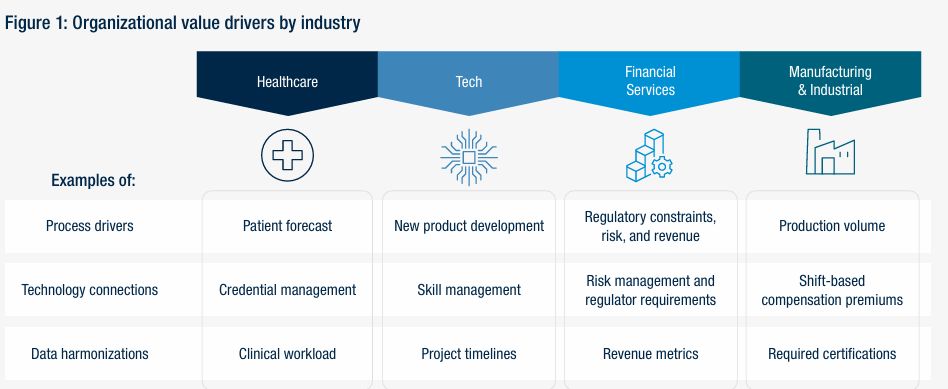
To truly drive value, organizations must also recognize how position management's three key areas—process, technology, and data—manifest differently across industries. While the fundamental principles remain the same, each sector has its own unique needs which demand tailored application.
Figure 1 illustrates how a specific process driver (the "why") in each industry connects to a particular technology (the "how") to enable data harmonization (the "what"), ultimately driving strategic value. For example, in healthcare, the need to manage patient forecasts (the driver) is linked to a credential management system (the technology) to harmonize clinical workload data, which is essential for staffing and patient care.
Right-Sizing Your Implementation for Maximum Impact
You don't need to overhaul everything all at once. You can—and should—right-size your position management approach to realize value based on your organization's needs:
- Baseline (manual): For smaller or less complex organizations, starting with a simple, perhaps spreadsheet-focused process may suffice. This minimal investment will still provide significant returns by centralizing your approach.
- Connected (HRIS-enabled): For growing organizations, integrating position management with your HRIS will streamline approvals and provide real-time data.
- Integrated (enterprise-wide): For large enterprises, a fully integrated solution will connect position data across all your core business systems (e.g., HRIS, ERP, financial planning, maintenance scheduling). This will provide a single source of truth, enabling advanced workforce planning and accurate f inancial tracking across the entire enterprise.
Even the most well-intentioned efforts can fall short if the implementation isn't matched to your organization's needs and executed with attention to detail.
A Practical Action Plan for Position Management
A clear and practical process can make all the difference when it comes to translating intent into impact for organizations. To transform position management from an administrative burden into a strategic advantage, organizations should focus on these seven high-impact steps:
1. Establish governance: Define ownership, decision rights, and cross-functional roles for effective position management.
2. Clarify strategic purpose: Align on what position management will enable—workforce planning, budgeting, role clarity, etc.
3. Assess current state: Evaluate existing position data, systems, and processes to identify gaps.
4. Design for usability: Create position structures and processes that are intuitive, scalable, and aligned with business needs.
5. Integrate systems: Ensure position data flows seamlessly across HRIS, finance, and planning platforms.
6. Enable change: Develop a change management plan that includes stakeholder engagement, training, and communications.
7. Measure impact: Track key metrics such as budgeting accuracy, internal mobility, and time-to-fill to demonstrate value.
Building or strengthening your position management capability can achieve value sooner and more consistently than you imagine. In fact, the resulting improvement in processes, role clarity, and integrated systems can increase profits by up to 23%.6
The Time to Act is Now
As AI and automation reshape how work gets done and by whom, it is crucial to get a cohesive picture of your future workforce. Position management builds the foundations of this future for HR, Finance, and Operations, ensuring that workforce decisions directly align with enterprise goals.
Turning Position Management into Competitive Advantage
A&M's CFO Services and Talent, Organization, and People practices partner to assess your position management processes. Our experts identify improvement opportunities in days, not months, turning position management into a strategic advantage. We bring deep cross-industry experience aligning HR, Finance, and Operations through data-driven insights, proven frameworks, and advanced technology—driving measurable results.
By integrating financial expertise with strategic talent management, we help organizations build robust position management frameworks that enhance visibility, improve decision-making, and drive alignment across all business functions. Let us help you transform position management into a catalyst for growth today.
Footnotes
1. ActivTrak. "Improving Efficiency and Cost Optimization Without Employee Burnout." 2025. https://www.activtrak.com/blog/improving-efficiency-cost-optimization/
2. Deskera. "A Comprehensive Guide to Integrated Business Planning (IBP)." 2025. https://www.deskera.com/blog/integrated-business-planning-ibp/.
3. Shyft. "Strategic Cost-Saving Opportunities in Shift Management." 2025. https://www.myshyft.com/blog/cost-saving-opportunity-identification/.
4. Gartner. "HR Strategic Planning Template." 2025. https://www.gartner.com/en/insights/strategic-planning/hr-strategic-planning-template
5. HiBob. "One team, one plan: Closing the HR-Finance gap with shared goals." 2025. https://www.hibob.com/guides/hr-finance-collaboration/.
6. Gallup. "The Benefits of Employee Engagement." 2023. https://www.gallup.com/workplace/236927/employee-engagement-drives-growth.aspx
Originally published 28 January 2026.
The content of this article is intended to provide a general guide to the subject matter. Specialist advice should be sought about your specific circumstances.