
Duane Morris Takeaway: This week's episode features Duane Morris partner Jerry Maatman, senior associate Zev Grumet-Morris, and associate Bernadette Coyle with their discussion of the key trends and developments analyzed in the 2026 edition of the Discrimination Class Action Review.
Check out today's episode and subscribe to our show from your preferred podcast platform: Spotify, Amazon Music, Apple Podcasts, Podcast Index, Tune In, Listen Notes, iHeartRadio, Deezer, and YouTube.
Episode Transcript
Jerry Maatman: Welcome to our listeners. Thank you for being here for our weekly podcast entitled The Class Action Weekly Wire. I'm Jerry Maatman, a partner at Duane Morris, and joining me today are my colleagues Bernadette Coyle and Zev Grumet-Morris. Thanks so much for being here on our podcast.
Bernadette Coyle: Thank you, Jerry.
Zev Grumet-Morris: Thanks, Jerry, glad to be here.
Jerry: Today on the podcast, we're discussing our newest publication and desk reference, the Duane Morris Discrimination Class Action Review. Listeners can find the e-book publication on our blog, the Duane Morris Class Action Defense Blog. Bernadette, can you tell our listeners about the publication?
Bernadette: Absolutely, Jerry. Class action litigation in the discrimination space remains an area of key focus for skilled class action litigators in the plaintiffs' bar. And Duane Morris is pleased to present the Discrimination Class Action Review – 2026 edition. This publication analyzes the key discrimination-related rulings and developments in 2025, and significant legal decisions and trends impacting discrimination class action litigation for 2026. We hope that companies and employers will benefit from this resource in their compliance with these evolving laws and standards.
Jerry: It's very clear that the discrimination class actions are front-page news and big-ticket items for the plaintiff's bar. Zev, could you share your thoughts with respect to the success rate of the plaintiffs in this space over the last 12 months?
Zev: Absolutely, Jerry. So, over the past year, we've seen plaintiffs succeed in certifying their cases at just a slightly lower rate than before. So, in 2025, courts granted class certification 50% of the time. Which was down slightly from 53% in 2024. And even though that's a bit lower, plaintiffs are still having considerable success in achieving certification. And really, this is a reflection of courts being more inclined to allow these cases to proceed forward, particularly in discrimination cases where there's broader societal awareness of issues like racial inequality and gender discrimination.
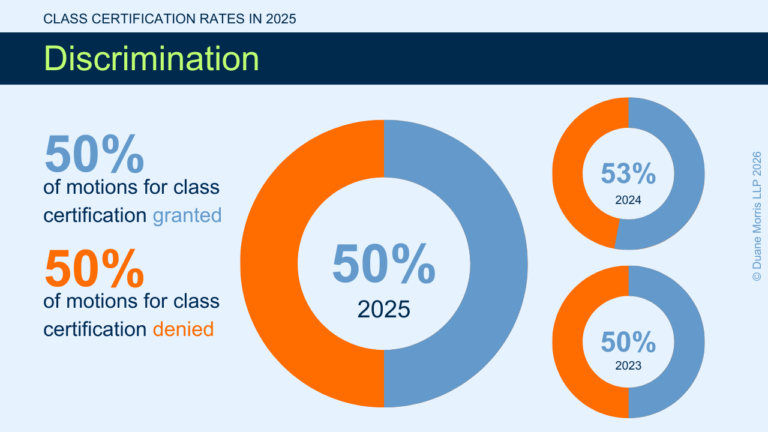
Jerry: Those certification analytics are certainly interesting, somewhat of a jump ball to the extent it's 53% versus 47%. Bernadette, what are some of the key defenses and things that courts focus on in terms of motions in these particular types of class actions?
Bernadette: Well, it's certainly become a much more rigorous process in terms of certifying these class actions, and particularly in the wake of the Walmart v. Dukes decision, courts have been much stricter about class certification. For a class to be certified, plaintiffs need to meet the requirements of Rule 23, especially around the issue of commonality. And in discrimination cases, that often means proving that the alleged discriminatory practices or policies apply uniformly across different departments, and sometimes even across state lines. It's not enough just to claim that one person was discriminated against. Plaintiffs need to show that this discrimination is a broader systemic issue. And if they can't do that, defense counsel will argue that the class should not be certified.
Jerry: I know the Walmart v. Dukes ruling in 2011 really shifted the ground and the battlefield for plaintiffs and defendants, and – at least for a few years – defendants did quite well. I think we're entering kind of a zone of Walmart 2.0, and Zev, you had mentioned that the pendulum is tending to shift back towards the plaintiffs. In your opinion, what's really fueling that swing of the pendulum?
Zev: It's a combination of several factors. Public opinion is certainly becoming more critical of large corporations, and social movements like Black Lives Matter and MeToo have kept workplace inequality in the spotlight. Businesses are facing not only increasing employee-friendly legislation, but also a more aggressive plaintiffs' bar. And courts, especially in the current climate, are more inclined to acknowledge these issues, and to allow these cases to move forward, especially in the discrimination context. The heightened awareness around issues of inequality has made it harder for employers to escape accountability, and we're seeing more court rulings that favor plaintiffs in this space.
Bernadette: But it's not all one-sided. While plaintiffs have gained some ground, courts are still very serious about ensuring that class actions meet the rigorous standards set by Walmart v. Dukes. And the bar is high. Plaintiffs can't simply rely on generalized statements along the lines of 'I was harmed, and others were likely too.' They have to provide concrete evidence that the issues they face are systemic across the class.
Jerry: Those are great takeaways and insights in terms of what's going on in this space. As we enter 2026. What do you view as the future of discrimination-based class action litigation, and where will the plaintiff's bar be focusing in the coming months?
Bernadette: Employers can expect to see more class actions in 2026, particularly as discrimination remains a high-profile issue. As I've mentioned, the public's growing interest in workplace equality and ongoing social justice movements will continue to provide momentum for plaintiffs. And even though there are challenges in securing class certification, the plaintiff's bar is becoming more strategic and sophisticated in their approaches, and they will certainly continue to press forward. Businesses will have to remain vigilant in defending these claims, and it's a constantly evolving landscape.
Jerry: Well, very important for clients to comply with just fundamental HR concepts and the like to root out discrimination and stop it from escalating into a class action. I know the review also analyzed the numbers on class action settlements in this space. How did the plaintiffs do in terms of monetizing their cases in 2025?
Zev: Plaintiffs did real well in securing high-dollar settlements in the past year, 2025, with the top 10 discrimination settlements totaling $507.1 million, which was significantly higher than the $356.8 million number that we saw in 2024.
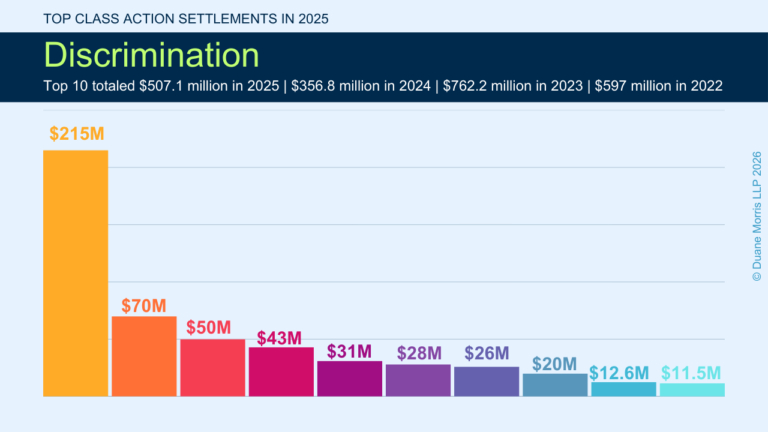
Jerry: Well, here at the Duane Morris Class Action Review editorial desk, we'll certainly be following those settlements throughout 2026 to see if the trend continues of higher and higher numbers of settlements in the discrimination class action space. Well, thank you, Bernadette, and thank you, Zev, for loaning your thought leadership in this space to us, and thank you for your contributions in this area to the Duane Morris Class Action Review.
Zev: Thanks for having me, Jerry, and thanks to all the listeners.
Bernadette: Thanks so much, everyone.
Disclaimer: This Alert has been prepared and published for informational purposes only and is not offered, nor should be construed, as legal advice. For more information, please see the firm's full disclaimer.
The content of this article is intended to provide a general guide to the subject matter. Specialist advice should be sought about your specific circumstances.