
- within Law Department Performance topic(s)
Duane Morris Takeaway: Arbitration agreements with class action waivers provide the foundation for one of the most potent defenses to class action litigation. While the U.S. Supreme Court has continued to promote arbitration agreements, plaintiffs have continued to attack their enforceability, and courts across the country have continued to apply exceptions in inconsistent and expansive ways.
Watch Review Editor Jerry Maatman explain this trend below:
One of the most impactful examples is the transportation worker exemption, which courts have applied expansively to local workers, such that the U.S. Supreme Court is poised to examine the exemption again, for a third time in the past five years. A defendant's ability to enforce an arbitration agreement containing a class or collective action waiver continues to reign as one of the most impactful defenses in terms of shifting the pendulum of class action litigation. The U.S. Supreme Court cleared the last hurdle to widespread adoption of such agreements with its decision in Epic Systems Corp. v. Lewis, et al., 138 S. Ct. 1612 (2018).
In response, more companies of all types and sizes updated their onboarding systems, terms of use, and other types of agreements to require that employees and consumers resolve any disputes in arbitration on an individual basis.
1. Defendants Continued To Enforce Arbitration Agreements At High Rates
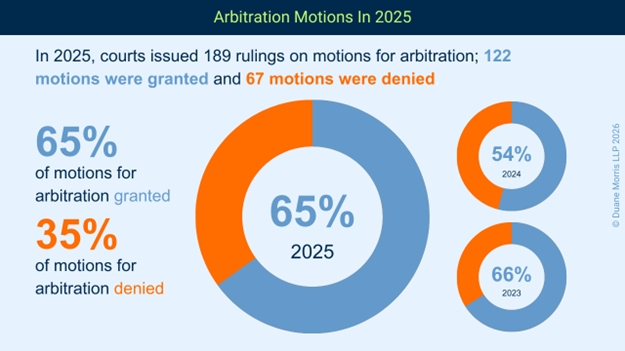
To date, companies have enjoyed a high rate of success enforcing those agreements and using them to thwart class actions out of the gate. In 2025, defendants continued to win most of the motions to compel arbitration they filed. Across substantive areas of class action litigation, courts issued rulings on approximately 189 motions to compel arbitration, and defendants prevailed on 122 of those rulings, for a success rate of approximately 65%.
Their success rate in 2025 was not wholly out of line with their success rates over the past two years. In 2024, courts issued rulings on 167 motions to compel arbitration, and defendants prevailed in 91 of those rulings, a success rate of approximately 54%. In 2023, courts issued rulings on 187 motions to compel arbitration, and defendants prevailed on 123 motions, which translated into a success rate of 66%.
2. The Transportation Worker Exemption Continued To Fuel Inconsistent Results
Given the potency of the arbitration defense, the plaintiffs' class action bar has continued to press potential exceptions to its coverage. One of the most litigated is the transportation worker exemption to the FAA. Over the past year, plaintiffs made significant strides in terms of expanding that exemption as courts issued a mixed bag of rulings. Many lower federal courts continued to apply the transportation worker exemption in a broad manner to workers who handled goods that moved in interstate commerce, irrespective of whether the workers played a direct and necessary role in transporting the goods across borders, leading to divergent outcomes for last-mile delivery drivers, warehouse workers, and local distributors.
Section 1 of the FAA exempts from arbitration "contracts of employment of seamen, railroad employees, or any other class of workers engaged in foreign or interstate commerce." The third category for workers "engaged in commerce" commonly is called the "transportation worker" exemption. Although the U.S. Supreme Court has instructed lower courts to interpret the exemption "narrowly," its parameters have proved a slippery slope for lower courts.
In Southwest Airlines Co. v. Saxon, et al., 142 S.Ct. 1783 (2022), the U.S. Supreme Court considered application of the transportation worker exemption to an airport ramp supervisor. Considering the language of the exemption, the U.S. Supreme Court reasoned that the exemption turns on the actual work that the "class of workers" to which the plaintiff belongs "typically carr[ies] out." Id. at 1792. The parties did not contest that the plaintiff, a ramp supervisor, frequently loaded and unloaded cargo. The U.S. Supreme Court held that, to be "engaged in foreign or interstate commerce," the class of workers must "at least play a direct and necessary role in the free flow of goods across borders" or, put another way, must "be actively engaged in transportation of those goods across borders via the channels of foreign or interstate commerce." It concluded that cargo loaders exhibited this central feature, reasoning that "there could be no doubt that [interstate] transportation [is] still in progress" when they do the work of loading or unloading cargo. Id. at 1793-94.
This ruling set off a barrage of disparate decisions as courts struggled to find a workable line. As a result, in April 2024, the U.S. Supreme Court took up Bissonnette, et al. v. LePage Bakeries Park Street, LLC, 601 U.S. 246 (2024). As in Saxon, the U.S. Supreme Court emphasized that the test for application of the transportation worker exemption focuses on the work performed and not the employer's industry. Addressing the employer's argument that its test would fold virtually all workers who load or unload goods, such as pet shop employees and grocery store clerks, into the exemption, the U.S. Supreme Court stated that the exemption has "never" been interpreted to apply in "such limitless terms." Id. at 256. It held that, for the exemption to apply, the worker "must at least play a direct and necessary role in the free flow of goods across borders." Id.
The Bissonnette decision, however, appears to have had a smaller impact on the lower courts, which continued to issue opinions before and after Bissonette that broadly construe the transportation worker exemption. In 2025, rulings by lower courts diverged substantially, particularly with respect to workers who move goods, which have crossed or ultimately will cross state borders, within a facility or local area.
The court in Wolford, et al. v. United Coal Co. LLC, 2025 U.S. Dist. LEXIS 15681 (W.D. Va. Jan. 28, 2025), for example, rejected plaintiffs' attempts to apply the exception to mine workers like electricians and machine operators who did not directly transport coal across state lines. The plaintiffs argued that their work was closely related to the interstate transportation of coal via a beltline, which crossed state lines into Virginia, because they interacted with the beltline. The court found that the plaintiffs' work did not qualify them as transportation workers under the FAA. Although coal crossed state lines, the court opined that the plaintiffs were primarily involved in tasks performed within the mine in Kentucky and their work was too far removed from the interstate transportation of coal to be considered transportation work.
Similarly, the court in Rubio-Leon, et al. v. Fresh Harvest, Inc., 2025 U.S. Dist. LEXIS 181816 (N.D. Cal. Sept. 16, 2025), ruled that the plaintiffs, a group of seasonal farm workers who hauled and trucked agricultural products, failed to show they qualified for the exemption. The plaintiffs demonstrated that they moved products from fields to a cooling facility at the farm's processing plant but did not produce evidence as to what then happened with the products. The plaintiffs pointed to statements on the defendant farms' websites indicating the farms' products were distributed nationally, but the court found such statements insufficient to show how, when, and where the products moved through the supply chain or how the plaintiffs played a meaningful role in that movement. The court therefore concluded that the FAA applied and compelled individual arbitration.
By contrast, numerous courts reached opposite conclusions. For example, the court in Mitchell, et al. v. Lineage Logistics Services, LLC, 2025 US Dist. LEXIS 35792 (E.D. Cal. Feb. 27, 2025), applied the transportation worker exemption to plaintiff, a warehouse worker, who organized boxes of goods and therefore denied the employer's motion to compel arbitration. Although the court found the plaintiff to be part of a class of workers that organizes boxes in preparation for storage or shipment, it concluded that such work was tied to the movement of goods in interstate commerce and thus applied the exemption. The court explained that "preparing boxes for egress from the facility or organizing them for storage before they are ready to be shipped is necessary to the subsequent transit of those goods out of the facility. In other words, those goods cannot be transported without the workers like Plaintiff." Id. at *15.
In Joyner, et al. v. Frontier Airlines, Inc., 2025 U.S. Dist. LEXIS 101068 (D. Colo. May 19, 2025), the court applied the exemption to three customer service agents who worked for an airline. Two of the plaintiffs worked at ticket counters and the third plaintiff worked at the boarding gates. The defendant argued that the plaintiffs were not supposed to touch customer baggage but were instead required to supervise passengers as they tagged and loaded their own bags onto conveyer belts. The plaintiffs argued that they often weighed bags, tagged bags, and loaded them onto conveyer belts or, if the conveyer belts malfunctioned, loaded baggage on to carts. As such, the court found that the plaintiffs belonged to a class of workers who lift, weigh, inspect, and tag baggage and move it to conveyer belts or carts during a route to a destination on a plane. The court concluded that the plaintiffs played a direct and necessary role in ensuring that passengers' baggage moves through the airport for loading on to planes and that this sufficed to establish the plaintiffs' status as transportation workers.
Finally, in Silva, et al. v. Schmidt Baking Distribution, LLC, No. 24-2103-CV (2nd Cir. Dec. 22, 2025), the Second Circuit applied the exemption to commercial truck drivers who created their own corporations and executed arbitration agreements in their capacities as presidents of their own companies. The drivers filed a putative class action alleged violation of wage & hour laws and, after the district court granted the defendant's motion to compel arbitration, the appellate court reversed. The appellate court noted that, before and after they formed their own corporations, their daily responsibilities involved driving commercial trucks to the defendant's warehouse to pick up baked goods, delivering the product to retail outlets within their assigned territories, unloading the goods, and stocking the goods on retail shelves. The Second Circuit held that truck-driving work directly impacts the free flow of goods and, therefore, concluded that the drivers qualified as transportation workers without any examination of whether their routes or the goods crossed borders. It also credited the workers' allegations that they were faced with a Hobson's choice of adopting a corporate form or losing their jobs and, therefore, declined to allow such form to circumvent the transportation worker exemption.
These and other decisions reflect continued inconsistent application of the transportation worker exemption. In 2025, this led the U.S. Supreme Court to grant a writ of certiorari in Flower Foods, Inc. v. Brock, No. 24-945, 2025 U.S. LEXIS 3947 (U.S. Oct. 20, 2025). That case involves a plaintiff who worked as a local distributor of baked goods. He placed orders for products, most of which were produced by Flowers bakeries outside the state, picked up the products at a local warehouse, loaded them onto his own vehicle, and delivered them to his customers within the same state. The district court denied Flowers' motion to compel arbitration based on the transportation worker exemption, and the Tenth Circuit affirmed that decision. The U.S. Supreme Court granted a writ of certiorari and is set to answer the question of whether workers who locally deliver goods, which traveled in interstate commerce, are transportation workers for purposes of the FAA exemption.
Thus, the Supreme Court is set to add some clarity to the scope of the transportation worker exemption in 2026, and its ruling could have a profound impact on class actions. Because nearly all products travel across state lines, the ruling effectively could exempt most workers from the FAA, weakening the force of arbitration agreements, or it could significantly curtail the broad reading the lower courts have given Saxon. Either way, given the enduring impact of the arbitration defense in class action litigation, the plaintiffs' class action bar is apt to continue to attempt to develop creative work arounds to arbitration agreements and to continue to push the boundaries of the transportation worker exemption.
Disclaimer: This Alert has been prepared and published for informational purposes only and is not offered, nor should be construed, as legal advice. For more information, please see the firm's full disclaimer.