
Key Findings
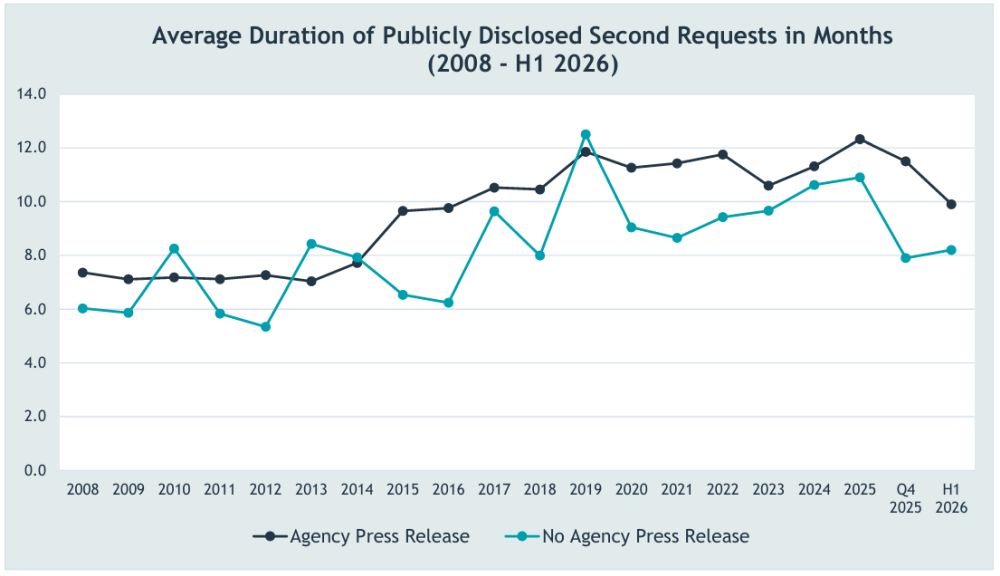
- The average length of time for agency-published outcomes of Second Request investigations fell to 9.9 months in the first half of 2026, a significant drop from record numbers above 12 months recorded for most of 2025. The average duration of Second Request investigations that ended without any agency statement came in even lower at 8.2 months. Together, these declines indicate that the Trump administration’s initiatives to streamline Second Request timelines are working, bringing Second Request timelines closer to averages last seen about a decade ago.
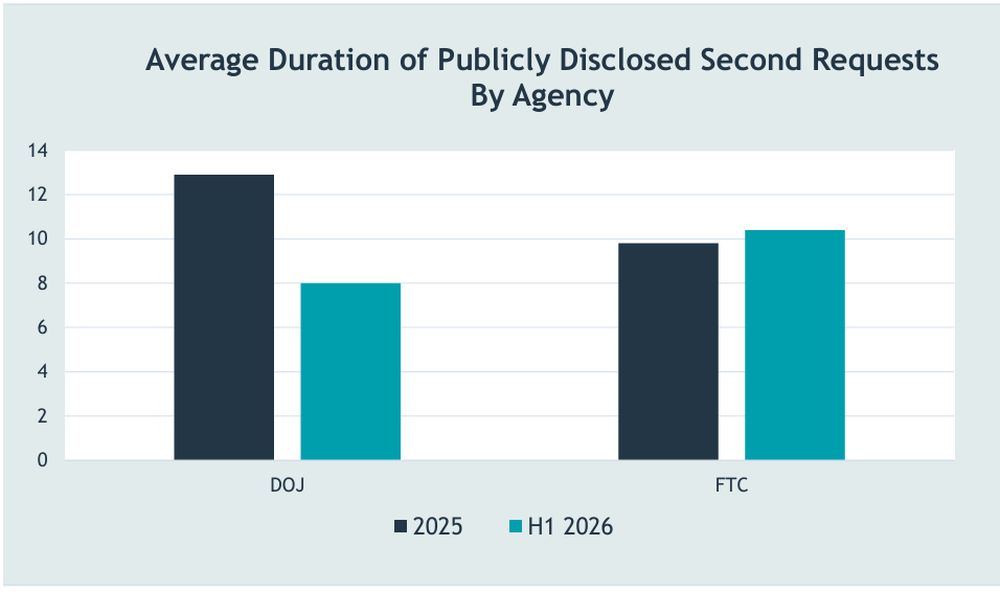
- The DOJ has been the main driver of shorter timelines so far this year. While DOJ timelines in 2025 remained high, perhaps due to a backlog of inherited investigations, newer investigations in 2026 are moving more quickly to resolution. By contrast, FTC Second Request timelines have remained relatively stable under the second Trump administration. Accordingly, while the average FTC investigation fell notably under the average for both agencies in 2025, the average DOJ duration was about two months shorter than the FTC average for the first half of 2026.
- While these results show welcome progress towards shortening Second Request investigation timelines, they cover transactions that were filed under the more cumbersome February 2025 HSR Act requirements (before they were rescinded) and before the DOJ announced it is “implementing targeted Second Request investigations to expedite merger review.” These factors, among others, provide reason to believe timelines may continue to decline in coming quarters.
- Settlement was the most common outcome for a publicly disclosed Second Request investigation that ended in the first half of 2026, followed by closed transactions without any agency statement. Overall, 87.5% of Second Request investigations resulted in a transaction that cleared to close—at least by the federal antitrust agencies. These results are consistent with the Trump administration’s pro-business philosophy and statements from agency leadership that continue to support and even encourage pragmatic merger settlements.
- Data recently released as part of the agencies’ latest HSR Report to Congress for FY 2025 shows that agency-reported outcomes in FY 2025 continued to cover a relatively low share of all Second Request investigations over the relevant period. These data highlight the importance of looking beyond agency press releases to gain a more complete picture of Second Request investigation activity.
- On the other hand, our TIME data, which includes more recent activity than contained in the agencies’ HSR Report to Congress, suggest that agency press releases are catching up and covering a higher share of Second Request outcomes so far in 2026.
Introduction
The data show the Trump administration has made good on pledges to tame merger review timelines.
Over the last decade, investigation timelines for transactions subject to Second Requests soared. Before 2015, the average timelines for Second Request investigation regularly fell under eight months. By 2025, that average had climbed to over 12 months. Of course, these average timelines only cover time before the agency decides whether to challenge a transaction. For transactions subject to a complaint, the clock ran longer. And as dealmakers know, time is often the enemy of closing.
Agency leadership signaled early in the Trump administration that it intended to streamline the merger review process to reverse this trend. In some ways this felt, in the words of Yogi Berra, a bit like “déjà vu all over again.” Back in 2018, for example, U.S. Department of Justice (DOJ) leadership had promised reforms to “expedite the merger review process,” but average durations continued to climb. Given this history, skeptics could probably be forgiven for wondering whether anyone, even with the best of intent, could really tame the Second Request beast.
Indeed, the average timelines for Second Request investigations that concluded last year contrasted sharply with pledges by the Trump administration to streamline merger review. Of course, as we noted last year, many of the lengthy investigations reported in 2025 began under the prior administration. For that reason, our Agency Transparency in Merger Enforcement (TIME) Report for Q3 2025 noted that we “expect shorter timelines to return once the backlog of matters from the last administration clears.” And our Agency TIME Report for Q4 2025 soon confirmed that timelines had begun to drop, especially for investigations concluding without any statement.
We are happy to report that this trend continued through the first half of 2026. With two more quarters of data available, Second Request timelines have plummeted and now approach levels last seen about a decade ago. The Trump administration’s commitment to streamline merger review timelines is seeing real results. And keep in mind: this data predates DOJ’s recent announcement that “it has returned to implementing targeted Second Request investigations to expedite merger review.”
While these results are increasingly evident in outcomes announced by U.S. antitrust agencies, we first saw signs of this trend with investigations that were announced by the companies that closed with no agency statement at all. The same trend is now evident for agency-announced outcomes. We believe one reason for the lag is that the agencies publicize relatively few Second Request investigation outcomes.
For example, the U.S. antitrust agencies’ reported in their latest Hart-Scott-Rodino Annual Report (HSR Report) to Congress that the Federal Trade Commission (FTC) and DOJ together issued 41 Second Request investigations in fiscal year (FY) 2025. To date, however, they have only issued press releases covering outcomes for 14 of those investigations. In other words, the agencies ultimately issued public statements for less than half of the Second Requests issued in FY 2025, a pattern that we also saw since the start of the Biden administration in 2021.
Our data suggest, however, that the gap between agency investigation activity and agency published activity narrowed in 2026. While we will avoid drawing firm conclusions until the agencies release their annual HSR Report for FY 2026, our review of a broader range of available public sources suggests that agency transparency has improved so far over the last year. In 2025, for example, 61% of Second Requests investigations closed without an agency statement, but that figure dropped to 42% in the first half of 2026. The biggest driver of this change has been the material uptick in formal settlements, which were disfavored under the Biden administration. Settlements have returned to being the most common outcome of a Second Request investigation.
Methodology
The Akin Agency TIME Report is a study of publicly available material relating to Second Request or equivalent investigations conducted by the U.S. antitrust agencies under U.S. merger control laws.
We acknowledge upfront that there is no way for private parties to track every Second Request investigation. The agencies are bound by strict confidentiality obligations under the Hart-Scott-Rodino Antitrust Improvements Act of 1976 (HSR Act), which prevent a clear window into their activity. All parties should value the professionalism of agency staff in this regard, even if it cuts against full transparency.
At the same time, parties to transactions under investigation often are not silent about merger investigation activity and outcomes. Public companies, for example, are often required to disclose the receipt of Second Requests under certain circumstances, typically under penalty of perjury. When issued, these certified disclosures are not only informative but also inherently credible.
The Akin Agency TIME Report considers all available information on Second Requests disclosed by either the U.S. antitrust agencies or the parties to each transaction themselves since 1996. Our sources include agency press releases, other agency materials released without press statements and other verifiable disclosures offered by parties to notified transactions or their agents through U.S. Securities and Exchange Commission (SEC) filings, corporate press releases, court filings and other public statements. In this study, transactions subject to Second Requests are tracked by the following outcomes:
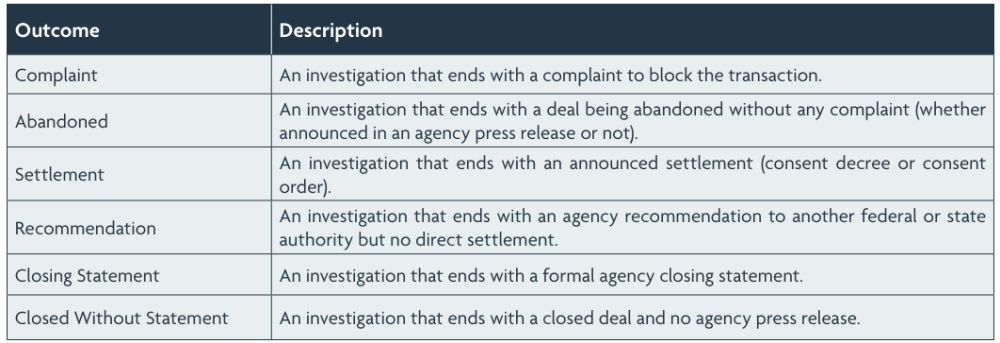
Our data include information about Second Request investigations beyond what the agencies disclose in public statements like press releases alone. Because our goal is increased transparency, however, we also aim to be transparent about the extent to which our data may not show the complete picture when benchmarked against agency statistics so that you can put our findings into context.
Findings By Duration
Continuing a trend we reported in Q4 2025, Second Requests in the first half of 2026 had lower durations, marking a welcome break from extended durations inherited from the previous administration.
Even though the average Second Request timeline peaked at 13.1 months in Q3 2025, we advised clients that relief was likely coming because we believed those averages were prejudiced by carryover matters from the Biden administration. As we expected, we saw the average timelines of Second Request investigations in Q4 2025 drop significantly, both for investigations that concluded with and without an official agency statement. At the time, however, the drop was considerably more pronounced for investigations that closed quietly without agency publication.
The overall average dropped further in the first half of 2026. The average duration for a Second Request that ended with an agency press release fell to 9.9 months in the first half of 2026, while the average duration for a Second Request that ended with no agency statement came in at 8.2 months. Together, the average duration for a Second Request regardless of outcome came to 9.1 months.
While both DOJ and FTC leadership deserve credit for these developments, our data show that DOJ timelines improved much more over the last year; the average duration of a DOJ Second Request clocked in at 8.0 months in the first half of 2026, while the average duration of an FTC Second Request came in at 10.4 months. As shown on the following chart, while DOJ durations might suggest it was a laggard in 2025, DOJ has now leapfrogged the FTC with shorter average Second Request durations.
On the FTC side, a key driver of shorter timelines may be the increased use of the quick look process short of full blown Second Request compliance. Similarly, the DOJ recently announced that “it has returned to implementing targeted Second Request investigations to expedite merger review,” introducing a new model timing agreement that aims to reduce burdens by identifying priority specifications to permit “expedited consideration” short of full Second Request compliance. Not surprisingly, the DOJ reserves the right to seek additional information, including full compliance with the Second Request, if necessary, but affords parties the possibility of avoiding the burden of full compliance. Given the discretion that the DOJ retains to seek full compliance, it is unclear how much effort this process will save merging parties in practice; many parties are likely to continue to work towards full compliance given the timing pressures inherent in any Second Request. DOJ’s renewed commitment to early engagement short of full substantial compliance, however, is notable, and our data suggest that the changes summarized in this new announcement, to the extent they have already been implemented, may already be yielding dividends by shortening timelines.
The drop in average Second Request durations noted in the first half of 2026 is also notable because it can be seen across all Second Request outcomes, as shown on the next page.
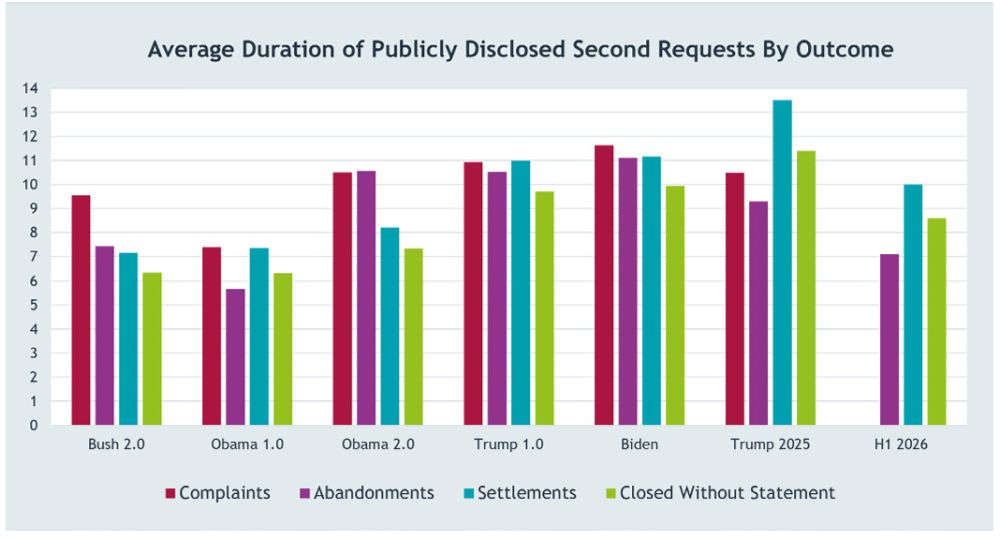
While a considerable improvement, these shorter durations are still higher on average than those seen in the first Obama administration and during the second Bush administration. In other words, relative to historical timelines, there is room for timelines to be compressed further.
And there is reason to believe that, on average, Second Request durations will continue to decline. The shorter durations observed in H1 2026, for instance, were largely notified under the new, more onerous HSR Act requirements that took effect in February 2025, which have since been reversed. Under those requirements, parties typically needed more time to prepare HSR Act filings, which likely increased timelines that begin from deal announcement or signing. Consequently, subsequent quarters may show even shorter timelines overall now that the 2025 HSR Act reforms have been rescinded because parties may submit HSR Act filings more quickly even if the agencies’ Second Request investigations otherwise do not change at all.
Findings By Outcome
The most recent data show that settlements after Second Request investigations are on the rise, a positive trend for parties considering strategic mergers and acquisitions (M&A).
While settlements retook their historic place as the most common Second Request investigation outcome announced by the agencies in 2025, transparency lagged—with our data showing that 61% of publicly disclosed Second Request investigations ended in 2025 without an agency press release. We are happy to report that this percentage appears to have essentially flipped, with 57.9% of publicly disclosed Second Requests ending in the first two quarters of 2026 with an agency press release. If this trend continues for the rest of 2026, as shown below, agency press releases will have covered more than 50% of publicly-disclosed Second Requests for the first time since 2022.
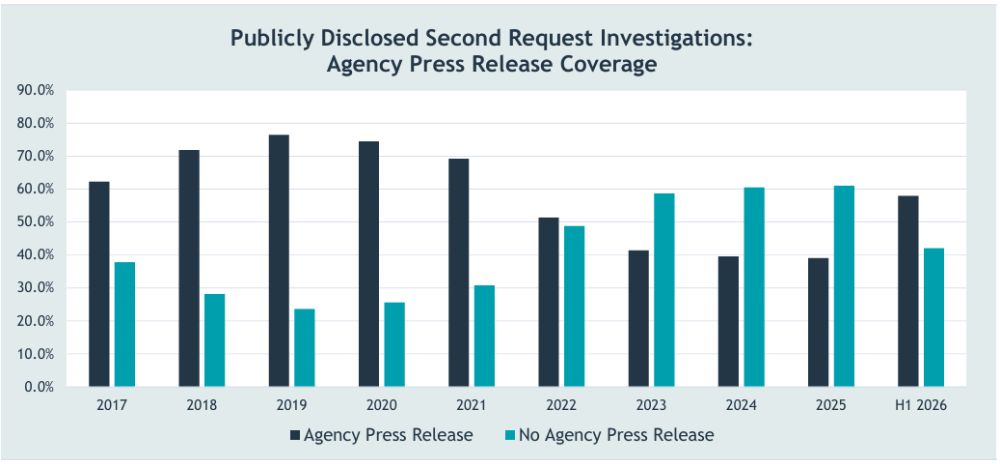
It is worth repeating that our data only tracks publicly disclosed Second Requests, so, just as has been the case in prior analyses, we are likely undercounting the number of Second Request investigations that closed without an agency announcement. We are only measuring the agencies’ transparency against transactions with Second Requests that have been publicly disclosed by the parties. But the agencies seem to be offering more transparency in significant investigations.
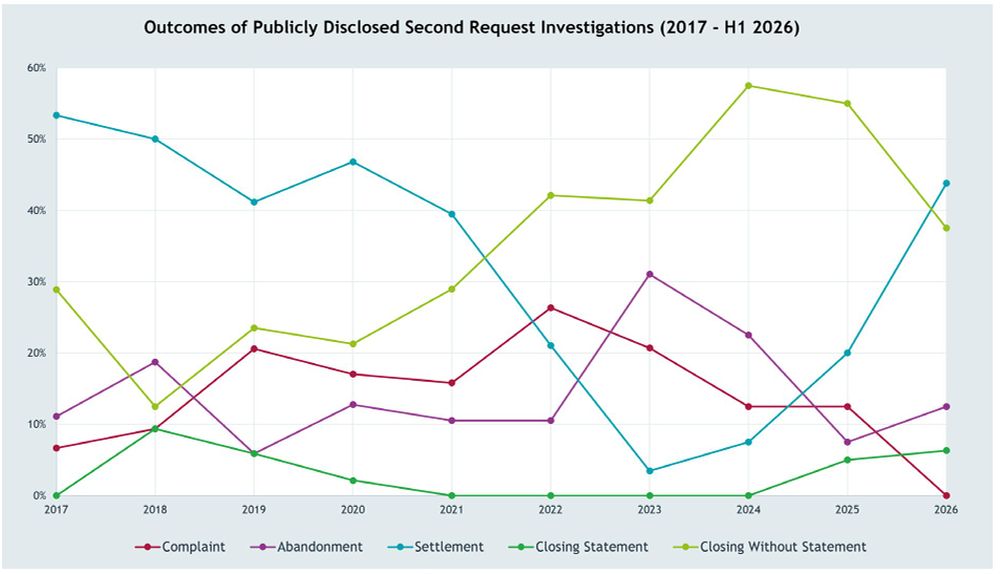
A key reason for that shift is the increased ratio of publicly disclosed Second Request investigations that have ended in an announced settlement. In 2025, for example, the most common outcome for publicly disclosed Second Request investigations by far was a closed transaction without an agency statement, which accounted for more than the number of abandonments, complaints and settlements combined. In the first half of 2026, by contrast, the most common outcome was an agency-announced settlement.
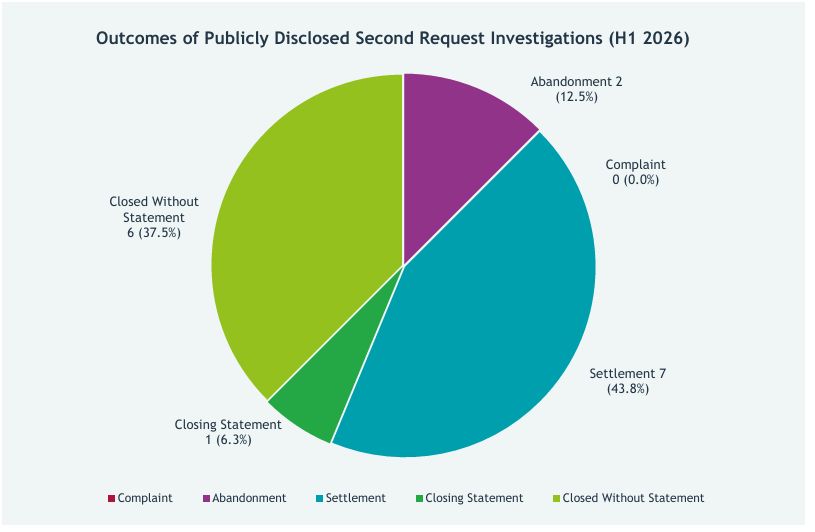
As shown below, the most common outcomes in 2025 and the first half of 2026 flipped, a reversal of trends that began in 2021 under the Biden administration, which preferred challenging mergers rather than settling while simultaneously increasing the number of Second Requests that concluded without any agency-announced enforcement action.
Benchmarking TIME Data Against Agency Reporting to Congress
Agency press releases have not been a reliable barometer for agency Second Request activity in recent years. Our TIME data, which include agency announcements and public disclosures from merging parties, more closely track the results disclosed in agency reports to Congress.
Anyone solely counting agency press releases might be tempted to think that the U.S. has seen record low numbers of merger investigations since 2022, especially in the final years of the last administration. This view, however, would be inconsistent with the agencies’ reporting to Congress. As shown below, while press releases from the U.S. antitrust agencies about results from Second Request investigations dried up during this period, the number of Second Request investigations reported in the agencies’ HSR Report to Congress remained in line with historical averages.
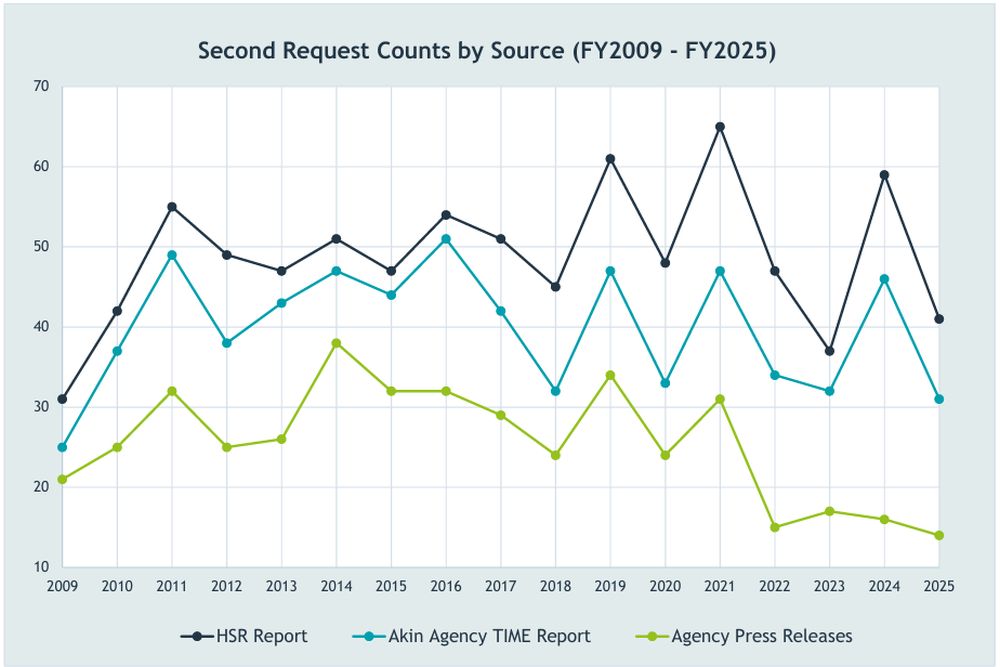
For example, the HSR Report counts 59 Second Requests issued in FY 2024, but, to date, agency press releases have only covered 16 (27%) of those investigations. In other words, there was no official agency statement for about 73% of Second Requests that were issued in FY 2024. Accordingly, agency press releases skewed to a narrow set of Second Request outcomes published by the agencies, while most Second Request investigations ended with agency silence.
As shown on the previous page, our data include agency statement and public disclosures from the investigated parties themselves and, accordingly, cover a wider set of Second Requests and closely resembles the level of Second Request activity reported in annual HSR Reports submitted by the agencies. And understanding the difference between what is covered in agency press releases and what was left out of the formal agency record can yield important insights for parties considering merger activity.
Because the agencies’ annual HSR Report always lags the more recent data tracked in our database, comparing its figures to agency press releases for the period covered in the report does not show any uptick in transparency. Instead, the data from the HSR Report suggests that the pattern of agency silence on most Second Request outcomes that accelerated under the Biden administration has persisted, as most of the Second Request investigations that were launched in FY 2025 concluded without any agency statement. Our more recent data, however, suggest that transparency is likely to improve further in the next quarter. As settlements return to being the most common outcome, and closing statements return after four years of hibernation, we expect the gap between the number of Second Requests reported by the agencies to Congress and the number of Second Requests covered by agency press releases to narrow.
Of course, it is impossible to capture all Second Request activity from public information, especially for investigations where the agencies decline to seek any enforcement. But since so many Second Request investigations go unreported, we will continue to track Second Request outcomes from available public sources. Merging parties considering deal risks on potential new transactions would be wise to pay attention to that broader context and not just the deals that get the most attention in agency press releases. The broader context may become even more important as the agencies expand phased or quick look Second Request investigations because these processes may provide more off ramps for some transactions and perhaps less transparency about Second Request activity.
Conclusion
At the end of 2025, ourAgency TIME Report for Q4 2025 highlighted “the potential for significantly shorter durations next year, as promised by the current administration.” Our data bear out that prediction. The data show that a Second Request may no longer pose the same timing risk today that corporate lawyers have come to expect over the last decade.
In our view, parties planning significant merger activity that could be subject to a Second Request would still be wise to budget at least 10-12 months to complete the investigation before considering an additional five to seven months, if necessary, to defend the transaction in court. But declining investigation timelines suggest that parties can feel more comfortable that those time allocations may be sufficient to get most transactions through the Second Request process, at least under the current administration.
The content of this article is intended to provide a general guide to the subject matter. Specialist advice should be sought about your specific circumstances.
[View Source]