
In December 2024, the EU’s Carbon Removal and Carbon Farming Certification Framework Regulation ("CRCF") (EU 2024/3012) was published, with the aim of establishing a harmonised, voluntary certification system for three main activities: carbon removals, carbon farming, and carbon storage. The CRCF aims to standardise the process of certifying carbon removals across the EU by putting in place quality and verification criteria. These developments are intended to boost carbon removals, and thereby contribute to the EU's climate targets.
Operationalisation of the CRCF Regulation is ongoing, most recently in the form of:
- an Implementing Regulation (EU 2025/2358), adopted in November 2025, which sets out the operational rules for certification schemes, audits, and reporting to ensure the Regulation is applied consistently across the EU (the "Implementing Regulation"); and
- a Delegated Act (EU 2026/285), adopted by the Commission in February 2026, which defines the technical methodologies for measuring, monitoring, and verifying carbon removals (the "Delegated Act").
When the Implementing Regulation was in draft form, some commentators raised concerns regarding the additional administrative burden that it would create. For example, they questioned whether limiting recognition to EU-only schemes (in Article 17 of the Implementing Regulation) could create unnecessary duplication and disadvantage those operators already using established international frameworks, such as Verra or Puro.earth.1 However, the Implementing Regulation as adopted does not appear to have addressed this concern.
The Delegated Act sets out the first set of certification methodologies for (i) direct air carbon capture and sequestration ("DACCS"), (ii) biogenic emission capture and storage ("BioCCS") and (iii) biochar carbon removal ("BCR").2 Following a two month scrutiny period, the Delegated Act was published in the Official Journal of the EU on 17 April 2026 and will enter into force on 7 May 2026.
Who does the CRCF apply to, and which activities are covered?
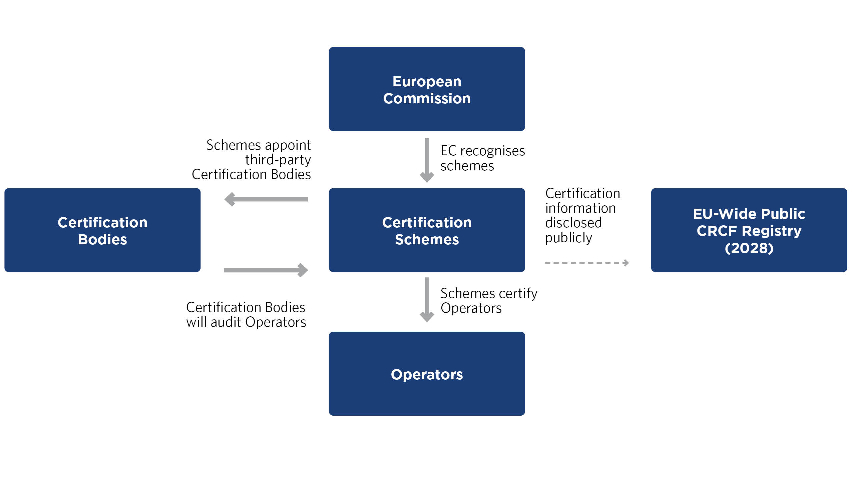
The CRCF is intended to apply to operators, which includes farmers, land managers and companies who carry out carbon removal, carbon farming or carbon storage activities in the EU. Participation in the framework is voluntary, but operators will need to be verified to receive CRCF-certified units. Operators will submit activity and monitoring plans to an EU-recognised certification scheme, which will then audit the activity alongside certification bodies to ensure it meets the quality standards. Only once an operator’s activities have been verified will the certification scheme issue certified units.
The CRCF covers operators carrying out three main types of certified activities: permanent carbon removal, carbon farming and temporary carbon storage in long-lasting products.
| Activity | Description |
|---|---|
| Permanent Carbon Removals |
Activities that capture and store atmospheric or biogenic carbon for several centuries, including:
|
| Carbon Farming and Soil Emission Reductions |
Activities that enhance carbon sequestration or reduce emissions in soils and forests:
|
| Carbon Storage in Long-Lasting Products | Activities that store carbon in products (e.g. wood-based construction materials) for at least 35 years. |
Quality criteria and steps for certification
To be certified under the CRCF, these different removals are all required to meet the following four quality criteria:
- Quantification: Activities must demonstrate a net carbon removal benefit, which is calculated using a two-step process: (i) quantification of additional carbon removals or soil emission reductions against a baseline and (ii) subtracting any associated greenhouse gas emissions from the activity's lifecycle.
- Additionality: To qualify, an activity must go beyond existing legal requirements of the operator and the incentive effect of the certification under the CRCF is needed for the activity to become financially viable.
- Long-term Storage: Operators must guarantee the storage of carbon for a defined long-term period.
- Sustainability: Activities must not cause significant harm to the environment and may also deliver co-benefits the surrounding ecosystem, such as for biodiversity and soil health.
Eligible activities which meet the quality criteria can generate "certified units", which can be sold on voluntary carbon markets.
Steps for certification
The Implementing Regulation sets out the steps for certification. These are as follows:
- Operators must apply to an EU Commission-recognised certification scheme.
- Operators must submit an activity plan and a monitoring plan for the carbon removal activity to their chosen scheme.
- The relevant activity will be audited by the chosen certification scheme. If successful, a certificate of compliance will be issued.
- Re-certification audits will be carried out at least every five years by certification bodies to check correct implementation of the activity and the generation of carbon removals.
By 2028, the EU Commission aims to establish an EU-wide CRCF registry, where certification information will be disclosed publicly. Until then, certification schemes will publish the information in their own registries, for transparency.
Conclusion and next steps
The CRCF represents a potentially significant shift in the landscape of the European carbon market, setting a new benchmark for quality and transparency of voluntary carbon credit projects.
However, participation is voluntary, and existing schemes could continue to operate outside the CRCF if they so choose. Once recognition of certification schemes begins, it remains to be seen how many operators are enticed by the prospect of enhanced credibility and transparency promised by CRCF certification.
While its ultimate impact will depend on uptake by key market players, the CRCF could set a new standard for carbon removals in the EU. The key question for the market is whether demand will shift towards CRCF-certified credits.
Footnotes
1 https://iogpeurope.org/resource/iogp-europe-feedback-to-the-implementing-act-on-certification-schemes-certification-bodies-and-audits/
2 https://climate.ec.europa.eu/news-other-reads/news/eu-sets-worlds-first-voluntary-standard-permanent-carbon-removals-2026-02-03_en
The content of this article is intended to provide a general guide to the subject matter. Specialist advice should be sought about your specific circumstances.
[View Source]