- within Antitrust/Competition Law topic(s)
- with readers working within the Banking & Credit and Business & Consumer Services industries
- within Antitrust/Competition Law, Intellectual Property, Media, Telecoms, IT and Entertainment topic(s)
The Turkish FMCG sector has been one of the Turkish Competition Authority’s (“TCA”) recurring areas of interest in recent years. In 2025 and 2026, the TCA conducted investigations into dominant undertakings operating in this sector, and it is noteworthy that it has imposed certain remedies using a broadly consistent approach, particularly regarding the placement of cabinets and display stands to allow competing products.
Recent cases concerning Coca-Cola Satış ve Dağıtım AŞ (“Coca-Cola"), Frito Lay Gıda Sanayi ve Ticaret AŞ (“Frito Lay”), Unilever Sanayi ve Ticaret Türk AŞ (“Unilever”), Magnum Dondurma AŞ (“Magnum”) and Haribo Şekerleme San. ve Tic. Ltd. Şti. ("Haribo") are of particular significance as they reveal a distinctly consistent line of approach. The common regulatory concern is whether the use of physical display infrastructure, such as coolers, freezers, display stands and shelves at retail outlets may limit competitors’ effective access to consumers. The measures introduced in these cases appear to be designed to break dominant undertakings' exclusive control over distribution and display infrastructure and to ensure that display visibility is opened up to competitors on a gradual basis.
TCA’s Recent Coca-Cola Commitment Decision
On 18 June 2026, the TCA announced a new commitment decision concluding the investigation initiated against Coca-Cola under Articles 4 and 6 of Act No.4054 on the Protection of Competition ("Competition Act")1. The decision addresses concerns relating to the exclusion of competitors through exclusivity practices and discount mechanisms. In particular, the cooler access rule previously established under the TCA’s 2021 commitment decision has been broadened in scope, and additional rule changes and obligations have been introduced. It is noted that the commitments accepted under the recent 2026 decision are subject to review by the TCA after a period of three years.
Expanding the Cooler Access Rule from 25% to 35%
In the said decision, the most visible amendment is the expansion of the cooler access rule. Under the 2021 commitment framework, 25% of Coca-Cola coolers at certain outlets were to be made available to competing products. The 2026 decision increases this ratio to 35% and introduces more detailed structural rules on implementation. These include vertical separation within the cooler using a physical separator, labelling of each shelf within the separated area stating that it is reserved for competing products, and application of the rule separately to each cooler at multi-cooler outlets.
The 2026 decision also narrowed the exception previously available where a sales outlet had its own non-alcoholic soft drinks cabinet; the presence of such a cabinet no longer prevents the rule from applying. Further information mechanisms for sales outlets have been introduced, including QR-code access to detailed explanatory texts. To ensure practical enforcement, Coca-Cola is also required to issue a warning upon the first instance of non-compliance identified during field visits, with progressive 10% order reductions for continued non-compliance of sales points. Moreover, independent third-party measurement reports must be submitted to the TCA upon request. Additionally, no labels, coatings or similar materials restricting the visibility of competing products may be placed on the glass surfaces of Coca-Cola coolers, and competing undertakings will be free to use their own price tags inside the coolers.
The 2026 Coca-Cola commitments also go well beyond cooler space rules outlined above. The cooler supply model has been restructured. The practice of linking cooler efficiency to a minimum annual number of parcels expected to be purchased by retail outlets has been discontinued, and it is no longer permitted to issue top-up invoices to dealers for failing to meet such requirements.
Substantial changes have also been made to target and bonus schemes as part of the commitments. The bonus scheme for Field Sales Managers has been abolished, the base salary ratio for Field Sales Managers and Sales Representatives has been increased to 80%, and variable pay has been capped at 20% of total remuneration. Dealer-based financial support and performance reporting practices have been discontinued. Regarding investment support for items such as awnings, signboards and shelving, such support must now be provided independently of product purchase contracts, based on objective criteria, and may not be made conditional upon the removal or non-stocking of competing products or coolers.
As to discount policies, discounts must be determined on the basis of independent and objective criteria for each product category, and no discount in any category may be tied to the purchase, sale or display of products in another category, which is a direct prohibition on cross-category discount tying that goes beyond the 2021 framework.
TCA’s Similar Approach in Frito Lay, Unilever/Magnum and Haribo Investigations
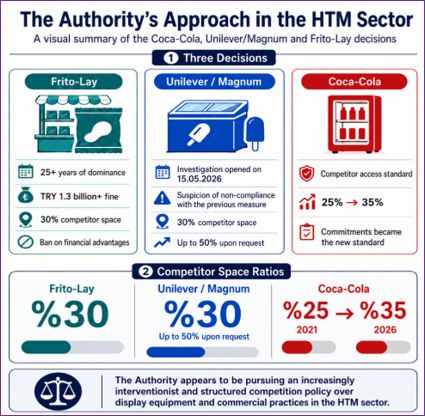
In the Frito Lay decision last year2, the TCA found that Frito Lay had maintained a dominant position in the Turkish packaged crisps market for over 25 years and had exploited this position through exclusivity practices restricting competitors' access to retail outlets in the traditional channel, such as small corner shops and kiosks. The Competition Board imposed an administrative fine of over TRY 1.3 billion and introduced a number of behavioral remedies.
The measures imposed in the Frito Lay case included limitations on the number of display stands per sales outlet and a requirement that, where no competitor stand is present, at least 30% of Frito Lay’s display stand must be allocated to competing products. Notably, where competing products are unavailable or out of stock at the sales point, the space reserved for competitors may not be filled with Frito Lay products. Furthermore, even where a second undertaking's stand is present at the sales point, 30% of Frito Lay's stands must still be made available—within one week of a request—to other competing manufacturers that do not have their own stand, with a minimum allocation of 35 cm horizontal space per basket. Additionally, a ban was imposed on financial incentives—such as discounts, additional discounts, incentives and bonuses—that affect competitors' visibility at retail outlets. The company was also required to submit regular reports and implement compliance measures to ensure that these obligations are met and maintained over time. The TCA’s approach is therefore comparable, at a general level, to the Coca-Cola decision recently announced. It is seen that the TCA focuses on whether an undertaking’s control over display units may reduce rival visibility in traditional retail.
On the other hand, the recent Unilever and Magnum case, which is still ongoing, is procedurally different, as the TCA announced in May 2026 that it had initiated an investigation following suspicions that Unilever and Magnum had not complied with the measure contained in the Board’s previous decision3. Similar to the Coca-Cola commitment decisions in 2021 and 2026, this investigation clearly demonstrates that previous TCA decisions and commitments constitute ongoing and enforceable obligations, and that failure to comply with a previously issued remedial decision may directly pave the way for the opening of a new investigation.
In connection with the 2026 investigation, the Board also adopted interim measures while the investigation continues4. The interim measures require, in sales points with a covered sales area of 100 m² or less where there is no freezer cabinet accessible to consumers other than the Unilever ice-cream cabinet, that 30% of the total volume of each such freezer be allocated in a single block for competing products by Unilever and Magnum, with appropriate labelling stating that “This part is allocated to competing products", and that Unilever and Magnum products may not be placed in this reserved area. If no competing product is available at the sales point, the reserved space must be left empty; and the 30% ratio may also be increased up to 50% if requested by the sales point.
Most recently, on 3.07.2026, the TCA announced interim measures imposed on Haribo within the framework of an investigation initiated to determine whether Articles 4 and 6 of the Competition Act had been violated. The Board imposed interim measures on Haribo in order to prevent potential competition infringements in the soft candy market and any irrevocable harm these may cause.
The interim measures require that, in all traditional outlets with an area of 200 square meters or less, a space corresponding to 30% of the volume of all Haribo stands must be allocated to competing brand products which do not have soft candy stands at the relevant outlet. This space must be placed on the visible side of all Haribo stands, on the vertical plane and in a single block, together with a label including the phrase "This space is allocated to competing products”. Implementation is required within one month following the notification of the reasoned decision, and Haribo must certify before the TCA that the obligations have been fulfilled within the same period. The investigation concerning Haribo remains ongoing.
Taken into account together, these recent developments, including the Coca-Cola commitment, the Frito Lay remedies, the Unilever/Magnum and the Haribo interim measures, demonstrate that the TCA appears to be examining whether control over cabinets, freezers or stands may have exclusionary effects in sales points where physical space and consumer visibility are commercially significant. Moreover, the Board has demonstrated that it is prepared to intervene not only in access to display equipment but also in the internal dynamics of the business model.
Economic / Market Impact
Display infrastructure has a practical importance in FMCG markets. In categories such as soft drinks, ice cream and packaged snacks, consumer choice is often made at the point of sale, and visibility can influence purchasing decisions. This is particularly relevant in traditional retail channels, where space may be limited and the presence of branded coolers, freezers or stands may shape the range of products consumers actually see.
The TCA’s recent measures appear to be aimed at preserving a degree of competitive visibility within this environment. The remedy percentages differ across cases: 35% in the 2026 Coca-Cola cooler commitment, 30% in the Frito Lay display-stand context, 30% in the Unilever/Magnum interim freezer measure (with the latter potentially increasing to 50% at request), and 30% in the Haribo stand allocation interim measure.
Conclusion
The Coca-Cola, Frito Lay, Unilever/Magnum and Haribo developments indicate that the TCA is paying close attention to how FMCG products reach consumers at the point of sale. The common theme is not simply contractual exclusivity, but the broader question of whether cabinets, freezers, display stands, discounts and field incentives may limit competitors’ practical access to sales points.
The decisions and announcements point to a continued focus on behavioral remedies that open a portion of display infrastructure to competitors, supported by labelling, monitoring and implementation requirements. Importantly, previously accepted commitments serve as a starting point in subsequent investigations, and these standards may be raised through new commitments—as demonstrated by the progression from 25% to 35% in the Coca-Cola cooler access rule.
Footnotes
1 The Board’s decision dated 4 June 2026 and numbered 26-20/614-243.
2 The Board’s decision dated 13 February 2025 and numbered 25-06/152-78.
3 The Board’s decision dated 18 March 2021 and numbered 21-15/190-80.
The content of this article is intended to provide a general guide to the subject matter. Specialist advice should be sought about your specific circumstances.