

- within Accounting and Audit, Insurance, Government and Public Sector topic(s)
- with Senior Company Executives and HR
- in Africa
AFRICA: ATAF and OECD concluded transfer pricing workshops for Francophone tax officials
On 31 March 2026, the African Tax Administration Forum (“ATAF”) and the OECD have concluded interactive capacity-building transfer pricing workshops for more than 130 tax officials from 17 French-speaking African countries.
The workshops focused on the simplified transfer pricing approach for baseline marketing and distribution activities, the use of the OECD pricing automation tools, and the ATAF suggested approach to drafting transfer pricing legislation.
Burkina Faso: Approval process for enterprise billing systems launched
The Directorate General of Taxes in official notice No. 004 dated 24 March 2026 have launched the approval procedure for enterprise billing systems (systèmes de facturation d'entreprise, “SFE”), as part of the implementation of the country's certified electronic invoicing framework.
Companies that have developed SFE for internal use, as well as publishers that market or intend to market such systems in Burkina Faso are required to submit an application file to the Directorate General of Taxes (Direction Générale des Impôts, DGI) to obtain a certificate of conformity. The application file must include the following documents:
- Duly completed application form;
- Copy of the trade and securities register;
- Valid tax clearance certificate;
- Certificate of affiliation to the National Social Security Fund (Caisse nationale de sécurité sociale, CNSS); and
- technical documentation relating to the SFE.
CôTE D’IVOIRE: VAT suspension for coffee and cocoa sector export-related operations extended
The Directorate General of Taxes (Direction Générale des Impôts, “DGI”) issued Service Note No. 02071/MEFB/DGI/DLCD-SDL/awg/04-2026 on 22 April 2026, extending the suspension of VAT on certain export-related operations carried out by companies in the coffee and cocoa sector for the 2025-2026 campaign.
The VAT exemption for these operations was abolished by the 2017 Fiscal Annex. However, a temporary suspension was introduced for the 2024-2025 campaign due to the absence of VAT in the sector's pricing structure and has now been extended for the 2025-2026 campaign as the Coffee and Cocoa Council (Conseil Café-Cacao) has not yet integrated VAT into the price-setting mechanism for these products.
The suspension applies to:
- Warehousing of goods intended for export, including goods in transit or transhipment;
- Technical inspection services relating to the weight and quality of goods intended for export;
- Sales of jute and sisal bags to exporters and companies operating in the coffee and cocoa sector, exclusively for packaging those products;
- Sales of packaging to exporters of processed or unprocessed agricultural products, where such packaging is exclusively used for goods effectively exported, or to companies operating in the coffee and cocoa sector; and
- Processing (milling) of coffee or cocoa.
The tax administration has been instructed not to pursue suppliers of these goods and services for VAT not invoiced or collected during the 2025-2026 campaign. However, VAT already invoiced and collected must be remitted to the tax administration under normal conditions.
CôTE D’IVOIRE: E-invoicing requirements for regulated professions clarified
In Service Note No. 01486/MEFB/DGI/DLCD-SDL/gr/03-26 dated 23 March 2026 by the DGI, the tax authorities have clarified, in regard to their professional secrecy obligations, that lawyers, doctors and other regulated professionals may use general descriptions of the services provided on their standardised electronic invoices.
Under the Ivorian e-invoicing framework, standardised electronic invoices must, in principle, include the identification of the client and a detailed description of the goods supplied or services rendered. The tax authorities have confirmed, however, that regulated professionals may instead use general wording such as "legal or medical services" or "professional fees". They must nevertheless provide the tax administration, upon request, with all relevant information used to establish the invoice.
DEMOCRATIC REPUBLIC OF THE CONGO: Moratorium on mandatory use of standardised invoices ended
Through Official Notice No. 006 of 8 April 2026, the Ministry of Finance has ended the moratorium on the mandatory use of standardised invoices (factures normalisées) for VAT purposes. As from 15 May 2026 all VAT collected or deducted must be supported by standardised invoices, with no possibility of regularisation.
The measure follows the conclusion of an ad hoc commission established in December 2025 to address implementation difficulties reported by businesses after the reform entered into force on 1 December 2025. The commission found that most concerns had been addressed, with remaining issues limited to technical and operational matters that no longer constitute major obstacles to compliance.
GHANA: Law reducing growth and sustainability levy on gold signed by the President
Following Parliament's approval on 13 March 2026, the President has assented to the Growth and Sustainability Levy (Amendment) Act, 2026. The Act reduces the levy applicable to gold mining companies from 3% to 1% of gross production, thereby reversing the increase from 1% to 3% introduced by the Growth and Sustainability Levy (Amendment) Act, 2025.
The Act forms part of the government's broader recalibration of the mining fiscal regime, particularly in light of the introduction of the Minerals and Mining Royalty Regulations, 2025, which established a sliding-scale royalty system for gold producers.
GUINEA: Finance Law 2026 adopted in Official Gazette
The Finance Law 2026 (Law L/2026/010/CNT) was adopted on 31 March 2026 and published in the Official Gazette of the Republic of Guinea Special Issue No. 04 on the same date. Significant amendments include:
- Establishing a dedicated revenue fund for the Simandou iron ore project, reflecting an increased focus on the management of mining-related revenues;
- Providing that the apprenticeship tax (taxe d'apprentissage) is now payable monthly, instead of annually, together with a consolidated monthly return. The tax is collected only if the monthly amount exceeds GNF10 000;
- Providing that taxpayers operating exclusively under externally financed contracts (financement extérieur, Finex) where VAT is paid through special treasury cheques (chèques Trésor Séries Spéciales, CTSS) are now eligible to claim VAT credit refunds.
- Reducing the single property tax (contribution foncière unique, CFU) rate from 5% to 2% for owner-occupied residential properties, and from 20% to 5% for completed but unoccupied properties. Rates on owner-occupied professional properties (10%) and rented properties (15%) remain unchanged;
- Simplifying invoicing requirements by removing the obligation to include the telephone numbers of the supplier, customer and fiscal representative; and
- Capping the duration of spot tax audits (vérifications ponctuelles), limited to specific taxes or periods, at three months.
KENYA: Finance Bill, 2026 published
The Finance Bill, 2026 was presented to the parliament in April 2026 following its publication in the Gazette on 2 April 2026. The Bill introduces a range of legislative amendments across the:
- Income Tax Act (Cap. 470);
- VAT Act (Cap. 476);
- Stamp Duty Act (Cap. 480);
- Miscellaneous Fees and Levies Act (Cap. 469C);
- Excise Duty Act (Cap. 472); and
- Tax Procedures Act (Cap. 469B).
Parliament approved the VAT (Amendment) Bill 2026 on 16 April 2026, with the Bill being assented into law on 17 April 2026.
Significant amendments include:
Direct taxes
- Exempting capital gains from property transfers carried out between a company and its shareholders where such transfers are undertaken as part of an “internal reorganisation”, defined as a restructuring of ownership or control of a company or its assets that does not involve a transfer to a third party. This includes transfers of property by the shareholders to the company for consideration, provided that:
- the property is transferred to shareholders in proportion to their existing shareholding immediately before the transfer; and
- if the property consists of shares, those shares relate to a subsidiary of the transferring company.
Indirect taxes
- Reducing the VAT rate applicable to certain petroleum products, in particular motor spirit (gasoline) premium, illuminating kerosene, and gas oil (automotive, light, amber for highspeed engines), from 16% to 8%. The reduction was effected through Legal Notice No. 70, which was published on 15 April 2026 and took effect from 16 April 2026 up to 14 July 2026. The VAT (Amendment) Act, 2026 grants authority to extend the application of the reduced VAT rate for an additional period of 90 days through a Gazette Notice, to be effective from 15 July 2026.
KENYA: Tax treaty with Singapore enters into force
On 20 April 2026, the Kenya - Singapore Income Tax Treaty (2024) entered into force. The treaty generally applies from 1 January 2027 for withholding and other taxes.
KENYA: Guidance on income and expense validations for income tax returns issued
The Kenya Revenue Authority (“KRA”) has published a Step-By-Step Guide for Income and Expense Validations for Income Tax Returns, explaining that:
- Under the validation process first announced by the KRA in November 2025, it will begin validating income and expenses declared in both individual and non-individual income tax returns against certain data sources with effect from 1 January 2026;
- As part of recent modifications to the iTax filing process, the system now pre-fills certain data and validates income and expenses to improve tax compliance. This requires taxpayers to download the latest version of the Income Tax Return Excel file from the iTax Portal using the option "Download Autopopulated ITR/ITNR/IT2C/IT2P Return";
- Certain sections of the Income Tax Return template will be automatically populated using data available in iTax and other integrated systems, which is intended to reduce manual data entry, minimise errors, and simplify the filing process;
- Income and expenses will not be prefilled in the downloaded file, however, and will be validated when the return is uploaded. Prior to upload, taxpayers are required to make necessary adjustments through a process detailed in the guide, including:
- manual adjustments for capturing business expenses not captured by electronic invoicing (TIMS/eTIMS);
- accounting and accrual adjustments for reconciling accounting and taxable income (e.g., deferred income, prepayments, or cost of goods sold from inventory); and
- credit and debit notes to adjust sales or purchases manually if they weren't automatically reflected.
This validation applies to all accounting year periods ending in 2025 for which returns are filed from 1 January 2026.
KENYA: Automated VAT returns for export transactions implemented
From May 2026, the KRA began linking export transaction data captured in the Integrated Customs Management System (“iCMS”) with prefilled VAT returns. Only export data validated in iCMS and linked to the exporter’s Personal Identification Number will be allowed in the prefilled VAT returns shown in iTAX. These changes apply to exports to the Single Customs Territory, other foreign countries, Export Processing Zones, and Special Economic Zones.
LIBERIA: VAT registration announced ahead of 2027 rollout
Through a revenue notice published on 13 April 2026, the Liberia Revenue Authority (LRA) has announced that VAT registration will take place from 1 July to 31 December 2026, while VAT implementation will kick off on 1 January 2027.
LIBERIA: Tax Amendment Act of December 2025 enacted
The Liberia Tax Amendment Act of December 2025 was approved on 24 March 2026 and published on 1 April 2026. Significant amendments include:
Direct taxes
- Enhancing the definition of “permanent establishment” by deeming it to exist where a non-resident conducts business in Liberia for 30 days or more, including through employees or agents. The provision expressly includes the furnishing of services, including consultancy, within this threshold;
- Including income derived from the sale or licensing of intellectual property, including software used in Liberia, to Liberian-source income;
- Providing that a 15% withholding tax applies to Liberia-source payments to non-residents, including interest, dividends, royalties, licence fees, mineral rights payments and software-related income;
Indirect taxes
- increasing the Goods and Services Tax (“GST”) rate on taxable supplies and services from 12% to 13%, effective 1 May 2026. The GST rate on exports of goods will remain at 0%, while telecommunications services will continue to be taxed at 15%;
Tax administration
- Empowering the Commissioner General to require taxpayers to provide security for unpaid taxes and to enforce this requirement through the placement of liens on land or buildings, distress and sale of movable property, third-party recovery notices and the seizure and forfeiture of goods;
- Providing that third parties who owe money to a taxpayer, hold money on account of a taxpayer, or are authorised to pay money to a taxpayer may be required to preserve such funds for a period not exceeding 10 working days, or for such further period as a court may allow;
- Empowering the Commissioner General to amend an assessment within the applicable assessment period by making necessary alterations, with the general assessment period running from the due date of filing the return or withholding the tax;
- Providing that, in cases of fraud or tax evasion, the limitation period runs from the date the offence is discovered, overriding the general rules;
- Providing for penalties of up to LRD400 000 or 10% of the understated tax for tax advisers, accountants and other persons who facilitate or attempt to facilitate tax evasion. In addition, obstruction of tax authorities attracts fines and/or imprisonment of up to three years;
- Empowering the Commissioner General to prevent individuals under investigation for tax offences from leaving Liberia through measures that include denial of immigration clearance and confiscation of travel documents. Such orders remain in force until tax liabilities are settled or satisfactory arrangements are made;
- Revising the additional penalty applicable to a person who knowingly fails to perform a withholding or collection obligation, increasing the fine from no more than USD50 000 to no more than 50% of the tax amount for a first offence and no more than 100% for a second or subsequent offence and/or imprisonment; and
- Revising the penalty for failure to meet a tax payment or tax reporting obligation, increasing it from a fine of USD25 000 to a fine of no more than 50% of the tax amount for a first offence and no more than 100% for a second or subsequent offence and/or imprisonment.
The Act takes effect immediately upon publication in handbills, unless otherwise provided under transitional rules.
MAURITIUS: Return and payment deadline for domestic minimum top-up tax extended
The Mauritius Revenue Authority (“MRA”) issued a communique on 24 April 2026 announcing an extension of the Domestic Minimum Top-up Tax (“DMTT”) return and payment deadline to 30 June 2026, where the standard deadline would otherwise fall between 1 April to 29 June 2026.
DMTT is applicable as from the year of assessment commencing on 1 July 2025 and applies to a resident company forming part of an in-scope multinational enterprise group having fiscal year ending on or after 1 January 2025. The Income Tax Act requires a designated person to file the DMTT return not later than 15 months from the end of the fiscal year and at the same time pay any tax payable in accordance with the DMT tax return.
MAURITIUS: Revenue Tribunal confirms disallowance of annual allowance under general anti-avoidance rules
On 2 April 2026, the Revenue Tribunal ruled against CMT Spinning Mills Ltd (“CMT”), upholding the MRA decision to disallow the company’s annual allowance claim (ARC/IT/361-19).
CMT, a yarn spinning operator with two factories in La Tour Koenig, benefited from a 10-year tax holiday between 2005 and 2014 under section 161A(7A) of the Income Tax Act. During this period, it claimed an annual allowance at a nominal rate of just 0.5%. Once the exemption expired, however, CMT significantly increased its annual allowance claims. Viewing this shift as excessive and tax driven, the MRA invoked the general anti-avoidance rule under section 90 of the Income Tax Act to restrict the annual allowance claimed for years of assessment 2015/16 to 2017/18.
The central issue before the Revenue Tribunal was whether the MRA was justified in applying section 90 to curb what it viewed as a strategic deferral of the annual allowance.
CMT argued that:
- Section 24 of the Income Tax Act and Regulation 7 of the Income Tax Regulations (“ITR”) allows a taxpayer to claim an annual allowance flexibly to recoup its capital expenditure provided the rate of annual allowance claimed does not exceed the prescribed rate;
- Neither the Income Tax Act nor the ITR mandates a fixed rate of annual allowance or requires the same rate to be applied year after year;
- By varying its annual allowance claims, CMT was simply exercising a legislative option deliberately built into the tax regime, rendering section 90 inapplicable; and
- The higher annual allowance claims for years of assessment 2015/16 to 2017/18 generated losses of approximately Rs 140 million carried forward into 2018/19, a year now time-barred. As the MRA did not challenge those brought forward losses, they must be treated as allowed, preventing any retrospective dispute of the underlying AA claims.
The MRA argued that:
- The pattern of claiming an annual allowance as low as 0.5% during the 10-year tax exemption period, followed by significantly increased rates once the exemption ended, demonstrates a deliberate postponement of the annual allowance claim resulting in the reduction of tax liability;
- The economic substance reveals that a 0.5% rate implies an unrealistic asset life of 200 years, inconsistent with financial statements;
- There was no commercial rationale for such distortion other than tax benefit; and
- Section 90 applies because the “scheme” consisted of a series of intentional acts designed to secure a tax benefit.
The Revenue Tribunal held that:
- The deliberate pattern of deferring the annual allowance from the tax-exempt period to taxable years appears inconsistent with the underlying purpose of the annual allowance provisions, which is to allow taxpayers to recover the cost of capital assets over the period in which those assets are used. By shifting those deductions to a later period solely for tax advantage, the arrangement undermines the intent of the legislation;
- In light of the Mauritius Freeport Development Supreme Court case (2025 SCJ 153), section 24 (1) of the Income Tax Act is to be interpreted as expressly providing that the annual allowance is to be claimed in that year and succeeding years without the choice to defer it to a later year;
- CMT appears to have crossed the boundary between legitimate tax planning and impermissible tax avoidance given that the annual allowance rate of 0.5% applied corresponds to an excessive life of 200 years to the economic life of the asset; and
- The MRA is right to invoke section 90 of the ITA to counteract a tax benefit as the intent behind application of a lower AA during the tax holiday followed by a higher percentage of annual allowance depicts a tax avoidance scheme.
NAMIBIA: Interest on Value Added Tax debts set at 10% from 1 May 2026
The Government of Namibia has issued Government Notice 107 of 2026 on 13 March 2026, confirming an adjustment to the interest rate applicable to VAT debt under the VAT Act, 2000. The interest rate on outstanding VAT liabilities is reduced from 10.75% to 10% per annum, with effect from 1 May 2026. The adjusted rate of 10.75% came into effect on 1 February 2025.
NAMIBIA: Deadline for returns impacted by loss-carry forward rules extended
The Namibia Revenue Agency (NamRA) issued a public notice on 27 March 2026 announcing an extension of the deadline to submit returns in relation to section 21 of the Income Tax Act (loss restrictions). In general, Section 21 provides that the offset of losses carried forward is limited to NAD1-million or 80% of taxable income, whichever is greater, with the carry-forward of losses limited to five years, increased to ten years in respect of entities involved in the mining, petroleum, or green hydrogen industry. The public notice provides that returns originally due between 31 July 2025 and 30 September 2026 are now due by 31 October 2026 if impacted by section 21.
NIGER: Three-month extension granted for application of tax on deposits and money transfers
In Official Notice No. 000000873/ME/F/SG/DGI/DGI/CFEI of 30 March 2026, the Ministry of Finance has announced the granting of a three-month extension, effective 1 April 2026, to electronic money institutions to implement the tax on deposits and money transfers (taxe sur les dépôts et transferts d'argent, TDTA) introduced by Finance Law 2026, thereby postponing its effective date to 1 July 2026.
The extension follows a request from electronic money institutions that cited the need to put in place the technical infrastructure required to process transactions, interface systems, and the collection of the tax in accordance with fiscal requirements. An initial three-month period had already been granted to institutions on 20 February 2026 through an explanatory circular to allow system configuration although the law had been in force since 1 January 2026.
NIGER: Electronic payment of customs duties introduced
In Circular No. 000009/DGD/DSI dated 27 March 2026, the Directorate General of Customs (Direction Générale des Douanes, DGD) announced that all taxpayers are required to pay all customs duties and taxes electronically at the national bank (Société Nigérienne de Banque, SONIBANK) effective 1 April 2026.
Taxpayers are required to present the references of the relevant customs declarations and the corresponding amounts payable in cash or by certified cheque. Declarations issued under an order-of-payment procedure are excluded from this system. Following payment, SONIBANK issues a receipt, and a clearance certificate is automatically generated in the automated customs system using a specific payment code (code 15). Taxpayers must then present the receipt at the relevant customs office to obtain the goods release note.
NIGER: Unique payment transaction number required for tax payments
In an official notice dated 27 March 2026 the Directorate General of Taxes (Direction Générale des Impôts) announced that, as of 1 April 2026, taxpayers are required to obtain a unique payment transaction number (numéro unique d'opération de versement, “NUOV”) prior to making any payment. Taxpayers must contact their respective tax offices to obtain the NUOV.
NIGERIA: Personal Income Tax Guidelines 2026 issued by Joint Revenue Board to harmonise compliance
The Joint Revenue Board has issued the Personal Income Tax Guidelines 2026 on 24 February 2026 (published on 7 April 2026) seeking to harmonise the administration of personal income tax and clarify compliance obligations for individuals and employers. The Guidelines cover the following key areas:
- Tax identification;
- The operation of the pay-as-you-earn system;
- Filing of returns and payment of taxes;
- Non-employment income;
- Tax clearance certificates; and
- Administrative matters.
REPUBLIC OF THE CONGO: Income tax currency conversion rules for foreign-currency accounts clarified
In Official Notice No. 005/CAB/MIN.FINANCES/DIRCAB/2026 dated 3 April 2026, pursuant to Ministerial Order No. 029/CAB/MIN/FINANCES/2026, the Ministry of Finance has clarified the currency conversion rules applicable to income tax (impôt sur les bénéfices et profits, IBP) for companies keeping their accounts in foreign currencies, in order to preserve tax neutrality and protect the real value of tax revenues.
The clarification follows exchange rate fluctuations in the last quarter of 2025, which allowed certain taxpayers to reduce their effective tax burden by making advance income tax payments in Congolese francs (“CDF”) at rates unfavourable to the Treasury.
The measure applies, in particular, to companies in the mining, petroleum and hydrocarbon sectors, as well as mining subcontractors benefiting from the Mining Code, many of which keep their accounts in US dollars. The following applies under the clarified rules:
- The taxable result and income tax liability (for 2025 revenues) are determined in the accounting currency;
- Advance payments made in CDF are converted into the accounting currency using the Central Bank of the Congo (Banque Centrale du Congo, BCC) indicative exchange rate applicable on the date of each payment;
- The final tax balance is calculated in the accounting currency after crediting the converted advance payments; and
- The final payment must be made in CDF at the BCC exchange rate on the date of payment.
Affected companies are required to comply strictly with these rules and are invited to contact the Directorate General of Taxes (Direction Générale des Impôts, DGI) for practical guidance, particularly regarding filing obligations and the crediting of advance payment. Non-compliance may result in penalties under applicable tax legislation.
REPUBLIC OF THE CONGO: Tax and customs incentives for commercial real estate zone introduced
Under Order No. 164 MATGT/MFBPP, signed on 4 February 2026 and published on the Ministry of Finance's website on 25 March 2026, the Republic of the Congo has introduced a preferential tax and customs regime for companies operating within a designated commercial real estate infrastructure zone, aimed at promoting investment and economic development. Approved companies benefit from the following fiscal incentives:
- A 10-year corporate income tax exemption from the year of investment, or five years from the date of installation in the zone, followed by a reduced corporate income tax rate of 10%;
- A reduced special corporate tax (taxe spéciale sur les sociétés, TSS) of 0.5%;
- A reduced tax on income from movable assets (impôt sur le revenu des valeurs mobilières, IRVM) of 5%;
- A reduced payroll tax of 2.5%;
- An exemption from property tax on commercial rents within the zone;
- Commercial lease registration and renewal fees at 50% of the standard rate; and
- A business licence (patente) at 50% of the standard rate.
Customs incentives include:
- A reduced 5% customs duty rate on goods imported in connection with the approved business activity;
- An exemption from customs duties and import taxes for equipment, materials, vehicles and other investment goods necessary for the implementation of approved projects; and
- A reduced VAT rate of 5% at import on equipment, vehicles, and office furniture.
The granting of the benefits of the regime is subject to approval by the Minister of Finance upon application to the Congo Infrastructure Development and Operating Company (Société d'exploitation et de développement des infrastructures du Congo, (“SEDIC”)). Approved companies must:
- Be registered in the Trade and Security Register (registre du commerce et du credit mobilier, RCCM);
- Be enrolled with the national social security system;
- Hold a bank account with a local financial institution;
- Prioritise local labour and service providers where qualifications are equivalent; and
- Conclude a contract with SEDIC.
RWANDA: Rules for imposing VAT on goods and service provided online published
Rwanda has published Ministerial Order No. 004/26/10/TC of 29 April 2026 in the Official Gazette, establishing the rules (modalities) for imposing VAT on goods and services provided online. Online supplies of goods and services were brought within the scope of taxable supplies for VAT purposes by Law No. 049/2023 of 5 September 2023 (the new VAT law).
Specified taxable goods and services under the rules for supplies of goods and services online include:
- Software programs and updating services;
- Services that link suppliers to recipients, including transportation-hailing platforms;
- Online gaming activities;
- Search engine services;
- Sales, licensing, or any other form of monetizing data generated from online users;
- Subscriptions for online journals and magazines;
- Online images, text, and information;
- Access to online media databases;
- Online education programs, including distance teaching programs through pre-recorded media, e-learning, education webcasts, webinars, online courses and training, excluding education services exempted by the Law;
- Streaming or downloading music and films;
- Websites, web hosting, or remote maintenance of programs and equipment;
- Political, cultural, artistic, sporting, scientific, and other broadcasts and events, including online television broadcasts; and
- Any other goods and services provided through an electronic, internet and digital marketplace.
Both domestic and foreign suppliers of taxable goods and services provided online are required to register for VAT if the goods and services provided online are supplied to customers in Rwanda. Alternatively, a foreign supplier may appoint a representative who has a business in Rwanda to fulfil the obligation to register on their behalf.
Goods and services provided online are considered to be supplied in Rwanda if:
- The recipient of goods or services provided online is in Rwanda, and the goods or services are beneficial to the recipient in Rwanda;
- The recipient of goods or services provided online is outside Rwanda, but the goods or services are consumed in Rwanda;
- The payment method, including the billing or home address, or access proxy, including internet proxy address, country code, or mobile telephone SIM card, and bank account of the recipient, are in Rwanda; or
- The features of the recipient of goods or services, including the receipt or residential address or access to the database including internet address, country code, or mobile communication card, are located in Rwanda.
The tax point for goods and services supplied online is the earliest of the following:
- The date on which the goods or services are delivered, in whole or in part;
- The date on which payment for the supply is effected; or
- The date on which the invoice, receipt, or any other proof of payment for the supply is issued.
Where the supplier of online goods and services is registered or has their representative registered, they must withhold the VAT due on their supplies and remit it to the tax administration in accordance with specified procedures. For each tax period, VAT returns and payment are due by the 15th of the month following the end of the period.
Where the supplier of online goods or services is not registered or has no representative registered, the VAT is withheld and paid by the financial institution that facilitates payment in accordance with specified procedures. The VAT withheld by financial institutions must be declared and paid by the 15th of the month following the month in which the VAT was withheld. For this purpose, a list of registered persons not subject to withholding will be provided by the tax administration.
The Ministerial Order entered into force on 29 April 2026, with in-scope online suppliers required to register or appoint a representative within three months.
RWANDA: New rules for transfer pricing, simplified accounting and loss carry-forward extensions introduced
Rwanda has published Ministerial Order No. 003/26/10/TC of 29 April 2026 in the Official Gazette. The Ministerial Order:
- Regulates the country's transfer pricing rules in accordance with Law No. 027/2022 of 20 October 2022 (the new income tax law), effectively updating and replacing prior transfer pricing regulations issued under prior law, including:
- introducing new rules for taxpayers to enter into advance pricing agreements (“APAs”) with the tax administration, including unilateral APAs, as well as bilateral and multilateral APAs if there is a relevant tax treaty in force;
- introducing amendments to transfer pricing documentation requirements. While the actual documentation required under the new order is largely similar to the prior order, the new order specifically requires a transfer pricing study, as well as a "local file" and "master file", which were not referenced in the prior order
- Provides rules for the simplified accounting method designed for taxpayers that carry out a small business and opt to pay taxes on actual profit, requiring them to keep only basic daily records of sales, purchases, and cash transactions; and
- Provides rules for taxpayers requesting a loss carry-forward extension. Normally limited to five years, the rules allow taxpayers to request an extension for up to an additional five years. Requests must be submitted along with prescribed documentation/information, including reasons for the loss, the strategy for overcoming the loss, proof that the taxpayer is reliable, and others. Extensions may be revoked if a taxpayer does not declare or does not pay taxes on time, is found guilty of tax evasion, or has distributed profits.
São Tomé and Príncipe: Budget 2026 approved by the Government
The General State Budget for 2026 was approved by the National Assembly on 10 February 2026, assented by the President on 2 March 2026, and published in the Gazette on 23 March 2026. The changes took effect on 1 January 2026, subject to any subsequent decree-laws issued under the legislative authorisation. Significant amendments include:
Direct taxes
- Revising the minimum corporate income tax payable from 1% to 0.2% of annual turnover, capped at STN2 400, and applicable to companies regardless of their profitability. The minimum corporate income tax applies to companies that maintain organised accounting records or meet the turnover thresholds requiring organised accounting records;
- Increasing the threshold for prizes from lottery winnings to be exempt from personal income tax from STN5 000 to STN25 000;
- Granting a right to taxpayers to amortise the costs inherent in the acquisition of invoicing software and related equipment in a single financial year;
Indirect taxes
- A full exemption from VAT on supplies of goods and services made to institutionalised state bodies or their subcontractors in connection with tenders for projects or works financed by international financial institutions. State bodies procuring such goods and services are required to issue and endorse a certified list of goods and equipment acquired by subcontractors;
- Maintaining import tax exemptions for basic goods, including basic food baskets, medicines and medical devices, renewable energy equipment, and scientific research imports;
- Introducing a 1% stamp duty for small sellers of cocoa, coffee, vanilla and other agricultural products operating under a self-assessment regime similar to that for civil construction services, with purchasers being required to withhold the tax and submit a monthly nominal list of sellers to the Directorate of Taxes. This stamp duty does not apply to taxpayers subject to normal and special VAT regimes for the supply of gasoline, Jet AI, petroleum diesel oil and butane gas;
- Maintaining the ecological import tax;
Tax administration
- Introducing a requirement for corporate and individual taxpayers with turnover of at least STN1-million, or those required to maintain organised accounting records, to use certified invoicing software for all invoices issued for their economic activities. Costs of acquiring such software and related equipment may be fully amortised in a single financial year;
- Granting authority to the Directorate of Taxes to continue to offset certified and endorsed tax debts of individuals and legal entities that are both debtors and creditors of the state;
- Requiring any recipient of state payments to be registered with the Tax Administration and hold a tax identification number;
- Enforcing the requirement for entities enjoying personal exemptions under the Corporate Income Tax Code to submit annual income returns;
- Prohibiting individual and corporate taxpayers with organised accounting from making cash payments or receipts of at least STN10 000 or equivalent amounts in foreign currency. Such transactions must be carried out using traceable methods such as bank transfers, nominative cheques and other means. Cash expenses exceeding this limit are not tax deductible; and
- Granting legislative authority to the government, within one year, to revise and harmonise the following tax legislation, provided that no new autonomous taxes are created: The Excise Tax Code, the VAT Code, the Customs Tariff and the Personal Income Tax Code.
SENEGAL: English synthesized text of Senegal-United Kingdom treaty published by the United Kingdon
On 10 April 2026, HM Revenue and Customs published the English synthesized text of the Senegal - United Kingdom Income Tax Treaty (2015), displaying the modifications made to the treaty by the MLI. Unless stated otherwise in the synthesized text, the provisions of the MLI will generally have effect with respect to the Senegal - United Kingdom Income Tax Treaty (2015):
- In the United Kingdom:
- 1 January 2023 for withholding taxes;
- 1 April 2023 for corporation tax; and
- 6 April 2023 for income tax and capital gains tax
- In Senegal:
- 1 January 2023 for withholding taxes; and
- 1 January 2024 for other taxes.
UGANDA: Tax amendments proposed by Tax Bills 2026
The government of Uganda has proposed a series of amendments to various tax laws for the financial year 2026/2027. The following Bills were published in the National Gazette on 25 March 2026 and has tabled before the parliament by the Minister of Finance, Planning and Economic Development:
- the Income Tax (Amendment) Bill 2026;
- the VAT (Amendment) Bill 2026;
- the Excise Duty (Amendment) Bill 2026;
- the Stamp Duty (Amendment) Bill 2026;
- the Lotteries & Gaming (Amendment) Bill 2026;
- the External Trade (Amendment) Bill 2026;
- the Traffic & Road Safety (Amendment) Bill 2026; and
- the Tax Procedures Code (Amendment) Bill 2026.
Following the approval by the parliament and assent by the President, the bills will take effect on 1 July 2026. Significant amendments include:
Direct taxes
- Introducing an alternative minimum tax of 0.5% for businesses which carry forward losses beyond seven consecutive years;
- Introducing a 5% withholding tax on interest paid by resident companies in respect of debentures to foreign financial institutions provided the following conditions are met:
- the debentures were issued by the company outside Uganda for the purpose of raising a loan outside Uganda;
- the debentures were widely issued for the purposes of raising funds for use by the company in the business carried on in Uganda or the interest is paid to a bank or financial institution of a public nature; and
- the interest is paid outside Uganda;
- Introducing withholding tax at a rate of:
- 10% on all commissions arising from telecommunication retail services, including mobile network services and the provision of mobile money services. Currently applied on only airtime distribution or mobile money services;
- 6% on public entertainers; and
- 6% on non-business assets;
- Extending the scope of existing 15% withholding tax on winnings from betting to also cover winnings from gaming;
- Introducing withholding tax as a final tax on:
- payment of commission paid to an insurance agent;
- payment of a commission for telecommunication retail services; and
- mobile network services or provision of mobile money services to a resident individual;
- Clarifying that withholding tax on winnings does not apply to persons licensed to conduct a national lottery under the Lotteries and Gaming Act;
- Redefining the meaning of the term “royalty” to include a payment made as consideration for software;
- Allowing a deduction for a bad debt in respect of business carried on by a micro finance deposit taking institution;
- Expanding the list of institutions whose income is exempt from tax to include:
- Arab Bank for Economic Development in Africa (“BADEA”); and
- Uganda Red Cross;
- Exempting from income tax:
- income of Bujagali hydro power project, up to 30 June 2032;
- income of a developer of a hotel or tourism facility whose investment capital is at least USD10-million in the case of a foreigner, or USD5-million in the case of a Ugandan citizen, if subject to availability, uses at least 70% of raw materials are sourced locally and at least 70% of their employees consists of Ugandan citizens earning an aggregate wage of at least 70% of the total wage bill;
- Requiring a person who has entered into a controlled transaction(s) to account for the transaction(s) in a manner consistent with the arm's length principle;
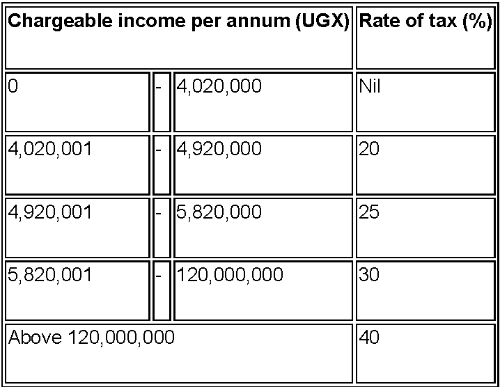
- Revising the income tax rates applicable to resident individuals as follows:
Indirect taxes
- Increase the annual VAT registration threshold from UGX150-million to UGX250-million;
- Exempting a designated person from the application of VAT withholding where payment for taxable supplies is made and is issued with an e-invoice or e-receipt;
- Expanding the list of exempt supplies to include the supply of nuclear energy;
- Expanding the list of exempt organisations to include BADEA;
- Including the Uganda Virus Research Institute and London School of Hygiene and Tropical Medicine (MRC/UVRI) and LSHTM) Uganda Research Unit as an alternative to Medical Research Council under the list of exempt organizations eligible for tax refund; and
- Allowing a credit for input tax in respect of civil works, services for feasibility study, design, construction or locally produced construction materials not available on the local market to a taxable person who develops only a hotel or tourism facility and invests:
- at least USD10-million (for a foreigner); and
- at least USD5-million (for a Ugandan citizen) provided that the supply of services or goods occurred not more than two years prior to the date of commissioning of the hotel or tourism facility;
- Disallowing input tax credit in respect of a taxable person supplying software except imported software;
- Reducing the value threshold for electronic receipts from UGX5-million to UGX2-million for a taxable person eligible for a tax refund;
- Revising the rate of lotteries and gaming tax for gaming and betting activities from 20% to 30%;
- Requiring financial institutions or persons carrying on lending business to file stamp duty tax returns;
- Requiring stamp duty-related records to be maintained for a period of at least five years;
- Increasing the stamp duty rate on transfers from 1.5% to 3% with the exception of transfers for motor vehicles;
- Increasing the surcharge on imported used clothing levied under the External Trade Act from 15% to 30%;
- Excluding essential medicines, vaccines and agricultural inputs from import declaration fee and infrastructure levy;
Tax administration
- Waiving any taxes including penal tax and interest owed by a taxpayer since 30 June 2016 and is still outstanding up to 1 July 2026;
- Amending the penal tax relating to electronic receipting and invoicing as follows:
- The penalty charged to a taxpayer for not using an electronic fiscal device ranges from an amount equivalent to double the tax due on the goods and services to an amount equivalent to double the tax due on the goods or services, or UGX200 000, whichever is higher; and
- the penalty charged on a taxpayer who does not issue an e-invoice or e-receipt for goods and services, or who tampers with an electronic fiscal device ranges from an amount equivalent to double the tax due on the goods and services, to an amount equivalent to double the tax due on the goods or services, or UGX200 000, whichever is higher.
ZAMBIA: Supplies of diesel and petrol temporarily zero-rated for VAT
During a special Cabinet meeting on 31 March 2026, the Zambian government has temporarily zero-rated VAT on supplies of petrol and diesel from 1 April 2026 to 30 June 2026. The zero-rating is implemented by the VAT (Zero-Rating) (Amendment) Order 2026. In addition to VAT zero-rating, excise duty on petrol and diesel is suspended during the same period.
The content of this article is intended to provide a general guide to the subject matter. Specialist advice should be sought about your specific circumstances.
[View Source]