

- in United States
- within Energy and Natural Resources topic(s)
- with readers working within the Oil & Gas industries
- within Energy and Natural Resources, Finance and Banking and Environment topic(s)
- in United States
The Nigerian Upstream Petroleum (Commercial) Regulations, 2025 (the "Commercial Regulations"), issued further to the Petroleum Industry Act ("PIA") establish a framework for regulating and approving the commercial aspects of upstream petroleum operations to ensure transparency, efficiency, and consistency in the commercial decision-making processes of upstream activities.
The Commercial Regulations apply to upstream licenses and leases: (i) granted under the PIA, particularly in relation to the approval of commercial components of Field Development Plans, Annual Work Programmes, and Status Reports; and (ii) preserved under the PIA, with similar requirements for commercial approvals.1 The key provisions:
Field Development Plan and Phase Development Plan
An application for approval of a Field Development Plan (FDP), Phase Development Plan (PDP), or any amendments must include the scope and work breakdown structure of the plan, detailed schedules of work activities, deliverables, and milestones. It must also present projected annual hydrocarbon production and price estimates for various products such as crude oil, condensates, associated and non-associated gas, and other natural gas liquids.
Additionally, the application must include a class 3 cost estimate (ranging from -10% to +20%) covering acquisition, royalties, production, operating, decommissioning, financing, depreciation, and capital costs, along with a commercial evaluation to ensure the plan supports maximum economic recovery.2
Approval will be based on the cost estimates within the specified project gate ranges and an assessment confirming the plan yields maximum economic recovery with a positive return on investment. This includes evaluating projected revenues and expenditures against hydrocarbon sales forecasts and benchmarking against similar projects and best practices.
Economic feasibility is further assessed using metrics such as Economic Value Added (EVA), Net Present Value (NPV), Internal Rate of Return (IRR), Break-even Analysis, and Return on Investment (ROI). Furthermore, any project execution activities must be accompanied by a project status summary, and any cost overrun beyond the pessimistic estimate will require prior approval through a plan amendment. 3
Submission and Approval of Annual Work Programme and Status Report
Licensees and lessees are mandated to submit an Annual Work Programme and Status Report to the Commission each year for approval, with submissions to be made between 15th October and 16th November, in the approved format and accompanied by the applicable fee4 .
Approved work programmes are valid from 1st January to 31st December of the corresponding year. For joint licenses or leases, the designated operator is responsible for submitting on behalf of all parties.5
No operational activity may be undertaken unless it forms part of an approved Work Programme. However, in emergency situations relating to health or safety, activities may proceed without prior approval, provided the Commission is notified within 48 hours and a formal amendment request reflecting cost implications is submitted thereafter.6
Contents of Annual Work Programme and Status Report Application
Any application for the approval of an Annual Work Programme and Status Report must include a detailed list of planned activities for the year, such as host community development, recruitment and manpower development, and other operational tasks along with commencement dates, timelines, cost estimates, and a work breakdown structure. Applicants must also provide a list of required regulatory approvals from the Commission and other relevant agencies, as well as a Status Report on the previous year's performance in the prescribed format and accompanied by the supporting documentation.7
The Commission shall approve an Annual Work Programme and Status Report before January 1st of the relevant year, provided it is commercially and economically viable, operationally feasible, environmentally sustainable, compliant with occupational safety and health regulations, and the licensee or lessee has fulfilled financial and ownership disclosure obligations. To determine commercial and economic viability, the Commission will assess whether the cost estimates align with established benchmarks, ensure optimal government benefit and acceptable investor returns, and fall within the authorized class 3 project gate range of -10% (optimal), base case, and +20% (pessimistic), with any excess requiring a new plan and separate approval.8
Modification of an Approved Annual Work Programme and Status Report9
An approved Annual Work Programme and Status Report may be modified either by the licensee or lessee, before or after commencement, or at the directive of the Commission. If initiated by the licensee or lessee, a formal application must be submitted at least 30 (thirty) days before the intended implementation, including payment of the applicable fee and justification for the changes. If initiated by the Commission, the licensee or lessee must either implement the directed changes or propose an acceptable alternative within 30 (thirty) days, with no fee required.
If the Commission fails to respond within 30 (thirty) days of receiving the application, the modification is deemed approved. The Commission may disapprove of an application, in which case it must provide written reasons and may require resubmission within a specified time, subject to payment of new application fees.
Half-Yearly Reporting Obligations
Licensees and lessees are required to submit a half-yearly report to the Commission, providing an update on the implementation status of the approved Annual Work Programme.10 The report must disclose any significant incidents such as accidents, environmental events, or safety-related occurrences along with the measures taken to manage, mitigate, or remedy such incidents.
Sanctions and Penalties
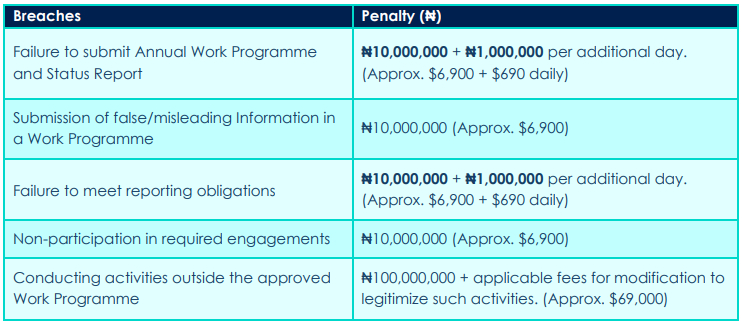
Where a licensee or lessee is found to be in breach of the Work Programme regulations, the Commission may either issue a written warning outlining the breach and required corrective actions or impose an administrative penalty. Specific breaches attract defined penalties set out below:11
Application Review
A licensee or lessee has the right to request a review of the Commission's decision concerning an Annual Work Programme and Status Report by submitting a written application within 30 (thirty) days of receiving the decision. The Commission is required to assess the application, ensuring it complies with regulatory standards, and must issue a written response within 30 (thirty) days. The decision made upon review is considered final, though it does not affect any other legal rights the licensee or lessee may have.12
Footnotes
1 Regulation 2 of the Commercial Regulations.
2 Regulation 3(1) of the Commercial Regulations.
3 Regulation 3(2) & 4 of the Commercial Regulations.
4 Regulation 5(1) – (3) of the Commercial Regulations.
5 Regulation 5(6) & (4) of the Commercial Regulations.
6 Regulation 5(8) of the Commercial Regulations.
7 Regulation 6(1) of the Commercial Regulations.
8 Regulation 7 of the Commercial Regulations.
9 Regulation 8 of the Commercial Regulations.
10 Regulation 10(1) of the Commercial Regulations.
11 Regulation 17 of the Commercial Regulations.
12 Regulation 18 of the Commercial Regulations
The content of this article is intended to provide a general guide to the subject matter. Specialist advice should be sought about your specific circumstances.

