

- within Corporate/Commercial Law topic(s)
- in United States
- within Compliance and Strategy topic(s)
Middle Eastern M&A held up relatively well through the U.S./Iran conflict, with transactions delayed rather than abandoned. Ongoing relations between the U.S. and Iran will continue to influence activity, including among sovereign investors.
In brief
Deal activity slowed in Q2 2026 against a backdrop of ongoing conflict in the region, although the impact was selective; retail, FMCG, hospitality and tourism were most affected, while defense tech and strategic buyer activity stayed robust.
In the UAE investment levels remained comparatively strong against recent historical benchmarks.
Sovereign investors continue to provide structural support, using long-term mandates and capital deployment to sustain regional growth and investment.
If stability holds, paused deal processes, intra-regional investment and IPO pipelines are expected to restart quickly.
Conflict delays, rather than derails, Middle East transactions
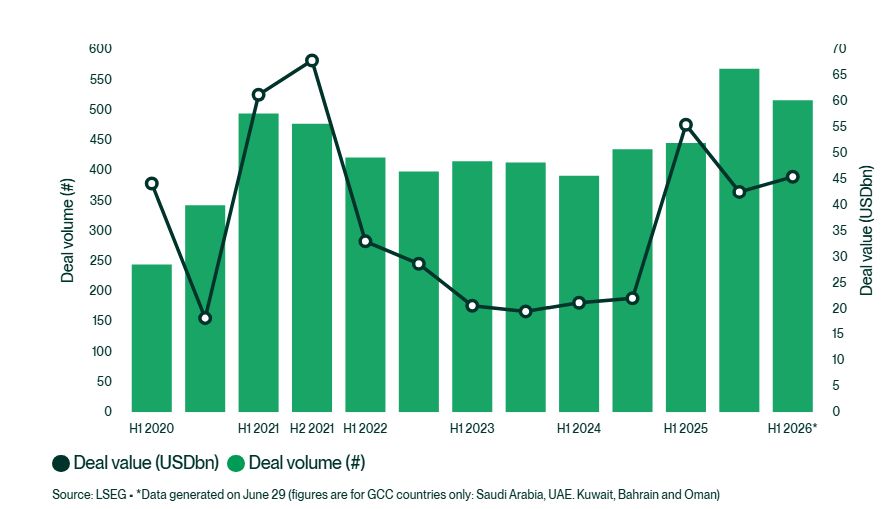
M&A activity in the Middle East across the first half of the year was remarkably resilient, totaling USD45.4 billion across 516 transactions. Volumes were down slightly on the previous half-year period, but deal values were broadly consistent with the total for the second half of 2025 despite the backdrop of the U.S./Iran war.
The overriding response to the conflict in the region was one of patience; few deals, if any, were terminated, with longer timelines the primary consequence. With that said, activity was up in Q2 compared to Q1, and was the third-highest quarterly total since 2021.
The year began with significant momentum, carrying a strong finish to 2025 into a busy period in January. From then, however, deals moved more slowly, with parties hitting pause in the hope of a resolution to the conflict.
Dealmaking in consumer-facing sectors saw biggest contraction
The impact of the conflict on dealmaking through H1 was sector-specific, not market-wide. The more pronounced disruption hit some infrastructure deals coming to market and retail and FMCG transactions. Consumer-focused assets, particularly in hospitality and tourism, were the clearest area of slowdown, while interest in defense tech assets remained robust.
Even within that, however, U.S. and international strategic buyers continued to transact despite the prevailing uncertainty, and several high-profile private equity deals were announced.
UAE activity remains robust despite headwinds
UAE M&A proves remarkably resilient amid military strikes
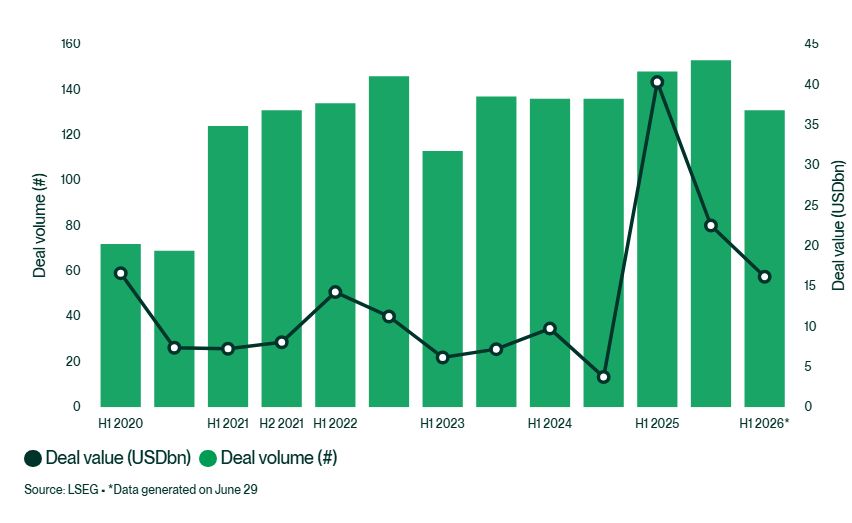
At a country level, the UAE was one of the strongest-performing markets despite the prevailing headwinds. While M&A value was down 28% vs h3 2025 to USD16.2bn, this figure is still the fourth-highest half-yearly total since 2020. Inbound investment was also up more than 167% to USD12.3bn compared to the previous six-month period.
Sovereign investors provide structural support
The fact that Middle Eastern M&A held firm can in part be explained by the long-term strategies of the region’s sovereign investors, which provide a degree of structural insulation from short-term geopolitical shocks. Funds such as the Saudi Public Investment Fund (PIF) and Abu Dhabi’s tech- and AI-focused MGX operate under decades-long mandates to diversify their national economies away from oil and gas.
Their investments outside the region into AI and digital infrastructure have continued throughout the year. Both PIF (via its AI-focused fund HUMAIN) and MGX invested in xAI ahead of its merger with SpaceX (with PIF also reportedly placing a large order for shares in SpaceX’s IPO), and have continued to target data center deals across the world.
The region’s sovereigns also view their continued investment as a way to sustain capital flows, deploying capital globally as a way to encourage foreign investment into the region. The Middle East remains an attractive destination for inbound investors, and reciprocal knowledge and technology transfer is a notable feature of these deals.
Capital pivots toward regional resilience
Looking ahead, we expect a deliberate shift toward strategic intra-regional investment aimed at shoring up domestic resilience, some of which will flow directly into oil and gas infrastructure damaged during the conflict.
Regional businesses are responding with the same agility, pivoting to hedge their exposures and shore up revenues. Some energy companies, for instance, are exploring outbound investments into the United States as a response to the revenue pressure they face in response to heightened tensions locally.
IPO pipeline poised to reopen
The Middle Eastern IPO pipeline similarly contracted during the conflict. However, even at the height of the disruption, several IPOs progressed, including the upcoming listing in Oman of Omifco, an Omani-Indian fertilizer business located outside the blockaded area around the Strait of Hormuz.
The content of this article is intended to provide a general guide to the subject matter. Specialist advice should be sought about your specific circumstances.
[View Source]