

The electronics and semiconductor industry presents a significant opportunity for India to capitalise on its inherent economic strengths, such as its R&D focus, robust logistics and supply chain, a readily available talent pool in the tech, AI, cloud computing and IoT space, component raw materials, and a vast pool of MSME component suppliers. Strategically calculated initiatives to exploit these strengths can enable India to emerge as a dominant player in the field and offset the geopolitical risk posed by the concentration of the sector’s supply chain in certain countries.
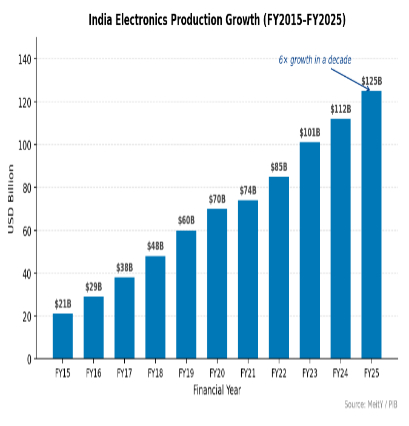
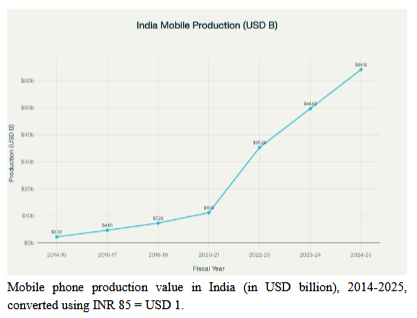
It is notable that India’s electronics production expanded from USD 21bn (2014–15) to USD 125bn (2024–25), while semiconductor investments under the India Semiconductor Mission (ISM) reached approximately USD 18bn across 10 approved projects.1
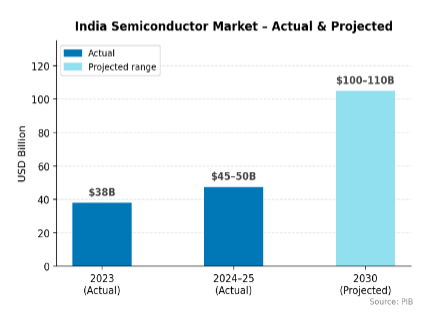
In a significant indicator of future potential, the size of the Indian semiconductor market grew from about USD 38bn in 2023 to USD 45-50bn in 2024-2025 and is expected to reach USD 100- 110bn by 2030.2
In this paper we examine the regulatory architecture applicable to India’s electronics system design and manufacturing (ESDM) sector, assess its outcomes, and propose legal and policy reforms to address residual structural constraints.3
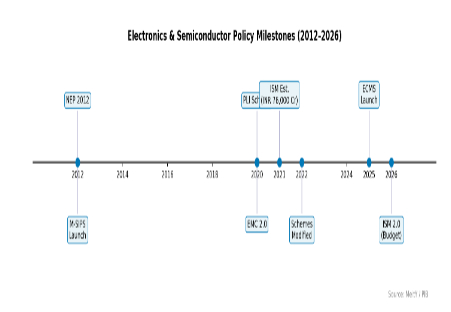
PART I Electronics and Electronics Component Manufacturing: Policy Landscape
Key Policy Initiatives
National Electronics Policy (2012)
The National Electronics Policy 2012 targeted a 20% global electronics manufacturing share by 2020, emphasising mobile phones and consumer electronics. However, the objective appears to have been only partially met, as the capital subsidies disbursed post-investment created cash- flow constraints and most foreign OEMs use India primarily as a low-cost assembly hub.
Modified Special Incentive Package Scheme (M-SIPS) (2012-2018)
M-SIPS provided a 20% capital subsidy for greenfield and 15% for brownfield electronics manufacturing projects, with an additional 5% for SEZ investments. The scheme required two-stage approval through MeitY, with subsidy disbursement only after project completion and statutory auditor verification, creating significant cash-flow constraints for beneficiaries. M-SIPS received applications across 22 states with INR 1.26 lakh crore in committed investment, but its limited contribution to component ecosystem development, led to its replacement by the output-linked PLI framework in 2020.4
Production Linked Incentive (PLI) Scheme (2020)
Launched in April 2020, the scheme covers large- scale electronics manufacturing, cellphones, IT hardware, telecom and networking products, LEDs, and other white goods through a 4-6% incentive on incremental sales (against a base year) for a 4-6 year period.5
Disbursement Process:
- Applications are submitted via a dedicated portal and undergo initial scrutiny by Ministry of Electronics and Information Technology (MeitY)’s Project Management Agency (PMA) within 15 working days of submission of the application.
- The Approval Committee evaluates applications and recommends approvals to the Competent Authority (Minister-in- Charge), with final selection to be completed within 60 days of the application window closure.
- Incentive claims are filed annually or quarterly post-achievement of incremental sales targets, verified by statutory auditors or independent chartered accountants, and reconciled by the PMA before disbursement.6
As of the latest available data, over 800 projects have been approved with a total committed investment of approximately INR 1.97 lakh crore.7
Electronics Component Manufacturing Scheme (ECMS) (2025)
ECMS was launched in April 2025 with an outlay of INR 22,919 crore and a 6-year tenure plus 1- year gestation period (i.e., from FY2025-26 to FY2031-32).8 The scheme targets upstream components, multilayer PCBs, camera modules, copper laminates, through a hybrid incentive structure combining turnover-linked and capex-linked support.9 The Union Budget (FY2026–27) has increased the ECMS outlay to INR 40,000 crore from INR 22,919 crore.10
Incentive Conditions and Process:11
- Beneficiaries receive a 4-6% incentive on incremental turnover over a defined base year, calculated annually for six consecutive financial years.
- For certain target segments (SMD passive components, supply chain components, and capital goods), an additional 25% capital subsidy is provided on eligible capital expenditure.
- Investment thresholds vary by product category: ranging from INR 100mn for supply chain components to INR 5bn for lithium-ion cells.
- The scheme adopts a “first-come, first- served” model for incentive distribution, with applications evaluated on an ongoing basis and disbursements proceeding as per approved milestones.12
The scheme received an overwhelming response at launch, with applications for investments representing approximately USD 13bn, nearly double the original target.13 As of the latest available data, MeitY has approved twenty-four ECMS projects with cumulative investments of approximately USD 1.53bn.14
Electronics Manufacturing Clusters 2.0 Scheme (EMC 2.0) (2025)
The Modified Electronics Manufacturing Clusters (EMC 2.0) Scheme was notified in April 2020 with a budgetary outlay of INR 3,762 crore and provides financial assistance of up to 50% of project cost (capped at INR 70 crore per 100 acres, with an overall ceiling of INR 350 crore per project) as financial assistance, which is disbursed in installments upon achievement of specified milestones.15
EMC 2.0 supports plug-and-play infrastructure (power, water, roads, factory sheds) within designated electronics parks. As of November 2025, 11 EMCs and 2 common facility centers across 10 states had been approved, covering 4,399 acres with projected investments of INR 1.46 lakh crore and estimated employment of 180,000 jobs.16
The scheme’s decentralised structure allows state governments, state industrial agencies, central/state PSUs, and industrial corridor development corporations to apply as Project Implementing Agencies, giving flexibility to identify and designate suitable industrial areas based on local anchor unit commitments and regional industrial development priorities. Minimum land requirements are set at 200 acres (100 acres for North-Eastern and hill states/UTs), with anchor units committing to acquire at least 20% of saleable land and investing a minimum of INR 300 crore (INR 150 crore in NE/hill regions), ensuring equitable regional distribution of electronics manufacturing capacity.17
Increase in Exports
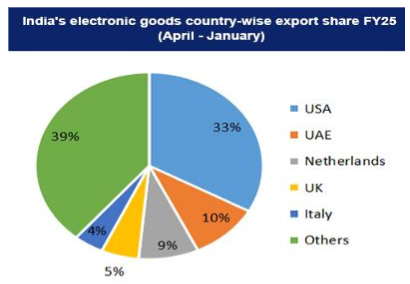
The electronics export market has witnessed an eight-fold increase in the period between 2014-15 and 2024-25, with an additionally impressive 47% year-on-year growth seen in Q1 FY26.18 Key export products include mobile phones, solar modules, networking devices, consumer electronics, and auto electronics. Primary export destinations span the Middle East, Africa, and Europe.19
Cellphone Manufacturing
India’s cellphone20 manufacturing sector now boasts 300+ manufacturing units producing 330mn phones annually, making it the world’s second-largest manufacturer of cellphones.21 Q2 FY26 saw India overtake China to become the top smartphone exporter to the United States, in part because of the shift in iPhone manufacturing supply chains.22
Footnotes
1 https://www.newindianexpress.com/business/2025/Aug/12/india-approves-four-new-semiconductor-projects-worth-rs-4600-crore-first-chip-likely-this-year; https://www.pib.gov.in/PressReleasePage.aspx?PRID=2155456
2 https://www.pib.gov.in/PressNoteDetails.aspx?NoteId=154968&ModuleId=3®=3&lang=1
3 https://evertiq.com/news/2025-10-14-indias-electronic-production-soars-to-140-billion-in-2024-25; https://www.pib.gov.in/PressReleasePage.aspx?PRID=2183028
5 https://www.rsm.global/india/insights/tax-insights/pli-scheme-in-india; https://www.meity.gov.in/static/uploads/2024/02/Frequently_Asked_Questions_on_PLI_Scheme.pdf
6 https://www.meity.gov.in/static/uploads/2024/02/Frequently_Asked_Questions_on_PLI_Scheme.pdf
7 https://www.pib.gov.in/PressNoteDetails.aspx?id=155082&NoteId=155082&ModuleId=3
8 https://www.pib.gov.in/PressReleasePage.aspx?PRID=2183028
10 https://www.pib.gov.in/PressReleasePage.aspx?PRID=2221522®=3&lang=1
11 https://www.pib.gov.in/PressReleasePage.aspx?PRID=2116172
12 https://www.pib.gov.in/PressReleasePage.aspx?PRID=2174192
15 https://www.meity.gov.in/static/uploads/2024/02/Final-Guidelines-of-EMC-2.0-Scheme-31st-May-2020.pdf.
16 https://www.pib.gov.in/PressReleasePage.aspx?PRID=2205046®=3&lang=1
17 https://www.meity.gov.in/static/uploads/2024/02/EMC-2.0-Guidelines-Presentation.pdf
18 https://economictimes.com/news/economy/foreign-trade/indias-electronics-export-surged-47-in-q1-2025-26-piyush-goyal/articleshow/123334023.cms; https://timesofindia.indiatimes.com/business/india-business/make-in-india-milestone-electronics-exports-jump-47-in-q1-99-of-mobiles-now-made-domestically/articleshow/123335165.cms; https://ibef.org/exports/electronic-and-computer-software-industry-in-india
19 Graphic source: https://www.ibef.org/exports/electronic-and-computer-software-industry-in-india
20 Graphic Source:https://www.pib.gov.in/PressReleasePage.aspx?PRID=2177755
21 Id.
22 Id.
To view the full article click here
The content of this article is intended to provide a general guide to the subject matter. Specialist advice should be sought about your specific circumstances.
[View Source]