On 1 October 2026, the Federal Act on Transparency of Legal Entities and the Identification of Beneficial Owners (“LETA”, BBl 2025 2900) entered into force. This new legislation contemplates several important developments: It introduces a centralized federal register of beneficial owners of legal entities paired with a duty for both controlling shareholders and the beneficial owner to report the identity of the beneficial owner to the legal entity. This Advestra Insight presents an overview of the requirements applicable to legal entities and their shareholders under the new LETA
I. Overview
The LETA provides for the introduction of a centralized federal register of beneficial owners (the “Transparency Register”), which will give certain authorities and financial intermediaries access to information about the beneficial owners of legal entities within its scope.
To ensure that the content of the Transparency Register is complete, the LETA introduces new obligations of legal entities, shareholders, partners and beneficial owners.
In addition, it provides for duties for Swiss trustees, who are not already subject to licensing under the Federal Act on Financial Institutions of 15 June 2018 (SR 954.1; “FinIA”) and the KYC duties of AMLA, to identify the beneficial owners of a trust (as defined under the LETA).
II. Personal Scope of Application
The LETA applies to:
- companies limited by shares (Aktiengesellschaft),
- partnerships limited by shares (Kommanditaktiengesellschaft),
- limited liability companies (Gesellschaft mit beschränkter Haftung),
- cooperatives (Genossenschaften),
- investment companies with a variable capital (SICAV),
- investment companies with a fixed capital (SICAF) and
- limited partnerships for collective investment (Kommanditgesellschaft für kollektive Kapitalanlagen) (article 2 (1)(a) LETA).
In addition to Swiss entities, the LETA also applies to legal entities incorporated under foreign law:
- with a branch in Switzerland which is registered in the commercial register,
- whose place of effective management is in Switzerland, and
- who own or have undertaken to acquire real property in Switzerland (article 2 (1)(b) LETA).
By contrast, the LETA excludes from its scope of the statute:
- listed entities as well as companies who are controlled by more than 75% by one or more listed entities,
- occupational benefits institutions, and
- legal entities that are held by more than 75% by corporations under public law (article 3 LETA).
Similarly, associations (Vereine) and foundations (Stiftungen), as well as registered and limited partnerships organized under Swiss law are out of scope of the LETA (article 2 (1)(a) LETA a contrario). This exemption does not, however, apply to similar foreign legal entities which remain fully in scope of article 2 (1)(b) LETA.
Finally, the law also requires trustees with their seat or domicile in Switzerland or who manage trusts in Switzerland to identify the beneficial owner of the trust, unless they are already subject to the AMLA (article 2 (2) LETA). However, trustees will not be required to register their beneficial owners in the Transparency Register but will be required to maintain information available upon request of the authorities.
III. Definition of Beneficial Owner and Control
1. General Principle
The purpose of the LETA is to provide a legal framework to identify and register beneficial owners of legal entities in a Transparency Register and, to a lesser extent, ensure that all trustees are subject to a duty to identify their beneficial owners. Ultimately, the goal is to improve the anti-money laundering tools in line with the recommendations of the Financial Action Task Force as well as facilitate the implementation of the common reporting standard and improve tax compliance more in line with the recommendations of the Global Forum on Transparency and Exchange of Information for Tax Purposes.
Overall, the term “beneficial owner” plays a key role in the framework. Article 4 (1) LETA follows the same structure as existing corporate law requirements that it supersedes. It defines the beneficial owner of an entity as the individual (i.e., the natural person) who ultimately controls an entity by either (see figure 1):
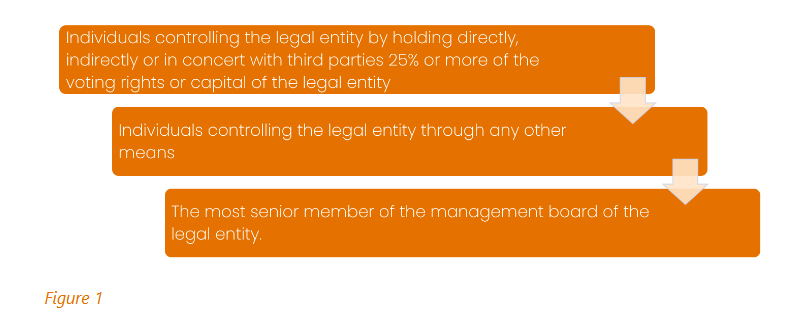
- holding, directly or indirectly, alone or in concert with third parties, at least 25% of the capital or voting rights in that entity or
- controlling it in any other way (article 4 (1) LETA).
By setting a threshold at 25% of the capital or voting rights, this definition allows legal entities to have more than one beneficial owner, even if the beneficial owners do not act in concert with each other.
By contrast, the term control implies an exclusive dominion that may be exercised directly, indirectly or in concert with other persons. Therefore, only one person or group of persons acting in concert may control a legal entity.
As a fall back, if no natural person controls a legal entity, the most senior member of the management body of the entity (article 4 (2) LETA)., e.g. the CEO of a company limited by shares, which delegated day-to-day management, is deemed to be the beneficial owner (article 20 (3) LETO).
Exceptionally, if the legal entity is in liquidation or in a composition proceeding, the liquidator or administrator will be the beneficial owner. This also holds when the liquidator or administrator is a legal entity, in a rare exception to the rule that the beneficial owner should always be an individual (article 20 (3) LETO).
2. Direct Participation
A direct participation arises whenever shares or voting rights are not held through one or more individuals, legal entities or trusts (article 1 (1) LETO). It is deemed to confer control to the beneficial owner whenever it extends to 25% of more of the voting rights or capital (article 1 (2) LETO). Under such circumstances control is deemed to exist by law, irrespectively of the actual ability to exercise control over the legal entity.
To view the full article click here
The content of this article is intended to provide a general guide to the subject matter. Specialist advice should be sought about your specific circumstances.
[View Source]