
Download a PDF copy of this Blog here.
Forced-labour compliance has been a growing issue for Canadian importers for several years. While Canada already has import restrictions on forced-labour products in place, the federal government is now looking to strengthen that regime further — this time under U.S. tariff pressure.
On June 2, 2026, the United States Trade Representative (“USTR”) announced that Canada had failed to effectively enforce prohibitions on goods made with forced labour. Accordingly, the USTR has proposed an additional 10% tariff on goods from Canada.
In response, Canada has indicated that new legislation will soon be introduced to make that regime even stronger. For importers, this is a clear signal that the forced-labour rules may become stricter.
Canada’s Forced-Labour Import Regime
Canada has prohibited the importation of goods made by forced labour since July 1, 2020. This prohibition was introduced following the renegotiation of the North American Free Trade Agreement.
In January 2024, the Fighting Against Forced Labour and Child Labour in Supply Chains Act introduced annual reporting requirements for certain entities on their efforts to address forced-labour risks in their supply chains. Most recently, Bill C-251 proposed to further expand import restrictions by creating a presumption against the importation of goods from designated countries and regions.
Lack of Enforcement? – Trump Administration’s Concerns
Despite this framework, the Trump administration is concerned that Canada has not done enough to enforce its forced-labour rules at the border. The USTR notes that Canadian authorities have intercepted only 50 shipments on suspicion of forced labour since 2020, with only two ultimately prohibited from entry. On that basis, the USTR has proposed an additional 10% tariff on goods from Canada, taking the position that weak enforcement disadvantages American workers.
Where is the truth in the matter? It is difficult to say, but it is fair
to say that both sides have some responsibility attached to their respective positions. Has Canada been sliding on strict enforcement of these rules? Probably yes. Has the Trump administration also used this issue to gain a negotiating advantage in the Canada-United States-Mexico Agreement review process? Probably yes.
Either way, the pressure is now pushing Canada toward stronger forced-labour import measures – which cannot be a bad thing!
What Canada May Do Next on Forced-Labour Imports?
Prime Minister Carney has indicated that Canada intends to introduce new legislation before June 19, 2026, to strengthen its forced-labour regime.
At this stage, it remains unclear what the new legislation will contain. What appears clear, however, is that more stringent measures are coming. Importers should be alert to these developments and begin considering whether their current supply-chain controls and compliance records are sufficient.
Takeaways
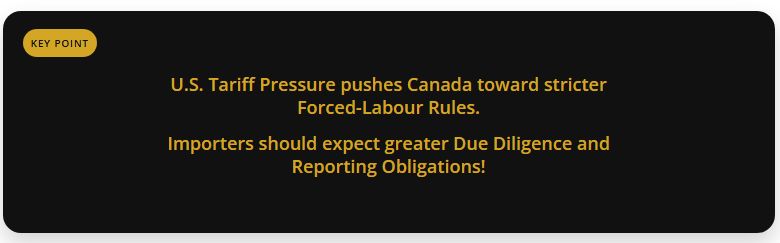
Although Canada already has a strong forced-labour regime, the proposed 10% U.S. tariff has put pressure on Canada to move in a stricter direction.
While the content of the upcoming legislation remains to be seen, importers should expect greater scrutiny of forced-labour risks and be ready to review their supply chains and compliance records.
For help with Forced Labour Imports, please click here.
The content of this article is intended to provide a general guide to the subject matter. Specialist advice should be sought about your specific circumstances.
[View Source]