

In short
Energy and water hardship has become more widespread. To rebuild customer trust, utilities need to move beyond reactive support and rethink their operating model, customer pathways and cross-sector partnerships centred on vulnerability.
Cost-of-living pressures continue, with around 1 in 51 Australian households experiencing, or at risk of, energy hardship. Of those, average energy debt sits at $2,3142 for customers with both electricity and gas. Beyond financial pressures, customer vulnerability is also shaped by how effectively the sector can support different demographics, cultural backgrounds, housing, wellbeing and safety needs. As vulnerability becomes more prevalent and systemic, the industry’s response remains largely reactive, and compliance driven. The conversation needs to shift towards building a sustainable, affordable and resilient ecosystem that works better for customers.
What does this mean in practice for utility organisations and the ecosystem?
Addressing utility hardship requires change at multiple levels of the ecosystem, often simultaneously rather than sequentially. Utility organisations can drive change at three different levels:
1. Within an organisation: Design operating model around customer vulnerability
Supporting vulnerable customers starts with an organisation’s internal capability, culture and processes, ensuring people, systems and decisions can consistently respond with empathy, fairness and effectiveness. When organisations design services around the realities customers face, the benefits are felt more consistently and sustained over the long term.
In practice, this is shifting:
- From interventionprograms to core business
- From arrears-based triggers to early interventions
- From compliancemetrics to customer outcomes
A leading example of this is Victorian water utility, Yarra Valley Water3, that demonstrates what it looks like to move customer vulnerability from the margins of an organisation into its core business. The focus is on customer vulnerability as a strategic organisational issue rather than a compliance obligation. The result is an operating model that is focused on preventing financial distress and improving customer wellbeing, rather than simply managing debt once it occurs.
The implication:
Organisations that embed customer vulnerability into their processes, pricing and operations will be better placed than those who treat hardship as the responsibility of a dedicated hardship strategy and team.
2. Working together: Deliver outcomes no single organisation can achieve on its own
Many of the drivers of utility hardship sit beyond the reach of any one organisation. Customers need retailers, networks, community organisations and government services to work together to deliver outcomes that are impossible through standalone programs.
Utility organisations could start shifting:
- From referring customers to jointly supporting them
- From organisation-specific programs to shared solutions
- From individual accountability to shared outcomes
An inspiring example is New Zealand energy retailer, Nau Mai Rā 4, that demonstrates how collaboration between retailers and electricity generators can deliver better outcomes for customers. The Pool of Power is a supply agreement that is designed to deliver a care-based model for families in energy hardship – the first of its kind in New Zealand.
The implication:
Collaboration should produce new products, services and customer pathways, rather than simply improving coordination of existing activities.
3. An ecosystem: Redesign the market, not just the response
The biggest opportunity for change sits beyond any single organisation or sector. Households don’t experience vulnerability in silos: they juggle stress on housing, energy, water and health at the same time. However, the support remains fragmented across essential services, social service, utilities programs, government programs, jurisdictions and federal regulatory frameworks.
The ecosystem needs to shift:
- From treating the symptom to root-cause response
- From energy-sector problem to cross-sector approach
- From individual products and services to sharedplatforms
A global example is, the Priority Services Register (PSR)5 in United Kingdom, which allows information about vulnerable households to be shared across retailers, networks and even water providers, creating coordinated support rather than fragmented interventions. The customer registers once, and data is shared across utilities and trusted partners to tailor the support for medical, social and accessibility needs. The UK’s broader Vulnerability Commitment goes further, requiring industry-wide collaboration, data use, and continuous improvement beyond regulatory minimum. Closer to home, Thriving Communities Australia6 demonstrates how utilities, financial services, government and community organisations can work across sector boundaries to improve support for people experiencing vulnerabilities.
The implication:
These examples show the potential to replace fragmented interventions with more connected customer pathways. Where ecosystems are redesigned, not just tweaked, outcomes materially improve for all parties.
What questions should utilities organisations be asking?
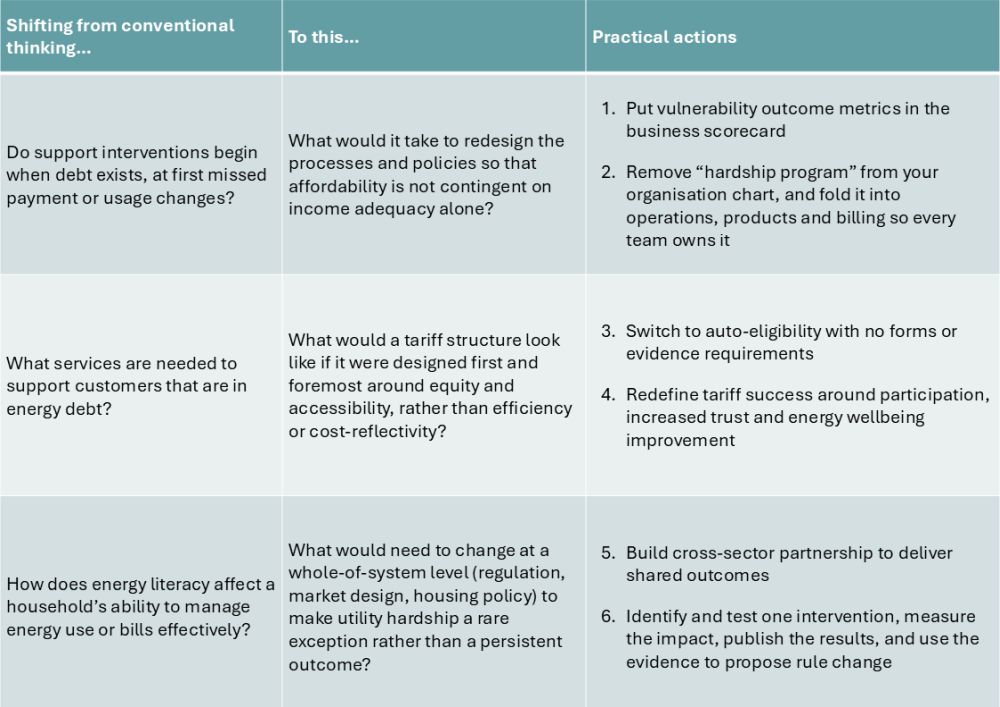
Adopting a system-thinking approach to create lasting change for vulnerable customers means understanding not only what the current model is designed to achieve, but also what it is achieving. Recognising challenges and barriers in the current model allows organisations to reframe customer vulnerability more effectively.
There are three questions utility organisations could start reflecting on to understand the system and drive sustained change. These questions are intended to challenge traditional assumptions about hardship and prompt a broader view of the factors driving it.
Where the sector goes next?
Cost-of-living pressures and climate-related challenges are likely to place further pressure on households as the energy transition continues.
Organisations that move beyond quick fixes and recognise the complexity of hardship will be best placed to drive meaningful and lasting change. No single retailer, network, regulator, government body, or community organisation can solve utility hardship alone, and none should try to. Addressing it requires collaboration across the entire sector and beyond.
Success should ultimately be measured by whether vulnerable customers achieve better outcomes: lower debt, greater stability and greater trust in the services they rely on. Regulators play a critical role in enabling this by setting the frameworks, incentives, and accountability mechanisms needed for collaboration at scale, while protecting customer outcomes.
The sector now needs practical models of support that work across organisations, not around them.
Anna Crowley, Associate Director in our Energy team, also contributed to this article.
Footnotes
1. ECA Report July 2025
2. AER Annual Retailer Markets Report 2025 – Combined Average Debt for Electricity and Gas
3. Yarra Valley Water – Outcomes Performance – 2024–25 Report
4. Māori Power Provider Reopens Doors After Securing Landmark Energy Deal – Waatea News
5. National Grid – Priority Services Register Promise
6. Thriving Communities Australia – Thriving Communities Australia
The content of this article is intended to provide a general guide to the subject matter. Specialist advice should be sought about your specific circumstances.
[View Source]
