
Article Summary
A commercial landlord in Queensland may have the legal right to lock a tenant out of leased premises for unpaid rent—but only where the lease grants a right of re-entry and the landlord has strictly complied with the requirements of the Property Law Act 2023 (Qld) and the lease itself. A lockout carried out without following the required statutory and contractual procedures may be unlawful and expose the landlord to significant liability.
For tenants, a commercial lease lockout can have immediate and serious consequences. Trading may cease without warning, valuable stock and equipment may become inaccessible, personal guarantees may be enforced, and financial exposure can continue long after possession of the premises has been lost. However, a lockout does not necessarily mean the end of the lease. In appropriate cases, Queensland courts have the power to grant relief against forfeiture and restore a tenant’s rights, provided urgent action is taken.
This guide explains when a commercial landlord may lawfully re-enter leased premises, the notice requirements that ordinarily apply before a lockout can occur, common mistakes made by landlords and tenants, the circumstances in which a lockout may be challenged, and the remedies available where a re-entry is unlawful. It also examines the relevant provisions of the Property Law Act 2023 (Qld) together with leading High Court authorities governing forfeiture, waiver, election and commercial lease termination.
Whether you are a landlord seeking to enforce your rights or a tenant facing the loss of your business premises, understanding the legal framework before taking action is critical. Early legal advice can often prevent costly mistakes, preserve valuable rights and significantly improve the prospects of achieving a favourable commercial outcome.
Commercial Lease Lockout in Queensland
A commercial landlord in Queensland may be able to lock a tenant out for unpaid rent, but only if the lease permits re-entry and any contractual and legal requirements have been properly followed. This is a critical issue because an unlawful commercial lease lockout can expose landlords to damages claims, while a lawful lockout may immediately prevent a business from trading and trigger ongoing liability for rent, damages, and personal guarantees. If you have missed rent payments, received a default notice, or have already been locked out, acting quickly is essential. Delaying may reduce your ability to challenge the termination or obtain relief against forfeiture through the Court.
If you are a landlord or tenant struggling with commercial lease disputes, contact us today for a free consultation with one of our experienced team of commercial lease dispute professionals.
Can a Commercial Landlord Lock You Out for Unpaid Rent in Queensland?
Business owners often ask whether a landlord can lawfully change the locks in specific situations. This scenario table answers common high-intent questions and simplifies a complex area of commercial leasing law.
| Scenario | Can the Landlord Immediately Lock Out the Tenant? | Comments |
| Rent overdue by a few days | Usually not immediately | A section 153 notice to remedy breach and any contractual notice or remedy period must ordinarily be satisfied before re-entry. |
| Rent overdue and contractual remedy period expired | Not necessarily | The landlord must also have complied with section 153 of the Property Law Act 2023 (Qld) and any other applicable requirements |
| Tenant disputes rent arrears | Not necessarily | Disputed arrears may affect termination rights |
| Required section 153 notice not issued | Usually no | Subject to limited exceptions, the landlord may not exercise a contractual right of re-entry without the statutory notice process |
| Landlord accepted rent after default | Depends | Acceptance before a section 153 notice may raise waiver or election issues; acceptance after the notice does not itself waive forfeiture, subject to any agreement to the contrary |
| Tenant already locked out | Court remedies may still be available | Relief against forfeiture may be considered |
Yes, a commercial landlord in Queensland may be entitled to peaceably re-enter leased premises and lock out a tenant for unpaid rent, but only where the lease grants that right and all contractual and legal requirements have been satisfied. Most commercial leases contain default clauses allowing the landlord to terminate the lease and re-enter if rent remains unpaid for a specified period.
Non-payment of rent is commonly treated as a serious breach of a commercial lease. In Progressive Mailing House Pty Ltd v Tabali Pty Ltd (1985) 157 CLR 17, Mason J reproduced the contractual re-entry provision which provided that upon specified defaults at [3]:
… the Lessor may at any time thereafter but without prejudice to any claim which the Lessor may have against the Lessee in respect of any breach of the covenants and provisions in this Lease on the part of the Lessee to be observed or performed either re-enter into and repossess and enjoy the Demised Premises as of its former estate … and thereupon this Lease shall absolutely determine …
The High Court recognised that a landlord’s right to re-enter depends upon the terms of the lease. Mason J noted that, traditionally, “a breach of a covenant by a lessee, even breach of the covenant to pay rent, conferred no right on the lessor to re-enter unless the lease reserved a right of re-entry” [39]. Where a lease contains such a clause, re-entry may permit the landlord to “re-enter into and repossess” the premises, following which “this Lease shall absolutely determine”. Commercial re-entry is therefore an example of forfeiture, being the landlord’s contractual right to terminate the tenant’s interest following default.
The Property Law Act 2023 (Qld) (“PLA”), which commenced on 1 August 2025, regulates the exercise of contractual rights of re-entry and applications for relief against forfeiture. Sections 153 to 159 prescribe requirements concerning notices to remedy breach, acceptance of rent, re-entry and possession, while sections 160 to 162 deal with applications for relief against forfeiture and the Court’s powers. Subject to limited statutory exceptions, these provisions apply to breaches of lease terms generally, including non-payment of rent.
In practice, whether a lockout is lawful usually turns on the lease wording, the nature of the breach, and whether the landlord has complied with all required preconditions before re-entry.
What Notices Must a Landlord Give Before Locking Out a Commercial Tenant?
Before a landlord takes possession under a commercial lease, the first issue is usually whether the lease and any required notice procedure have been followed. Tenants should review the alleged arrears, service method, remedy period, and re-entry clause before assuming the landlord is entitled to change the locks.
Is a Formal Breach Notice Always Required?
Generally, yes. Under section 153 of the Property Law Act 2023 (Qld), a landlord may exercise a contractual right to re-enter leased land for breach of a lease term only after giving the tenant a notice to remedy breach in the approved form, and the tenant has failed to remedy the breach, or pay any properly claimed reasonable compensation, within the reasonable period stated in the notice.
The statutory notice must identify the nature and extent of the breach. If the breach is capable of remedy, it must require the tenant to remedy it within a reasonable period. It must also state that the landlord intends to terminate the lease if the breach is not remedied, or any claimed reasonable compensation is not paid, within the stated period.
This statutory regime applies to rent defaults as well as other breaches. The lease may impose additional contractual requirements concerning notices, cure periods and service. A landlord must therefore comply with both the PLA and any applicable contractual preconditions.
Limited exceptions apply. For example, section 156 permits re-entry without a notice to remedy breach where the landlord reasonably believes that the tenant has given up possession of the premises.
Disputes frequently arise because the approved form was not used, the breach was inadequately described, the remedy period was unreasonable, the notice was served incorrectly, or the landlord acted before the statutory or contractual period expired. Non-compliance may invalidate the attempted re-entry and expose the landlord to claims for relief or damages.
What Happens When a Commercial Landlord Re-Enters the Premises?
The first 24 to 48 hours after a commercial lockout are often critical. Delays can increase business losses and reduce available legal remedies. This infographic provides a practical action checklist for tenants who have already been excluded from their premises.
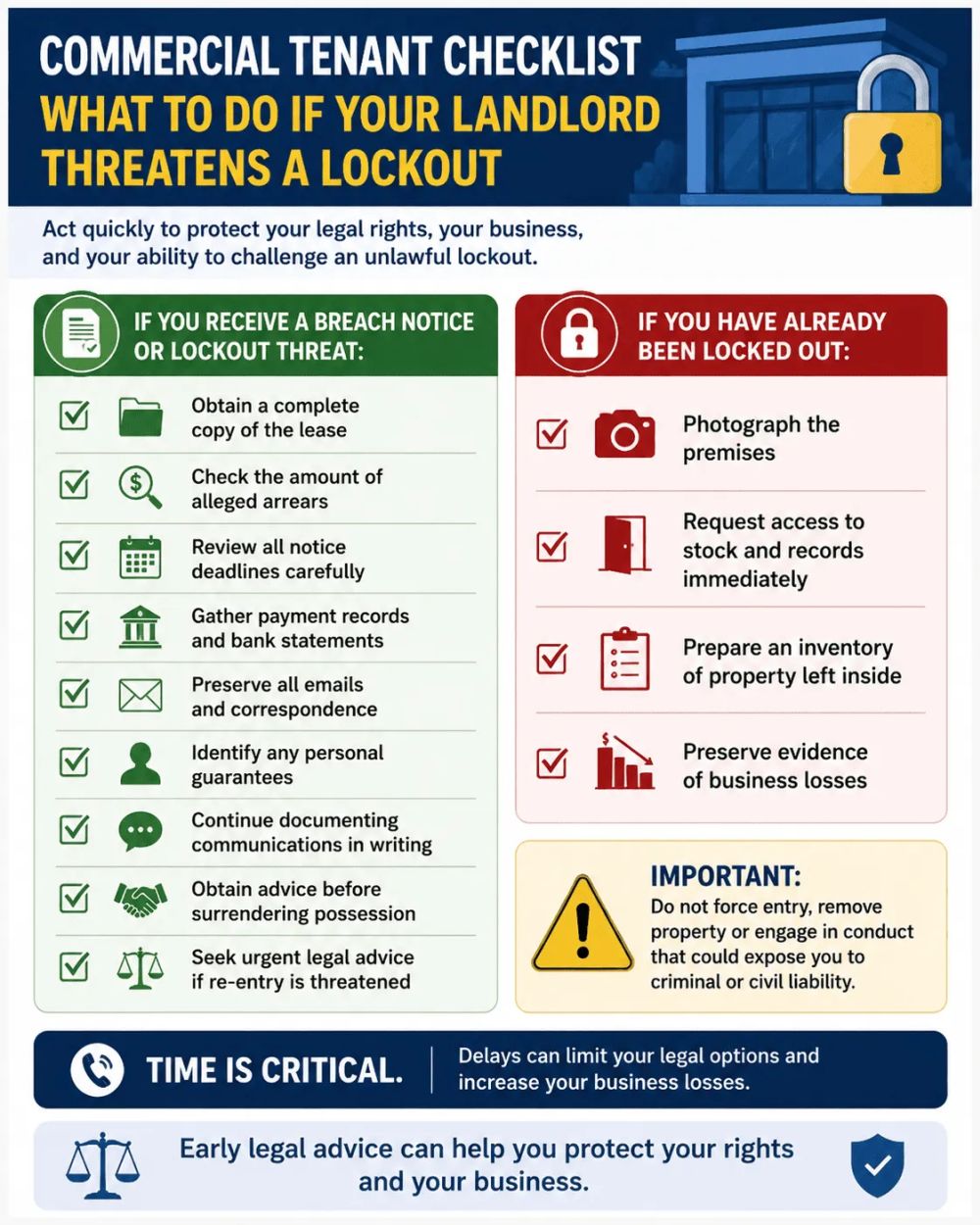
Once a landlord lawfully re-enters commercial premises, they will usually change the locks, secure the site, and take back possession on behalf of the landlord. In most cases, the tenant immediately loses the right to occupy the premises and trading operations cease.
A lockout does not necessarily end the tenant’s financial exposure. Businesses may still remain liable for unpaid rent, outgoings, make-good obligations, and, in some cases, damages arising from the early termination of the lease. Where a landlord has exercised rights of re-entry, understanding whether the lease has been validly terminated is critical, and our guide on terminating a commercial lease in Queensland explains the process in greater detail.
Directors who have provided personal guarantees may also remain personally liable. Business owners should carefully review any guarantee documents because personal guarantees can expose assets such as the family home, savings, and other personal property to recovery action. Our guide on personal guarantees explains which assets may be at risk if a business fails.
Practical problems commonly arise where stock, plant, equipment, or business records remain inside the premises. Tenants should act quickly to arrange access and document all communications with the landlord. Particular urgency may arise where perishable stock is involved.
In practice, disputes often develop over access arrangements, missing property, or the landlord’s handling of goods left on site. Early legal advice can help minimise business disruption and preserve valuable assets.
Can You Challenge a Commercial Lease Lockout?
Whether a commercial lease lockout is lawful often depends on a combination of lease terms, notices, and landlord conduct. The following table helps tenants quickly identify common warning signs that may indicate a lockout should be reviewed urgently by a lawyer.
| Issue | Lower Risk of Unlawful Lockout | Higher Risk of Unlawful Lockout |
| Lease Terms | Lease expressly permits re-entry for rent arrears | Lease contains no clear re-entry clause |
| Notices | Required notices properly issued | No notice issued or notice defective |
| Rent Arrears | Arrears clearly outstanding | Arrears amount disputed |
| Timing | Contractual remedy period expired | Landlord acted before remedy period expired |
| Landlord Conduct | Conduct consistently preserving the right to terminate | Conduct before the statutory notice that unequivocally affirms the lease, or conduct otherwise inconsistent with the alleged termination |
| Access | Landlord permits supervised access to retrieve property | Landlord refuses all access to stock or records |
Warning: A combination of higher-risk factors may indicate the lockout should be reviewed urgently.
When Might a Commercial Lease Lockout Be Unlawful?
A commercial lease lockout may be challenged where the landlord has not strictly complied with the lease or applicable legal requirements. In some disputes, tenants also allege that representations made during lease negotiations were inaccurate or misleading, and our article on misrepresentation in commercial contracts explains when those statements may give rise to legal remedies.
Common grounds include a failure to issue required notices, defects in the content or service of notices, disputed rent arrears, or re-entry occurring before any contractual cure period has expired.
Waiver and election may affect a landlord’s right to terminate, particularly where the landlord acts inconsistently with the continued existence of that right before giving a notice to remedy breach.
Australian courts have long recognised that a party who elects between inconsistent rights may lose the ability to change position later. In Sargent v ASL Developments Ltd (1974) 131 CLR 634, Stephen J explained that conduct amounting to an election must be “consistent only with the exercise of one of the two sets of rights and inconsistent with the exercise of the other”. Conduct undertaken with knowledge of the relevant facts may therefore affirm the continued operation of the contract and preclude reliance on an inconsistent right to terminate.
However, section 155 of the Property Law Act 2023 (Qld) now provides that, after a landlord gives a notice to remedy breach, acceptance of rent or another amount does not itself waive the landlord’s right to forfeit the lease because of that breach, subject to any agreement to the contrary. The timing of the payment, the terms on which it was accepted, the wording of the lease and notice, and the landlord’s other conduct must therefore be examined carefully.
In practice, lockout disputes are highly urgent. Business interruption losses can escalate quickly, particularly where staff, customers, stock, or trading income are affected. Prompt legal advice is often critical to preserve evidence, challenge the lockout, and consider urgent applications for relief.
Our commercial litigation lawyers regularly advise businesses involved in urgent commercial lease disputes, lockout disputes, and applications for relief against forfeiture.
Can the Court Order the Tenant Back Into the Premises After a Commercial Lease Lockout?
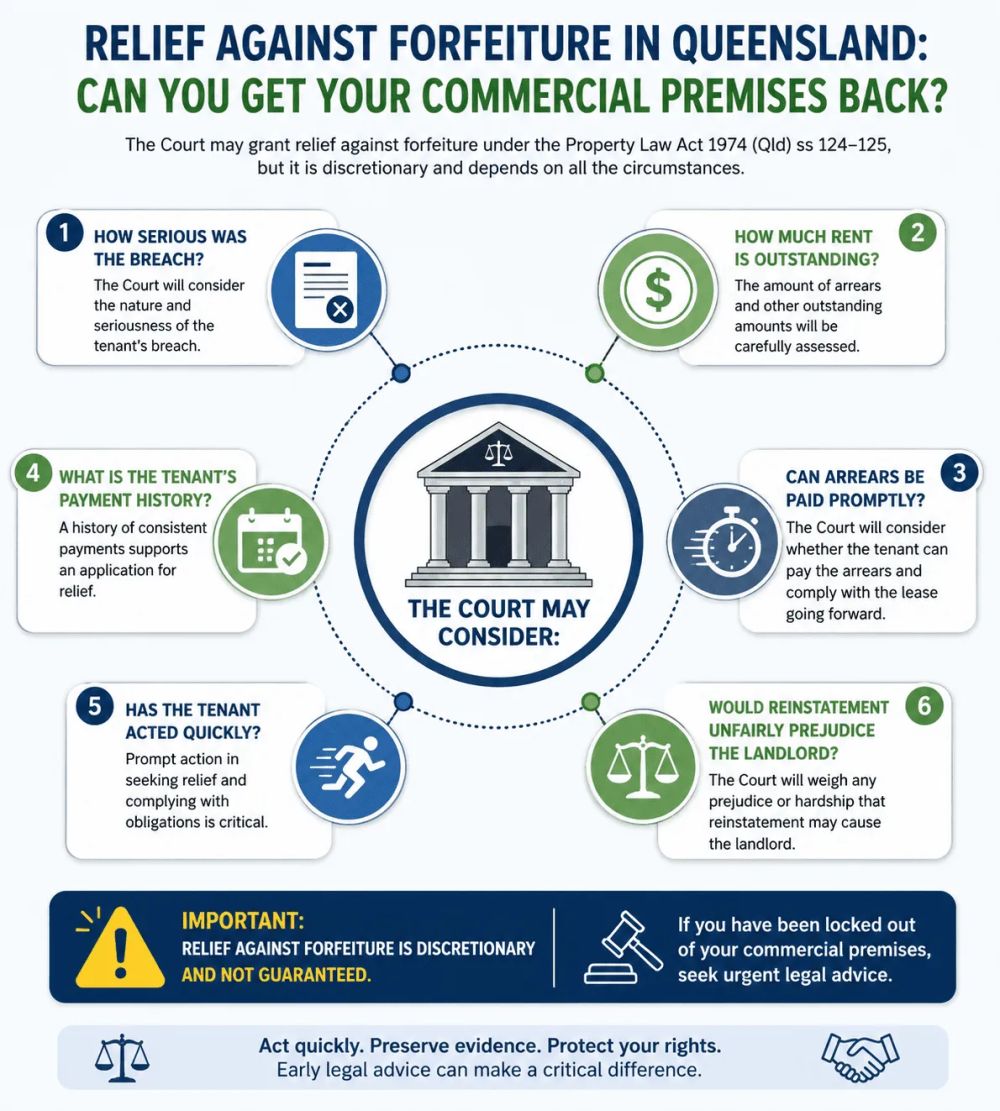
Being locked out does not always mean the end of the lease. Queensland courts may grant relief against forfeiture in appropriate circumstances, although the remedy is discretionary and urgent action is essential.
Relief Against Forfeiture in Queensland
Yes. In appropriate circumstances, the Court may grant relief against the forfeiture or proposed forfeiture of a commercial lease and may make orders restoring the tenant’s interest or possession, subject to conditions. Sections 160 to 162 of the Property Law Act 2023 (Qld) govern applications for relief and the Court’s powers. Section 153 principally regulates the notice process that must ordinarily precede re-entry; it is not itself the source of the Court’s power to grant relief.
Relief against forfeiture is discretionary. The Court may consider all relevant circumstances, including the nature and seriousness of the breach, whether the default can be remedied promptly, the tenant’s conduct and payment history, the tenant’s ability to meet the lease obligations going forward, whether the landlord can be adequately compensated, and any prejudice that relief would cause to the landlord or third parties. No single factor is necessarily decisive.
Relief against forfeiture is historically directed to preventing a landlord from using a right of re-entry as an instrument of oppression where the breach, particularly non-payment of rent, can be remedied and the landlord can be adequately compensated. Under sections 160 to 162 of the Property Law Act 2023 (Qld), the Court has a broad discretion to grant relief against an actual or proposed forfeiture and may impose conditions, including payment of amounts owed and reasonable compensation.
Broader equitable principles concerning the enforcement of strict contractual rights were considered in Tanwar Enterprises Pty Ltd v Cauchi (2003) 217 CLR 315; [2003] HCA 57. However, Tanwar concerned the termination of contracts for the sale of land rather than forfeiture of a commercial lease. It is therefore best treated as general equitable context, not as a direct statement of the statutory test under sections 160 to 162.
Urgent action is essential. Where the landlord has peaceably re-entered the premises, section 160 of the Property Law Act 2023 (Qld) prescribes a one-month period for the relevant application for relief against forfeiture, although the Court may extend that period if it considers it appropriate. If the landlord has commenced proceedings for possession, the application must be made before the Court makes an order for possession. A successful application may restore the lease or possession on conditions, but relief is discretionary and is never guaranteed.
Common Mistakes Seen in Commercial Lease Lockout Disputes
Commercial lease disputes become harder to resolve when tenants delay action after receiving a breach notice or being excluded from the premises. The safest first steps are to preserve evidence, review the lease, confirm the arrears position, document business losses and seek advice before urgent remedies or negotiation options are lost.
Waiting Too Long After Being Locked Out
One of the most common mistakes I see is tenants assuming that a landlord cannot lock them out without first obtaining a court order. A landlord may, after satisfying the statutory and contractual requirements, exercise a right of peaceable re-entry without a possession order. Delay in obtaining advice may allow business losses to escalate and may jeopardise compliance with the one-month period prescribed for certain applications for relief against forfeiture following re-entry.
Continuing Informal Discussions Instead of Addressing Formal Notices
Businesses often continue negotiating informally while ignoring default notices or remedy periods under the lease. Commercial discussions should never replace complying with formal contractual requirements.
Assuming Payment of Some Rent Prevents Termination
Partial payment does not necessarily remedy a rent default or prevent termination. The effect of a payment depends on the amount outstanding, the statutory notice, the terms of the lease, any agreement between the parties and the basis on which the landlord accepts the payment. Under section 155 of the Property Law Act 2023 (Qld), acceptance of rent or another amount after a notice to remedy breach does not itself waive the right to forfeit because of the notified breach, subject to any agreement to the contrary.
Failing to Review Personal Guarantees
Directors commonly focus on regaining access to the premises while overlooking personal guarantees. Even if possession is lost, guarantors may remain personally liable.
From a practical perspective, preserving correspondence, photographs, financial records, and evidence of payments immediately after a lockout can significantly strengthen a tenant’s position in subsequent negotiations or court proceedings.
When Should You Seek Legal Advice in a Commercial Lease Lockout?
You should seek legal advice as soon as you receive a breach notice, are threatened with a lockout, have been locked out of the premises, dispute the alleged rent arrears, cannot access business assets, or the landlord is refusing access to stock or records. Urgent advice is also important if you are considering a court application for relief against forfeiture. Commercial lease disputes are highly time-sensitive. Delays can prejudice negotiations, reduce available remedies, and significantly increase business interruption losses and financial exposure.
Key Takeaways
A landlord may lawfully lock out a commercial tenant for unpaid rent, but only if all lease and legal requirements are satisfied. Prompt action is essential if a lockout is disputed.
Frequently Asked Questions
The following questions address common commercial lease issues, including whether a landlord can change the locks for unpaid rent, what notices may be required, whether a tenant can regain access, what happens to stock and equipment, and whether directors remain liable under personal guarantees.
Can my landlord lock me out of my commercial premises for unpaid rent?
Yes. A commercial landlord may be able to lock you out for unpaid rent if the lease permits re-entry and all contractual and legal requirements have been satisfied. Whether a lockout is lawful depends on the lease terms, the nature of the breach, and whether any required notices were properly given.
What should I do if I have been locked out of my business premises?
You should seek legal advice immediately. Preserve all notices, correspondence, photographs, and payment records, and avoid forcing entry into the premises. Prompt action is important because you may have rights to challenge the lockout or apply for relief against forfeiture.
How long do I have to respond to a commercial lease breach notice?
The timeframe depends on the lease and the notice itself. Many commercial leases specify a contractual remedy period. Because missing a deadline may result in termination or re-entry, you should review the notice and obtain legal advice as soon as possible.
Can a landlord change the locks without going to court?
In some cases, yes. If the lease grants a right of re-entry and the landlord has complied with section 153 of the Property Law Act 2023 (Qld) and all applicable contractual requirements, section 157 permits the landlord to exercise the right by peaceably re-entering the premises. If peaceable re-entry is not possible, the landlord may make a written demand for possession and, if possession is refused, apply to the Court for recovery of possession. An unlawful, forceful or premature lockout may expose the landlord to claims for possession, relief against forfeiture or damages.
Can I get my commercial premises back after being locked out?
Possibly. The Court may grant relief against forfeiture and restore possession in appropriate circumstances. Whether relief is available will depend on factors such as the amount of arrears, the seriousness of the breach, and how quickly the tenant acts.
What happens to my stock and equipment after a commercial lease lockout?
Stock, equipment, and business records often remain inside the premises after re-entry. Access arrangements should be negotiated promptly with the landlord. Urgent action may be required where perishable goods, confidential information, or essential business records are involved.
Can I still be liable for rent after my commercial lease is terminated?
Yes. Termination of the lease does not necessarily end your financial obligations. Depending on the lease, you may remain liable for unpaid rent, outgoings, make-good obligations, and damages arising from the early termination.
Can a landlord terminate a commercial lease for missing one rent payment?
Potentially, but not merely because the payment was missed. Unpaid rent may constitute a breach under the lease, but the landlord must ordinarily comply with section 153 of the Property Law Act 2023 (Qld), including giving a notice to remedy breach in the approved form and allowing a reasonable period for the breach to be remedied. The landlord must also satisfy any additional contractual preconditions before exercising a right of re-entry.
Can a director be personally liable for unpaid commercial rent?
Yes. If a director has signed a personal guarantee, they may be personally liable for rent arrears, damages, and other lease obligations even if the tenant company ceases trading or loses possession of the premises.
Can I dispute the amount of rent arrears claimed by my landlord?
Yes. Tenants may dispute rent arrears where there is a genuine disagreement regarding rent calculations, outgoings, incentives, abatements, or previous payments. If arrears are disputed, legal advice should be obtained before any lockout or termination occurs.
The content of this article is intended to provide a general guide to the subject matter. Specialist advice should be sought about your specific circumstances.
[View Source]