

- within Environment topic(s)
- in European Union
- within Environment topic(s)
- in European Union
- in European Union
- within Environment, Technology and Real Estate and Construction topic(s)
- with readers working within the Banking & Credit industries
Carbon Capture, Utilisation and Storage (CCUS) is increasingly
recognised worldwide as a critical mechanism for reducing CO₂
emissions from industrial and energy facilities. As of today, 77
commercial carbon capture and storage (CCS) projects are
operational worldwide, with a combined capture capacity of 64
million tonnes per annum (Mtpa) of CO₂ 1.
The core concept of CCS involves capturing carbon dioxide at
emission sources, transporting it, and injecting it into deep
underground formations where it can be stored permanently. This
technology is essential for mitigating climate change, particularly
in sectors where emissions cannot be eliminated solely through
renewable energy.
Kazakhstan is one of the world's carbon-intensive economies,
heavily reliant on fossil fuels and energy-intensive industries.
Although Kazakhstan currently lacks a dedicated legal or regulatory
framework governing CCUS, the country has adopted ambitious climate
commitments, including carbon neutrality by 2060, and is expected
to introduce supportive regulations in the coming years.
Understanding the compatibility of CCUS projects with existing laws
is therefore essential for project developers and investors.
Global practice recognises several types of deep geological
formations suitable for long-term CO₂ storage, from
which two formations are particularly relevant for Kazakhstan:
- Depleted oil and gas reservoirs represent a favourable and well-studied option. Their geological characteristics, including porosity, permeability and structural integrity, have been extensively assessed during years of hydrocarbon extraction. Existing wells, pipelines and injection facilities can often be repurposed. In addition, CO₂ injection may support enhanced oil recovery (EOR), improving the economic viability of early CCUS projects.
- Saline aquifers represent a second option for implementing CCUS projects as they constitute formations containing highly mineralised water at depths exceeding 800-1000 meters. Such water is not suitable for drinking or industrial use and is found extensively across Kazakhstan. International bodies such as the IPCC recognise deep saline formations as one of the most promising long-term CO₂ storage options due to their large capacity and widespread distribution. Salt domes are another potential option for CO₂ storage, but Kazakh legislation does not yet contain a defined licensing regime for their use.
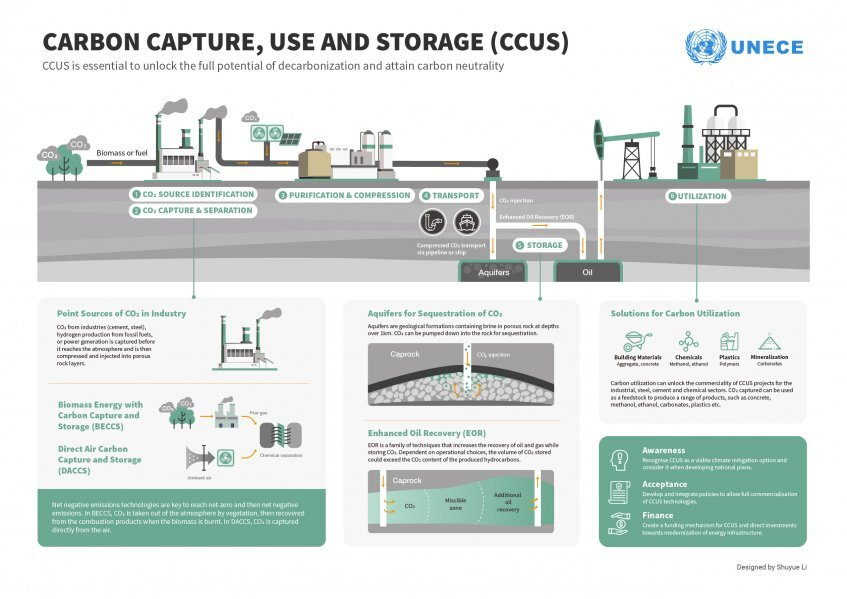
Image credit: UNECE 2.
Development of CCS Regulation Across
Jurisdictions
The regulatory foundations for carbon capture and storage (CCS)
were laid the earliest in Norway, which in 1996 launched the
Sleipner project and relied on the Petroleum Act (1996) and the
Pollution Control Act (1981) to regulate offshore CO₂
injection. These laws, later supplemented by detailed technical and
environmental regulations in the 2000s and 2010s, created the first
functioning CCS permitting system in the world and demonstrated how
existing petroleum legislation could be adapted for permanent
CO₂ storage 3-5. Onshore capture facilities are
further regulated under the Energy Act, land-use planning rules and
general environmental permitting regimes, whereas CO₂
pipelines and associated offshore infrastructure are increasingly
governed by CCS-related legislation. The cumulative effect of this
multi-layered framework is that any CCS project in Norway must
secure a petroleum-type license for reservoir access and use, a
pollution control permit for injection and storage, conventional
permits for capture installations and transport infrastructure, and
the necessary approvals for closure and post-closure monitoring,
reflecting an effective petroleum-environmental regulatory model
that has influenced CCS legislation worldwide.
The United States developed a federal regulatory framework for CCS
beginning with foundational environmental laws, such as the
National Environmental Policy Act (NEPA) of 1969 and the Safe
Drinking Water Act (SDWA) of 1974. A significant regulatory
development occurred in 2010, when the Environmental Protection
Agency (EPA) introduced the Class VI well requirements under the
Underground Injection Control program 6. These
regulations set stringent standards for geological storage,
monitoring, and financial assurance. In parallel, CCS capture
facilities are generally required to obtain permits under the Clean
Air Act and state-level air quality regulations. CO₂
pipelines may be regulated as hazardous liquid pipelines and
therefore require authorisations under federal pipeline safety
regulations and, in many cases, certificates or permissions from
state public utility commissions, especially where eminent domain
or common carrier status is involved. Consequently, CCS project
developers must secure both federal Class VI injection permits and
the necessary state-level approvals for storage, surface access,
and environmental protection, rendering the U.S. regulatory
framework one of the most complex and influential globally.
Around the same time, Australia advanced its own comprehensive
legal approach. The Commonwealth adopted the Offshore Petroleum and
Greenhouse Gas Storage Act 2006, one of the first explicit CCS
statutes globally, establishing titles for assessment, injection
and closure 7.
The European Union followed with a harmonised regulatory system
through Directive 2009/31/EC, adopted in 2009 and implemented by
Member States between 2010 and 2012 8. The Directive
introduced EU-wide standards for geological storage, monitoring,
corrective measures, financial security and post-closure
responsibility, while also integrating CCS into the EU Emissions
Trading System by deeming permanently stored CO₂ as "not
emitted". The Directive requires national transposition,
creating a consistent framework for exploration, operation,
closure, and post-closure phases of CO₂ storage. CCS projects
in the EU require environmental and industrial permits for capture
installations, CO₂ transport infrastructure, and geological
storage. Operators must provide detailed site characterisation,
modelling, and financial assurance, with a storage permit granted
only if the site poses no significant risk of leakage or harm.
Post-injection monitoring and corrective measures continue until
responsibility for the site is transferred to the state, ensuring
the permanent containment of stored CO₂. The EU's
approach marked the first international attempt to unify CCS
regulation across multiple sovereign states.
In parallel to the EU, the United Kingdom developed its own
comprehensive CCS regime through the Energy Act 2008 and the
Storage of Carbon Dioxide Regulations 2010, creating a two-step
licensing system (carbon storage license and storage permit) for
offshore CO₂ storage 9-10. The regime
differentiates between offshore geological storage on the UK
Continental Shelf and onshore capture and transport activities. For
offshore storage, the North Sea Transition Authority is the
licensing body, awarding carbon dioxide appraisal and storage
licences (CS Licences) in designated licensing rounds. These grant
exclusive rights to explore and develop a storage site, and must be
supplemented by a storage permit at the operational stage, which
authorises CO₂ injection and imposes conditions on maximum
pressure, injection rates, monitoring, financial security, and
decommissioning. Onshore, operators must secure environmental
permits under the Environmental Permitting Regulations, which cover
discharges to groundwater and emissions to air 11.
CO₂ pipelines are governed by national pipeline safety rules,
with additional consents for construction and operation, and marine
licences for seabed works where applicable. The Storage of Carbon
Dioxide (Termination of Licences) Regulations 2011 outlines the
post-closure obligations and liabilities once a storage site is
decommissioned 12. The UK's system is considered one
of the most detailed offshore storage regimes globally, closely
aligned with the North Sea decarbonisation efforts.
Similarly, South Korea is transitioning from policy-based
governance to a statute-based system with the CCUS Act,
which took effect in February 2025 13. The CCUS
Act regulates CO₂ capture, transport, storage, and
long-term management as part of the country's carbon neutrality
goals for 2050.
Finally, developing economies are now adopting specialised CCS
regulation, with Indonesia issuing Presidential Regulation No.
14/2024. This act authorises CO₂ collection, transport and
storage, allows up to 30 percent of capacity for imported
CO₂, and integrates CCS with the country's oil and gas
framework, while AMDAL environmental assessments (established in
the 1990s and updated in 2021) govern environmental
approvals.
Strategic Direction and Legal Framework for CCUS in
Kazakhstan
Although Kazakhstan does not yet have a dedicated law regulating
CCUS, the strategic direction clearly recognizes CCUS as a crucial
component for achieving the country's decarbonisation goals.
The Government of Kazakhstan has outlined these objectives in its
national strategy, which serves as a foundation for future
legislation and regulatory measures.
The Strategy for Achieving Carbon Neutrality by 2060 envisions
systematic development of carbon capture, utilisation and storage
technologies 14. Kazakhstan aims to reduce greenhouse
gas emissions by 50 percent by 2030 and by 95 percent by 2060
relative to 1990 levels, increase the share of renewable energy to
50 percent of the national energy mix, modernise energy and
industrial infrastructure, and accelerate the deployment of
low-carbon and climate-resilient technologies.
The strategy focuses on three main pillars of Kazakhstan's
low-carbon transition:
- decarbonisation of fossil fuel industries and processes,
- decarbonisation of non-fossil-fuel industries, and
- expansion of natural carbon sinks, coupled with the development of industrial technologies for carbon capture, utilisation, long-term storage, and sequestration.
Particular attention is given to the energy and industrial
sectors, which account for the majority of national emissions. In
the medium and long term, Kazakhstan plans to implement CO₂
capture and storage technologies at coal-fired power plants that
will remain operational beyond 2035. Decommissioned units will be
granted priority to participate in the development of renewable or
other "green" energy projects. In parallel, the
industrial sector is expected to adopt zero-emission production
technologies combined with CCUS solutions, expand recycling
efforts, and integrate alternative low-carbon materials.
Although CCS operations are not explicitly addressed in
Kazakhstan's existing legal framework, the Environmental Code
does reference "carbon dioxide capture" as an activity
requiring permits, classifying such installations as Category I
hazardous facilities. This reference may indicate the regulatory
system's preparedness to accommodate CCUS technologies, laying
the groundwork for the future development of a comprehensive legal
framework for CCUS.
Drawing from the experiences of other countries, Kazakhstan may
follow a model similar to Norway's early approach, utilising
existing subsoil use legislation to regulate CCUS activities in its
initial stages.
Applicability of Current Kazakh Subsoil Use Legislation to
CO₂ Storage
Kazakhstan's Subsoil Use Code does not directly regulate CCUS.
As a result, implementation of storage projects may require
applying general subsoil regulations by analogy. Kazakhstan
mandates licences for any type of subsoil use, but the law does not
expressly envision a licence category for CO₂ storage.
Consequently, developers must consider which form of subsoil
licence could lawfully cover CO₂ injection.
The first theoretical option involves licensing
underground storage facilities for oil, gas and related products
under Article 249(1) of the Subsoil Use Code 15.
However, this provision is inapplicable to CCS because it concerns
only man-made storage facilities for hydrocarbons,
not geological formations, and therefore cannot be interpreted to
cover CO₂.
The second option, under the Article 249(2), allows a
licence for the placement or operation of underground sites for the
storage or disposal of liquid waste, hazardous substances or
industrial effluents injected into the subsoil. This provision
appears to be the most legally feasible route for CCS, as injection
of CO₂ into geological formations could be viewed as the
storage or disposal of liquid substances into the subsoil. The term
"underground sites" is not defined in the Code, but
Article 16 describes subsoil space as a three-dimensional
geological environment available for industrial use, suggesting
that natural reservoirs may fall within its scope.
Depending on the geological target formation, further permits may
be required:
- If CO₂ is injected into depleted oil and gas reservoirs, additional regulatory uncertainty arises. The Ministry of Energy may require a hydrocarbon operations licence for enhanced oil recovery activities. Whether such a licence applies to CCS operations without hydrocarbon extraction requires a project-specific assessment.
- If injection is performed into deep saline aquifers, two permits may be required: first, a subsoil use licence issued by the Ministry of Industry and Construction (MIC), and second, a special water-use permit issued by the Ministry of Water Resources, because saline aquifers constitute water bodies subject to water regulation.
Application of this provision is contingent upon CO₂ being
formally recognised as "waste" for
regulatory purposes. This is where a key uncertainty arises:
current Kazakh legislation does not expressly designate CO₂
as waste. Under Article 317 of the Environmental Code, waste
includes any material that an operator recognises as waste or must
dispose of by law 16. CO₂ separated from flue gas
after capture might fall within this definition, unless regulators
clarify otherwise.
If CO₂ is recognised as waste, the operator must comply with
waste management requirements, including notification, permitting
and documentation under Section 19 of the Environmental Code. If
CO₂ is classified as hazardous waste, a separate licence for
hazardous waste recovery and removal will be required.
Conclusion
Having examined the potential legal mechanisms for implementing
CCUS projects in Kazakhstan, we may conclude that, despite the
absence of a dedicated regulatory framework, the existing system of
subsoil, environmental and water legislation provides a minimal yet
workable basis for launching pilot projects. At this stage, the
most realistic and legally supportable approach appears to be
obtaining a subsoil-use licence for the injection of liquid
substances under Article 249(2) of the Subsoil Use Code,
supplemented by a special water-use permit when operating with deep
saline aquifers. Where depleted oil and gas reservoirs are used, an
additional assessment may be required to determine whether
licensing for hydrocarbon-related operations is triggered.
The further development of CCUS in Kazakhstan faces several
unresolved legal uncertainties that are critical for project
structuring and investment decision-making. The central issue
concerns the legal classification of CO₂ in whether it should
be treated as "waste" and if so, at what stage of the
technological process. Current legislation does not expressly
designate CO₂ as waste, but under certain conditions captured
CO₂ may fall within the definition of waste provided in
Article 317 of the Environmental Code. Such recognition would
trigger the full scope of waste-management requirements, including
licensing, notifications, permitting procedures and where
applicable, compliance with the rules governing hazardous
waste.
The correct determination of CO₂'s legal status directly
affects the applicability of Article 249(2) of Subsoil Use Code,
the potential qualification of subsurface injection as
"disposal" or "storage" of liquid waste, the
need for water-use authorisations, and regulatory obligations
relating to monitoring, reporting and long-term liability for the
storage site. The lack of a clear statutory position on these
matters creates significant risks for investors and operators,
including uncertainty regarding the appropriate permitting pathway,
operational regime, allocation of responsibilities between the
state and the project developer, and the scope of future monitoring
and remediation obligations.
Kazakhstan's strategic documents demonstrate a strong
commitment to developing a comprehensive regulatory framework that
will enable the large-scale deployment of CCUS technologies. The
current state policy positions CCUS as a critical element in the
country's energy and industrial transformation, aligning with
the national objectives of carbon neutrality. To facilitate this
transition, further development of the legal framework is
essential. Key areas include the formal classification of
CO₂, defining permitting requirements, addressing long-term
liability and monitoring obligations, and clarifying the
interaction of CCUS activities with water and waste legislation.
Resolving these issues will be key to attracting investment,
reducing regulatory uncertainty, and supporting Kazakhstan's
success in achieving its long-term carbon-neutrality goals.
Footnotes
1 Global Status of CCS report. Global-Status-of-CCS-2025-report-9-October.pdf
2 UNECE. Carbon Capture, Use and Storage (CCUS). https://unece.org/sustainable-energy/cleaner-electricity-systems/carbon-capture-use-and-storage-ccus
3 Regulations relating to documentation in connection with storage of CO2 on the shelf. https://www.sodir.no/en/regulations/regulations/materials-and-documentation-in-connection-with-surveys-for-and-utilisation-of-subsea-reservoirs-on-the-continental-shelf-to-store-co/
4 Regulations relating to exploitation of subsea reservoirs on the continental shelf for storage of CO₂ and relating to transportation of CO₂ on the continental shelf. https://www.sodir.no/en/regulations/regulations/exploitation-of-subsea-reservoirs-on-the-continental-shelf-for-storage-of-and-transportation-of-co/
5 CO₂ safety regulations. https://www.havtil.no/contentassets/85219a8bda32464a97e024d6be29cdba/co2-sikkerhetsforskriften_e-2.pdf
6 Underground Injection Control Program. https://www.epa.gov/uic/underground-injection-control-regulations
7 Offshore Petroleum and Greenhouse Gas Storage Act 2006. https://classic.austlii.edu.au/au/legis/cth/consol_act/opaggsa2006446/
8 Directive 2009/31/EC. https://eur-lex.europa.eu/eli/dir/2009/31/oj/eng
9 Energy Act 2008. https://www.legislation.gov.uk/ukpga/2008/32/contents
10 Storage of Carbon Dioxide Regulations 2010. https://www.legislation.gov.uk/uksi/2010/2221/contents
11 Environmental Permitting Regulations. https://www.legislation.gov.uk/uksi/2016/1154/contents
12 Storage of Carbon Dioxide (Termination of Licences) Regulations 2011. https://www.legislation.gov.uk/uksi/2011/1483/contents
13 CCUS Act. https://climate-laws.org/document/act-on-the-capture-transportation-storage-and-utilisation-of-carbon-dioxide_ce05
14 Strategy for Achieving Carbon Neutrality by 2060. https://adilet.zan.kz/rus/docs/U2300000121
15 Subsoil Use Code. https://adilet.zan.kz/rus/docs/K1700000125
16 Environmental Code of the Republic of Kazakhstan. https://adilet.zan.kz/rus/docs/K2100000400
The content of this article is intended to provide a general guide to the subject matter. Specialist advice should be sought about your specific circumstances.

