

- within Intellectual Property, Environment and Finance and Banking topic(s)
- with readers working within the Retail & Leisure industries
Part VI Of A NERA Insights Series
Introduction
Since the start of the ongoing credit crisis, financial institutions have taken over $1 trillion in credit losses and write-downs, 48 banks in the US have been taken over by the FDIC, and markets around the world remain highly volatile.1,2 The financial crisis, which first manifested in the subprime mortgage market, soon became a full blown credit crisis with unprecedented disruptions in financial markets around the world.
As the crisis has deepened, the allegations in and parties related to the resulting litigation have changed. During late 2006 and most of 2007, many of the suits were filed against lenders, originators, and home builders. The key allegations in this early wave of litigation included (i) concealment of, and failure to adequately reserve for, subprime risk exposure; (ii) misrepresentation of subprime exposure and failure to write down assets in a timely manner; and (iii) misrepresentation of the collateral underlying the securities.3 As the credit crisis grew more severe, an increasing number of the suits targeted asset management firms and involved complex financial instruments such as collateralized debt obligations (CDOs) and credit default swaps (CDS).
In this article, we provide an update on the credit crisis-related securities litigation in terms of filings, percentage of cases involving directors and officers, types of defendants and plaintiffs, and recent decisions with emphasis on cases involving complex financial products such as CDOs and CDS. We compile the data from various sources including Bloomberg, Factiva, RiskMetrics Group/Securities Class Action Services, SEC filings, and case dockets from January 2007 to March 2009. We focus exclusively on securities cases—cases in which the allegations relate to the purchase, ownership, or sale of securities. We also catalog, among others, ERISA claims, shareholder derivative actions, individual state and federal cases, international cases, and state and federal shareholder class actions.4 Collectively, we will call these lawsuits "credit crisis filings." If any cases are consolidated, the duplicate filings are removed and the data are adjusted.
We find that credit crisis filings increased 172% in 2008 relative to 2007, rising to 188 cases from 69. The percentage of cases in which Directors and Officers (D&O) are named as defendants remains high, with 62% named in suits in 2008 as compared to 68% in 2007. Asset management firms became the main defendants in litigation in 2008 as opposed to lenders and home builders, and lawsuits involving structured products are on the rise. In 2007, 35% of the lawsuits were filed against lenders and home builders while 14% were filed against asset management firms. In 2008, 17% of the lawsuits were filed against lenders and home builders while 33% were filed against asset management firms. Structured products were involved in 3% of the lawsuits in 2007 and 22% of the lawsuits in 2008. Since late 2007, there have been 23 motions to dismiss granted and 10 denied; the more high-profile denials have been in the New Century and Countrywide cases.
The article is organized as follows. First, we briefly review the trends in total filings by quarter and the percentage of claims naming D&O. Second, we discuss the changing trends in the plaintiffs and defendants named in the litigation and the emergence of cases involving structured products. We then examine the types of allegations brought against defendants in cases involving structured products, in particular CDOs and CDS. Finally, we conclude with a discussion of recent decisions in the credit crisis filings.
The Number Of Credit Crisis Filings In 2008 Increased 172% From 2007
From January 2007 until 17 March 2009, we recorded 303 credit crisis filings. Exhibit 1 presents the number of credit crisis filings by quarter.
Exhibit 1. Credit Crisis Filings By Quarter

Total filings in 2008 (188) exceeded 2007 (69) by 172%. The high filing activity seen in 2008 shows no signs of slowing in 2009.5
The Percentage Of Credit Crisis Filings Naming Directors And Officers Remains High
D&O insurance is an important component of corporate insurance, as approximately 95% of the Fortune 500 companies maintain D&O liability insurance.6 In the wake of the subprime and credit crisis and the rising number of lawsuits, the impact of D&O insurance liability on the insurance industry could prove severe. Guy Carpenter estimated in November 2007 that insured D&O losses could exceed $2 billion.7
The percentage of credit crisis filings that name D&O defendants remains high—on average 62% in 2008 and 72% in 2009. Exhibit 2 presents the share of credit crisis filings that have D&O exposure.
Exhibit 2. Percentage Of Credit Crisis Filings Naming Directors And Officers

Credit Crisis Lawsuits By Shareholders Are No Longer The Majority Of The Filings
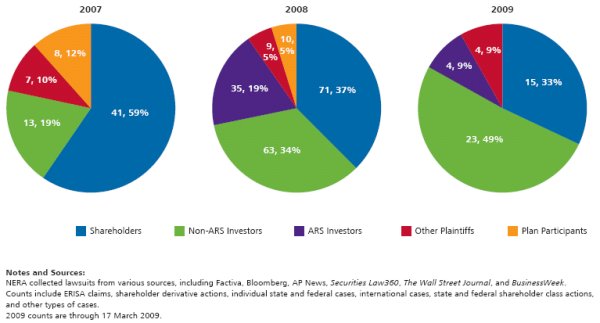
We classify the plaintiffs in the credit crisis filings as shareholders, auction-rate securities (ARS) investors, non-ARS investors, plan participants, and other plaintiffs. We define shareholders as common stock owners. ARS investors are those who invested in long-term variable-rate instruments (usually municipal or corporate bonds) whose interest rates are reset through auctions. The non-ARS investors are those who invested in preferred securities, corporate bonds, mortgage-backed securities (MBS), asset-backed securities (ABS), mutual funds, and money market funds. Plan participants are generally employees that file ERISA claims. Other plaintiffs include swap counterparties, CDS counterparties, insurance companies, and state attorneys general. The credit crisis filings include both class actions and individual actions.
Some of the recent allegations in the investor suits include (i) misrepresentations of the investment characteristics of the securities in terms of liquidity and/or exposure to nonprime loans; (ii) false and misleading registration statements for newly issued securities due to omissions regarding exposure to subprime loans, CDOs, and CDS; and (iii) misrepresentations about investments in Lehman Brothers securities.
The percentage of credit crisis suits by shareholders decreased from 59% in 2007 to 37% in 2008 to 33% in 2009. In turn, credit crisis suits by ARS investors were nonexistent in 2007 but represented 19% of the credit crisis lawsuits in 2008 and 9% of the lawsuits in 2009. Similarly, suits by non-ARS investors have also increased, making up 19% of the credit crisis filings in 2007, 34% in 2008, and 49% in 2009. Credit crisis suits by plan participants have dropped from 12% of suits in 2007 to 5% of suits in 2008. Exhibit 3 shows the number and percent of filings by type of plaintiff.
Exhibit 3. Credit Crisis Filings By Type Of Plaintiff
Asset Management Firms, Issuers, And Underwriters Are The Main Defendants In 2008 And 2009
We classify the defendants in the credit crisis filings as securities issuers/underwriters, asset management firms, mortgage lenders, insurers, home builders, and others. The defendants' classifications are based on the allegations and the role of the defendants in each case. For example, one firm may be categorized as a securities issuer/underwriter in one lawsuit for packaging and selling MBS. The same firm may then be categorized as an asset management firm in another lawsuit for managing and advising a mutual fund. Asset management firm defendants may include broker dealers, hedge funds, private equity firms, and investment advisors, among others. Insurers include mortgage and bond insurers. Other defendants include CDO and CDS counterparties.
As the credit crisis moved from the mortgage-related markets to the overall credit markets, the focus of the related litigation also shifted towards more complex financial instruments and different market participants. Asset management firms and issuers/underwriters now represent the majority of the defendants. The percentage of asset management firms that were named as defendants more than doubled between 2007 (14%) and 2008 (33%). The percentage of filings that named securities issuers/underwriters as defendants also increased during this period, from 22% in 2007 to 27% in 2008. Exhibit 4 shows the number and percent of filings by type of defendant.
Exhibit 4. Credit Crisis Filings By Type Of Defendant

Credit crisis filings in the first three quarters of 2007 focused on lenders and home builders. By the end of 2007, as losses spread to markets well beyond mortgages, an increasing number of the lawsuits focused on investment management firms and structured products. These include 34 cases involving mutual funds and/or investment advisers. Exhibit 5 illustrates the changing trend in the litigation.
Exhibit 5. Credit Crisis Lawsuits By Type Of Market Participants

Lawsuits Involving CDOs Are On The Rise As Losses Mount
Mortgage-backed securities are also the focus of suits involving collateralized debt obligations. CDOs often held mortgage-backed securities as assets that supported their tranched liabilities. As the mortgage-backed securities dropped in value, so did CDO issuance and values. We examined Merrill Lynch's, Citigroup's, and UBS' recent SEC filings and found that approximately 40% of write-downs and/or credit losses were attributable to CDOs between Q1 2007 and Q3 2008.8 It is not surprising then, that the litigation is heading towards CDOs and other structured finance products.
In the following sections, we briefly examine the state of the CDO market and then turn to lawsuits involving them.
Trends In CDO Losses
CDOs showed signs of trouble beginning in 2007. Signs of trouble include events of default (EOD), notices of acceleration, and liquidation. An event of default indicates the possibility of imperiled cash flows and may mean losses to the note holders. A notice of acceleration is when the controlling note holders have voted to accelerate the maturity of the CDO notes outstanding. A notice of liquidation is when the controlling note holders have voted to terminate the CDO transaction and liquidate the portfolio collateral. A liquidation event is when assets in the collateral pool are in the process of being sold or have been sold. Alternatively, events of default are occasionally "cured" or otherwise retracted.9
Unsurprisingly, as CDOs began experiencing losses or potential losses, the lawsuits have followed. Bethel et al. (2008) documented the CDOs on the path to liquidation and we summarize their findings below. The authors examined 193 CDOs (issued as far back as 2002), which have experienced events of default, acceleration, and liquidation.10
Exhibit 6 shows the CDO balances at issuance and the current status (i.e., event of default notice, retraction, acceleration notice, liquidation notice, liquidation) by the month in which the events of default occurred. For example, approximately $7.3 billion in aggregate CDO issuance experienced events of default in October 2007. Of these, $3.5 billion have been liquidated, $0.75 billion have issued notices of liquidation, and $3 billion have issued notices of acceleration (as of 30 May 2008).
The 193 CDOs represent approximately $215 billion in issuance. Of these, 20 CDOs ($23 billion at issuance) have been liquidated, another 18 CDOs ($15 billion at issuance) have given notices of liquidation, and 67 CDOs (representing $77 billion at issuance) have provided notices of acceleration (through May 2008). As of May 2008, 87 CDOs had provided notices of events of default (representing $98 billion at issuance) while one CDO had retracted the notice of default (approximately $2 billion at issuance).
Exhibit 6. CDOs In Trouble: Balance At Issuance And Current Status By Month Of EOD (As Of 30 May 2008)

Examples Of Credit Crisis Litigation Involving CDOs
In general, the CDO-related cases allege failures to disclose proper valuations and misrepresentations about the quality of the underlying collateral. We discuss the following three cases in more detail.
Exhibit 7: Examples Of Credit Crisis Cases Involving CDOs
|
Case Name |
File Date |
|
Bank of America, National Association, and Banc of America Securities LLC, v. Bear Stearns Asset Management Inc., et al. |
29 October 2008 |
|
Southeastern Pennsylvania Transportation Authority, et al. v. Lehman Brothers Holdings Inc., et al. |
29 April 2008 |
|
Harold H. Powell Trust et al. v. Royal Bank of Scotland Group Plc., Et Al. |
22 January 2009 |
Bank of America, National Association, And Banc Of America Securities LLC, v. Bear Stearns Asset Management Inc., Et Al.
Bank of America filed a suit against Bear Stearns Asset Management that focuses on a $4 billion CDO that Bank of America structured and marketed.11 The CDO collateral included mortgage-backed assets which were primarily owned by two Bear Stearns hedge funds. The lawsuit alleges that Bear Stearns Asset Management:
"...concealed from Bank of America (as well as from the two hedge funds' investors and other creditors) that the hedge funds were suffering substantial withdrawal requests from investors and by the spring of 2007 were in imminent danger of collapse. The eventual collapse of the funds in June 2007—an event that contributed to the ultimate demise of Bear Stearns—predictably caused an enormous decline in the value of both the assets underlying the CDO-squared transaction and the securities issued in the transaction. As a direct and foreseeable consequence of Defendants' misconduct, the Bank sustained significant losses."12
Southeastern Pennsylvania Transportation Authority, Et Al. v. Lehman Brothers Holdings Inc., Et Al.
In another CDO-related lawsuit, shareholders filed a class action against Lehman Brothers.13 The suit alleges violations of Rule 10b-5 and Section 20(a) due to, among other factors, Lehman Brothers' alleged misrepresentation and failure to disclose the proper value of its CDO portfolio. The complaint claims:
"...(1) that the Company had failed to fully disclose the nature and extent of its exposure to losses incurred from trading in subprime mortgage backed derivatives; (2) that the Company had failed to fully disclose the nature and extent of its exposure to losses incurred from CDOs, and had failed to timely write-down its positions in these securities; (3) that the Company had failed to fully disclose the nature and extent of its exposure to losses incurred from mortgage backed security originations, and had failed to timely write-down its positions in these securities; (4) that the Company had materially overvalued its positions in commercial and subprime mortgages, and in securities tied to these mortgages; (5) that the Company had inadequate reserves for its mortgage and credit related exposure; (6) that the Company's financial statements were not prepared in accordance with Generally Accepted Accounting Principles ("GAAP"); and (7) that the Company lacked adequate internal and financial controls."14
Harold H. Powell Trust Et Al. v. Royal Bank Of Scotland Group Plc., et al.
A recent class action brought against the Royal Bank of Scotland involves purchasers of the RBS Preferred Series T Stock, which was issued in September 2007. The complaint alleges that "...RBS was suffering from several adverse factors that were not revealed." These factors included, "...extensive investments in asset backed securities, including collateralized debt obligations (CDOs), and its exposure to the subprime mortgage market."15 The complaint alleges that RBS failed to adequately write down bad assets and was forced to "face the long term consequences of its short term focus" after the housing bubble burst.
Credit Crisis Lawsuits Involving Credit Default Swaps
Credit default swaps are credit derivative products that are currently in the litigation limelight. CDS are bilateral contracts in which the "buyer" purchases protection on underlying debt obligations and pays "premiums" to the "seller," who in return provides protection against defaults or other "credit events." The premiums for protection would increase as the risk associated with the underlying obligations increases. The underlying obligation can be single entities/securities or indices of many securities or entities. One characteristic that makes CDS distinct from insurance is that counterparties to CDS contracts need not have any ownership in the underlying obligations or entities.16 For example, a hedge fund may buy protection on General Electric's (GE) bonds via a CDS with a bank, which in turn would be selling protection against any credit event for GE such as a write-down or other specified event agreed upon in the contract. In this case, the hedge fund is "short" the credit of GE (and the bank is "long" it) even though neither party may be holding any of the actual GE bonds.
As the credit crisis has roiled financial institutions, the underlying debt and indices that are often used as reference entities for CDS contracts have plummeted in value and thus the providers of protection have experienced significant losses. Failure to pay protection buyers following the occurrence of credit events is a key allegation in CDS disputes.
Most of the CDS lawsuits are breach of contract cases but there are a few shareholders class actions as well. Below we summarize the key allegations in the following CDS cases listed in Exhibit 8.
Exhibit 8: Examples Of Credit Crisis Cases Involving CDS
|
Case Name |
File Date |
|
UBS AG v. Paramax Capital International, Ltd. And Paramax Capital Group II, Ltd. |
13 December 2007 |
|
CDO Plus Master Fund Ltd v. Wachovia Bank, National Association |
12 January 2008 |
|
VCG Special Opportunities Master Fund Limited v. Citibank, N.A. |
14 February 2008 |
|
Jacksonville Police and Fire Pension Fund v. American International Group, Inc., et al. |
21 May 2008 |
UBS AG v. Paramax Capital International, Ltd. And Paramax Capital Group II, Ltd
In a suit brought by Paramax Capital against UBS, the complaint alleged a breach of contract due to Paramax Capital's failure to pay approximately $33 million for CDS contracts it had entered into with UBS following a decline in the value of the reference assets.17 UBS and Paramax subsequently reached a settlement in October 2008.18
CDO Plus Master Fund Ltd v. Wachovia Bank, National Association
CDO Plus Master Fund, a hedge fund with $50 million under management, sued Wachovia for allegedly terminating their CDS and closing on the collateral funds in the absence of a credit event as required under the terms of the contract. The complaint asserts,
"[p]erhaps in a panic over recent turmoil in the debt markets connected to the sub-prime mortgage lending crisis, Wachovia purportedly determined (but without any reasonable basis) that the creditworthiness of the reference obligation (and/or the Plaintiff) had drastically deteriorated in the scant weeks that had passed since it entered into the credit default swap with the Plaintiff."19
VCG Special Opportunities Master Fund Limited v. Citibank, N.A.
Citibank, acting as a protection buyer on a CDS, was sued by the same hedge fund that sued Wachovia, again as the protection seller.20 The complaint alleges that Citibank "improperly demanded and extracted from Plaintiff a total of $9,960,000 of collateral for a $10,000,000 swap that it bought from the Plaintiff, based upon an erroneous reading of the swap transaction documents."21 Citibank was dismissed from the lawsuit in November 2008 by US District Judge Barbara Jones, who wrote in her decision that, "The gravamen of VCG's complaint is that Citibank improperly demanded from VCG additional collateral beyond the independent amount, and improperly declared a Floating Amount Event...there is no dispute that the Floating Amount Events that would trigger VCG's payment obligation to Citibank include: a 'Failure to Pay Principal,' an 'Interest Shortfall,' or a 'Writedown.'"22 Judge Jones described that in the case of the disputed contract's reference obligation, Class B Notes issued by the Millstone III CDO, Ltd., no principal payment failure or interest shortfall had occurred. Thus, the argument centered on the write-down. The CDS contract delineated an "implied write-down" of zero if the "reference obligation's 'Underlying Instruments' expressly provide for 'writedowns, applied losses, principal deficiencies or realized losses' to occur." Otherwise, the Calculation Agent, Citibank, would be allowed to calculate an "implied write-down." Judge Jones further explained,
"The crux of the parties' disagreement centers on whether the portion of the Millstone III Indenture that accounts for a 'Written Down Amount' concerns the reference obligation at issue... VCG's interpretation of the Millstone III Indenture is flawed in that the cited definition of 'Written Down Amount' does not involve writedowns of the Class B Notes...[it] refers to securities owned by the CDO. In other words, VCG confuses the CDO's assets (the securities it owns) with its liabilities (the securities it issues)."23
Thus, Citibank was dismissed in the action.24
Jacksonville Police And Fire Pension Fund v. American International Group, Inc., Et Al.
In addition to breach of contract lawsuits, CDS are also at the center of some shareholder class action lawsuits. A key example is a suit brought against AIG which alleges that:
"...AIG consistently assured investors of the security of its 'super senior' credit default swap ('CDS') portfolio, representing to investors the material fact that it was 'highly unlikely' to suffer any actual losses as a result of the mortgage meltdown."25
The suit charges AIG with misrepresenting the exposure and value of the CDS portfolio and failing to disclose other exposures, such as $6.5 billion in liquidity puts written on CDOs linked to subprime mortgages. The suit asserts that "Defendants' knowing or reckless statements and inadequate disclosure of the massive losses inflicted on the Company's CDS portfolio artificially inflated the price of AIG stock throughout the Class Period..."26 This alleged fraud and material misrepresentation are at the center of the lawsuit's charges of Rule 10b-5 and Section 20 violations.
Recent Decisions In A Still Evolving Story
As the credit crisis-related litigation progresses past the initial stages, there have been some decisions, especially in the motion-to-dismiss stages. NERA reviewed various news sources and compiled 48 decisions stemming from the credit crisis filings discussed in the previous sections. Of them, 23 were orders granting motions to dismiss, while 10 denied such motions.27 The remaining were settlements, voluntary dismissals, or partial dismissals. The breakdown of the decisions is shown below in Exhibit 9.
Exhibit 9. Recent Credit Crisis-Related Decisions

Of the 48 decisions compiled by NERA, the majority involved mortgage lenders (18) and securities issuers/underwriters (13).28 Within these two categories of defendants, the types of decisions are shown in Exhibit 10. No motions to dismiss have been denied in the cases involving the securities issuers /underwriters, while five of the 18 motions to dismiss involving mortgage lenders have been denied.
Exhibit 10. Recent Credit Crisis-Related Decisions By Type Of Defendant

Next, we discuss decisions in five prominent cases, listed below. All are class action lawsuits. Motions to dismiss have been granted for two of the cases and denied for the other three.
Exhibit 11: Examples Of Recent Decisions (As Of 17 March 2009)
|
Case Name |
Decision Date |
Decision |
|
Waymon Tripp v. IndyMac Financial Inc, et al. |
29 November 2007 |
Motions to Dismiss Granted |
|
Michael Atlas and Gail Atlas v. Accredited Home Lenders Holding Co. et al. |
4 January 2008 |
Motions to Dismiss Denied |
|
Robert W. Boyd, III, et al. v. NovaStar Financial, Inc., Scott F. Hartman, W. Lance Anderson, and Gregory S. Metz |
4 June 2008 |
Motions to Dismiss Granted |
|
George Pappas, et al. v. Countrywide Financial Corporation, Angelo Mozilo, and Eric P. Sieracki |
1 December 2008 |
Motions to Dismiss Largely Denied |
|
New York State Teachers Retirement System v. New Century Financial |
3 December 2008 |
Motions to Dismiss Denied |
Waymon Tripp v. IndyMac Financial Inc., Et Al.
In a previous article, we discussed the decision in the case against IndyMac, a "hybrid thrift/mortgage banker."29 Plaintiffs alleged that the defendant "inappropriately loosened its underwriting guidelines ... inadequately hedged against its risks... [and] had inadequate 'internal controls.'"30
As we discussed, Judge Wu granted the motions to dismiss with leave to amend in his decision in November 2007, contending that there was a lack of a "strong inference" of scienter and instead that "an even stronger inference is that Defendants were simply unable to shield themselves as effectively as they anticipated from the drastic change in the housing and mortgage markets, and once that inability became evident, IndyMac's financials were changed accordingly."31 Since that time, the plaintiffs filed an amended complaint and Judge Wu, in May 2008, again granted the motions to dismiss with leave to amend. The plaintiffs have since filed another amended complaint and defendants have in return, filed motions to dismiss.
Michael Atlas And Gail Atlas v. Accredited Home Lenders Holding Co. Et Al.
In a consolidated class action against subprime lender Accredited Home Lenders Holding, Co., plaintiffs alleged that defendants materially misrepresented the company's underwriting standards, manipulated reserve amounts, and improperly accounted for the Aames acquisition. In her decision in January 2008, Judge Huff largely denied the motions to dismiss, concluding that "...an inference of scienter is sufficiently supported by the Complaint's allegations regarding the frequency with which Defendants caused Accredited's underwriters' decisions rejecting risky loans and the degree to which Accredited's reserves were decreased compared to historic levels, at a time when according to generally accepted accounting principles such reserves should have been increased."32
Robert W. Boyd, III, Et Al. v. NovaStar Financial, Inc., Scott F. Hartman, W. Lance Anderson, And Gregory S. Metz
In a consolidated class action against REIT NovaStar Financial, Inc., plaintiffs alleged that the defendants materially misrepresented the company's lack of internal controls, inadequate guidelines and appraisal review process in lending practices, and failure to properly account for allowance for loan losses. In his decision in June 2008, Judge Smith granted the motion to dismiss with prejudice, stating that the plaintiffs did not specify "the allegedly misleading statements," nor specify "why the statements... referred to are misleading."33 Judge Smith concludes that the plaintiffs created "an illusion of detail," and insinuated "the existence of fraud."34 The plaintiffs have filed an appeal, which is currently pending.
George Pappas, Et Al. v. Countrywide Financial Corporation, Angelo Mozilo, And Eric P. Sieracki
In a consolidated class action against mortgage lender Countrywide Financial Corporation, plaintiffs alleged that "borrower requirements were progressively loosened... actual loan quality was lower than the borrower's FICO score and LTV ratio suggested because Countrywide misrepresented how lax its verification practices became... and Countrywide management routinely circumvented the normal underwriting process by approving highly risky loans for sale into the secondary market."35 In her decision in December 2008, Judge Pfaelzer largely denied the motions to dismiss based on the inference of scienter from insider sales concurrent with company stock repurchases and the "systematic changes in Countrywide [that] came from the top down and pervaded virtually every office," while defendant's had "publicly professed knowledge of Countrywide's underwriting practices."36 In addition, Judge Pfaelzer addressed the Defendants' argument that "an 'unprecedented' external 'liquidity crisis' caused all (or most) of Countrywide's decline."37 She largely denied these macroeconomic arguments in the context of Countrywide's decline and asserted that the macroeconomic conditions would be complicating factors only in the damage calculations. She explained in her opinion, "The Court will not be distracted by liquidity versus solvency and other macroeconomic arguments... The issue at present is whether the alleged securities violations caused a loss. Not how much of the loss the alleged violations proximately caused."38
New York State Teachers Retirement System v. New Century Financial
In a consolidated class action against subprime lender New Century, plaintiffs alleged that defendants fraudulently made "false and misleading statements regarding New Century's financial condition, internal controls, underwriting standards and loan quality, and in audits of the company, and improper underwriting and auditing standards."39 In his December 2008 decision, Judge Pregerson largely denied the motions to dismiss and strike, finding that defendants "were at least deliberately reckless in making misrepresentations as to loan quality, internal controls, and various financial statements."40
The End...For Now
As the losses continue to mount, it is not clear that the litigation will slow down. The lawsuits remain in the early stages and the credit crisis story is far from over.
Footnotes
* Faten Sabry is a Vice President, Anmol Sinha is a Senior Analyst, and Sungi Lee is an Associate Analyst with NERA Economic Consulting. The authors would like to thank Lucy Allen and Drew Claxton for insightful comments. All errors are ours.
1. As of 2 April 2009, according to Bloomberg, total write-downs and credit losses for banks/brokers, insurers, and GSEs worldwide were $1,291.5 billion.
2. See the FDIC's "Failed Bank List," http://www.fdic.gov/bank/individual/failed/banklist.html (as of 2 April 2009).
3. Faten Sabry, Anmol Sinha, and Sungi Lee, "Subprime Securities Litigation: Key Players, Rising Stakes, and Emerging Trends." 3 July 2008. The NERA article can be found here: http://www.nera.com/publication.asp?p_ID=3534.
4. We do not include cases related to predatory lending, mortgage loan repurchase disputes, or consumer finance.
5. Findings reported for 2009 are through 17 March 2009.
6. See David Gische and Vicki Fishman, "Directors and Officers Liability Insurance Overview." Working Paper (2000).
7. "Credit Market Aftershock Threatens Professional Liability Profits." Guy Carpenter Specialty Practice Briefing (November 2007), p. 3.
8. Loss figures were based on both quarterly and annual SEC filings.
9. For event of default and subsequent actions, see "Cash Flow and Hybrid CDO of ABS Event of Default Notices Received as of April 7, 2008." Standard & Poor's RatingsDirect (8 April 2008).
10. See Bethel, Jennifer, Allen Ferrell, and Gang Hu, "Legal and Economic Issues in Litigation Arising from the 2007-2008 Credit Crisis." Harvard John M. Olin Discussion Paper (November 2008).
11. Complaint for Plaintiff at 1, Bank of America, National Association, and Banc of America Securities, LLC., v. Bear Stearns Asset Management Inc., et al., No. 08-CV-9265 (S.D.N.Y. filed 29 October 2008).
12. Complaint for Plaintiff at 2, Bank of America, National Association, and Banc of America Securities, LLC., v. Bear Stearns Asset Management Inc., et al., No. 08-CV-9265 (S.D.N.Y. filed 29 October 2008).
13. Southeastern Pennsylvania Transportation Authority v. Lehman Brothers Holdings Inc., et al., No. 1:2008cv02431 (N.D. Ill. filed 29 April 2008).
14. Complaint for Plaintiff at 4, Southeastern Pennsylvania Transportation Authority v. Lehman Brothers Holdings Inc., et al., No. 1:2008cv02431 (N.D. Ill. filed 29 April 2008).
15. Complaint for the Plaintiff at 3, Harold H. Powell Trust et al. v. Royal Bank of Scotland Group Plc., et al., No. 09-CV-617 (S.D.N.Y filed 22 January 2009).
16. For a discussion on CDS, see Erik Sirri, Director, Division of Trading and Markets for the US SEC, Testimony Concerning Credit Default Swaps Before the House Committee on Agriculture (15 October 2008).
17. UBS AG v. Paramax Capital International, Ltd. and Paramax Capital Group II, Ltd., No. 07604233 (N.Y. Sup. Ct. filed 26 December 2007).
18. "Paramax Capital and UBS Reach Amicable Settlement on Outstanding Legal Issues," The New York Times (27 October 2008).
19. Complaint for Plaintiff at 2, CDO Plus Master Fund Ltd. v. Wachovia Bank, National Association, No. 07-CV-11078 (S.D.N.Y. filed 12 January 2008).
20. The Wachovia complaint notes that CDO Plus Master Fund Ltd. changed its name to VCG Special Opportunities Master Fund Ltd. See Footnote 19.
21. Complaint at 1, VCG Special Opportunities Master Fund Ltd. v. Citibank, N.A., No. 08-CV-01563 (S.D.N.Y. filed 14 February 2008).
22. Order at 9, VCG Special Opportunities Master Fund Ltd. v. Citibank, N.A., No. 08-CV-01563 (S.D.N.Y. 5 November 2008) (order granting motion to dismiss).
23 Id., Order at 12-13.
24. Other CDS disputes over protection payments include the suit pending against XL Capital Assurance Inc. and others. See Merrill Lynch International v. XL Capital Assurance Inc., et al., No. 08-CV-2893 (S.D.N.Y. filed 19 March 2008).
25. Complaint for Plaintiff at 2, Jacksonville Police and Fire Pension Fund v. American International Group, Inc., et al., No. 08-CV-47727 (S.D.N.Y. filed 21 May 2008).
26. Id., Complaint for Plaintiff at 5.
27. Of the 10 motions to dismiss that were denied, five were against mortgage lenders. The other five denials were in cases against asset management firms, home builders, Real Estate Investment Trusts (REITs), insurers, and CDS counterparties.
28. Of the 17 remaining cases with decisions that are not against mortgage lenders or issuers/underwriters, the defendants include asset management firms, home builders, REITs, ratings agencies, and others.
29. Faten Sabry, Anmol Sinha, and Sungi Lee, "Subprime Securities Litigation: Key Players, Rising Stakes, and Emerging Trends." 3 July 2008. The NERA article can be found here: http://www.nera.com/publication.asp?p_ID=3534.
30. Order at 4, Waymon Tripp v. IndyMac Financial Inc, et al., No. 2:07-CV-01635-GW-VBK (C.D. Cal. 29 November 2007) (order granting motion to dismiss).
31. Id., Order at 5.
32. Order at 15, Michael Atlas and Gail Atlas v. Accredited Home Lenders Holding Co. et al., No. 07-CV-488 H (RBB) (S.D. Cal. 4 January 2008) (order denying motion to dismiss).
33. Order at 3, In re 2007 NovaStar Financial, Inc., Securities Litigation, No. 07-0139-CV-W-ODS (W.D. Miss. 4 June 2008) (order granting motion to dismiss).
34. Id., Order at 3.
35. Order at 78, In re Countrywide Financial Corporation Securities Litigation., No. CV-07-05295-MRP(MANx) (C.D. Cal. 1 December 2008).
36. Id., Order at 84-85.
37. Id., Order at 56.
38. Id., Order at 57.
39. Order at 10, In re New Century., No. CV 07-00931 DDP (JTLx) (C.D. Cal. 3 December 2008) (order denying motion to dismiss).
40. Id., Order at 41.
The content of this article is intended to provide a general guide to the subject matter. Specialist advice should be sought about your specific circumstances.