

On December 3, 2025, the Office of Space Commerce hosted the first stakeholder engagement session to shape the regulatory landscape that will ultimately form the mission authorization for novel commercial space activities pursuant to Section 5 of Executive Order No. 14335, Enabling Competition in the Commercial Space Industry, August 13, 2025, which directs the Secretary of Commerce to develop and implement a mission-authorization process for novel commercial space activities.
During the briefing on the office's concept for an initial framework, the Director of Policy, Advocacy and International Division, Mr. Gabriel Swiney, described the OSC's overarching goal to streamline mission authorization while expediting authorization of US novel commercial space activities. While Executive Order 14335 does not define novel commercial space activities, the OSC is considering creating a regulatory framework for operators who engage in satellite servicing, In-Space Servicing, Assembly and Manufacturing (ISAM) activities generally, commercial low-earth orbit destinations (CLDs), lunar operations, space resource operations, and perhaps even nuclear power and propulsion activities in space. OSC emphasized that these categories are preliminary and that it has not yet released draft rules, application requirements, timelines, or process flows.
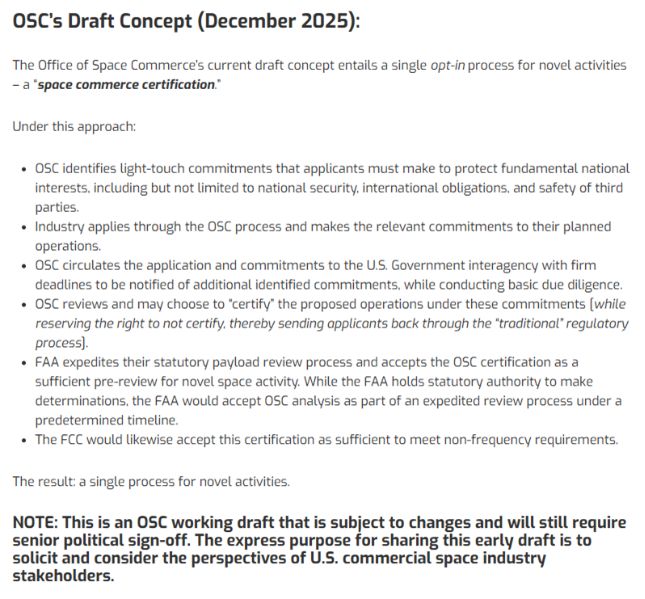
Additionally, Mr. Swiney highlighted that the office was mindful of stakeholders' consistent feedback that the authorization processes currently in place often require several duplicative applications, and that the final approval or licensing timelines remain lengthy. Thus, the OSC has undertaken interagency coordination across the federal government to draft an initial concept of the forthcoming regulatory process where the OSC would coordinate with the relevant government stakeholders on a set timeline.
Notably, OSC did not present any concrete regulatory proposal at the December 3 session. The discussion remained conceptual, with OSC explicitly stating that it is still developing the structure, scope, and timelines for a new authorization regime.
Although the Office of Space Commerce did not address the Federal Communications Commission's ongoing work during the December 3 session, the FCC has actively modernized its regulatory framework for ISAM and other on-orbit operations. Between 2023 and 2024, the FCC adopted several ISAM-related orders updating requirements for proximity operations, reliability disclosures, and orbital-debris mitigation, and it continues to consider additional maneuverability, disposal, and reporting obligations in pending rulemakings. The FCC underscored this modernization effort in its recent Satellite and Earth Station Second Report and Order, explaining that the updated satellite licensing framework is designed to accommodate rapidly evolving activities such as in-space servicing, assembly, and other emerging commercial on-orbit operations. At present, these FCC efforts constitute the most detailed federal regulatory guidance applicable to many ISAM and servicing activities.
Commerce's mission-authorization concept is intended to offer operators with a single point of contact and single point of application for orbital mission authorization, rather than change existing substantive approval and licensing requirements. The FCC, for example, will continue to exercise exclusive authority over all communications and spectrum operations for ISAM and other novel missions, and operators should expect to maintain compliance with FCC requirements even after a Commerce-administered authorization process is established. Until the federal government formally implements a unified or harmonized approach, companies pursuing novel commercial space activities will likely navigate parallel regulatory processes across multiple agencies. Moreover, Commerce indicates that the Federal Aviation Administration (FAA) intends to accept OSC's analysis as part of its expedited review process under a forthcoming predetermined timeline.
The OSC continues to invite dialogue with stakeholders, accepting feedback via their webpage. Commerce accepts opt-in mailing and engagement list requests from the public and email inputs.
Finally, Commerce anticipates submitting the regulatory proposal for approval in late January 2026.
The content of this article is intended to provide a general guide to the subject matter. Specialist advice should be sought about your specific circumstances.

