
Introduction
On 9 July 2025, Türkiye's first climate law, the Climate Law No. 7552 (Turkish Climate Law or Law), entered into force upon its publication in the Official Gazette of the Republic of Türkiye. The Turkish Climate Law aims to combat climate change in line with the green growth vision and net zero emissions target. It sets out the procedures and principles for reducing greenhouse gas emissions and adapting to climate change.
The biggest innovation introduced by the Turkish Climate Law is that it makes it mandatory for businesses within its scope to obtain greenhouse gas emission permits by regulating the Turkish Emissions Trading System (Turkish ETS) and carbon credits. The recitals of the Turkish Climate Law state that the Law's fundamental principle is social and environmental sustainability. In this sense, the Turkish Climate Law is the first law grounded in Türkiye's sustainability principles and holds a special place for its aim of achieving sustainability not only through environmental measures but also through social and economic transformation.
This article will first explain the preparation process and reasons behind the Turkish Climate Law, followed by explanations of the Turkish ETS, the obligations introduced under the Turkish Climate Law, violations and sanctions, and the Turkish Carbon Border Adjustment Mechanism (Turkish CBAM).
1. The Process Leading to the Turkish Climate Law
The preparation of the Turkish Climate Law is not only a result of the national policies and objectives of the Republic of Türkiye; it is also a consequence of its responsibilities arising from international law, the process of harmonisation with the European Union (EU) acquis, and the high volume of trade with companies based in EU Member States. This is because combating climate change cannot be carried out solely at the national level; many states beyond the Republic of Türkiye are also taking action through various regulations.
a. Responsibilities of Türkiye Arising from Public International Law
States, recognising that human activities have resulted in adverse environmental consequences and that, in the long term, this situation affects global climate, came together in 1992 and signed the United Nations Framework Convention on Climate Change (Framework Convention). The Framework Convention entered into force in 1994. Its purpose is to prevent dangerous human interference with the climate system and to stabilise greenhouse gas concentrations in the atmosphere.
Under the Framework Convention, the Kyoto Protocol, signed in 1997 and entered into force in 2005, contains commitments by State Parties to limit the emissions of carbon dioxide (CO2) and other greenhouse gases. The Kyoto Protocol is based on the principle of "common but differentiated responsibilities" and sets targets for developed countries to limit greenhouse gas emissions, while not imposing the same obligation on developing countries.
Furthermore, under the Framework Convention, the Paris Climate Agreement, signed in 2015 and entered into force in 2016, aims to keep global warming below 1.5 °C and, in this context, to reduce greenhouse gas emissions by 50% by 2030. Unlike the Kyoto Protocol, the Paris Climate Agreement does not distinguish between developed and developing countries.
The Republic of Türkiye is a party to the Framework Convention, the Kyoto Protocol and the Paris Climate Agreement. Therefore, it has committed itself to reducing greenhouse gas emissions under international law, and failure to fulfil this commitment would render the Republic of Türkiye liable for violating international treaty law. In this respect, combating climate change is not only a matter of national policy but also a matter of state responsibility.
b. The Process of Harmonisation with the EU Acquis
The Republic of Türkiye has been a candidate country for EU membership since 1999. With the negotiation process that began in 2005, the process of harmonisation with the EU acquis has become one of the official programmes and policies of the Republic of Türkiye. Chapter 27 of the negotiations relates to the Environment and Climate Change. Therefore, policy and regulatory changes in the EU aimed at combating climate change are of great interest to Türkiye.
With the entry into force of the Kyoto Protocol, the EU established the "European Union Emissions Trading System" (EU-ETS) in 2005, the world's first carbon market, to fulfil its concrete commitments under the Protocol. Based on the principle of "cap and trade", this system controls the total amount of greenhouse gases businesses can emit by setting a declining cap each year; the quantities of greenhouse gases are linked to allowances that can be traded between businesses.
Under the Paris Climate Agreement, the European Green Deal, approved in 2020, commits the European Commission to reducing greenhouse gas emissions in Europe by 55% by 2030 and achieving net-zero greenhouse gas emissions by 2050. EU's "Fit for 55" package, which aims to reduce greenhouse gas emissions in the EU by 55% by 2030 and achieve net-zero greenhouse gas emissions by 2050, thereby becoming the world's first carbon-neutral continent. Within these targets, the EU has expanded the scope of the EU-ETS.
Therefore, the Republic of Türkiye's implementation of the Turkish ETS is critical to Türkiye's EU membership and to its harmonisation with the EU acquis.
c. Trade between Türkiye and the EU
The EU accounts for 41.4% of the Republic of Türkiye's total exports. In this respect, the EU is Türkiye's largest trading partner. Therefore, the legal regime applicable to goods exported from Türkiye to the EU is one of the issues that most affects Türkiye's foreign trade. In this context, customs procedures and financial obligations, along with importers' obligations arising from EU law and their transfer into contractual obligations in goods sales and supply relationships, are of critical importance for businesses exporting goods from Türkiye to the EU.
In 2023, the EU established the Carbon Border Adjustment Mechanism (EU CBAM). Thus, the aim is to impose certain obligations on importer companies regarding the importation into
the EU of goods produced outside the EU in the aluminium, cement, electricity, iron and steel, hydrogen and fertiliser sectors, and to equalise the carbon costs of imported products with the carbon pricing of products produced in the EU under the EU-ETS.
Under the EU CBAM, the EU has designated the period from 1 October 2023 to 31 December 2025 as a transition period and has limited itself to reporting obligations. From 1 January 2026, financial obligations under the EU CBAM will apply, and importer companies will be charged based on the carbon emissions of imported products.
Importers based in the EU have begun to reflect their obligations under the EU-ETS to exporters and producers in non-EU countries by adding special provisions to their sales and supply contracts with exporters in many major trading partner countries, including the Republic of Türkiye, that produce goods covered by the EU-ETS. With the financial obligations coming into effect on 1 November 2026, It is anticipated that carbon pricing will also be added to sales and supply contracts as a penalty clause.
For the reasons outlined above, it is important for the Republic of Türkiye to have a carbon trading system compatible with the EU-ETS to ensure that exporter companies can continue their operations with minimal risk in trade with the EU.
2. Turkish Emission Trade System (Turkish ETS)
The most significant innovation introduced by the Turkish Climate Law is the establishment of an Emission Trading System within the borders of the Republic of Türkiye, similar to that in the EU. The fundamental concepts and processes within the scope of the Turkish ETS are defined in the Turkish Climate Law as follows:
- Turkish ETS: A national and/or international market-based mechanism that operates on the principle of setting an upper limit on greenhouse gas emissions in line with the net zero emissions target and encourages greenhouse gas emission reductions through the buying and selling of allowances.
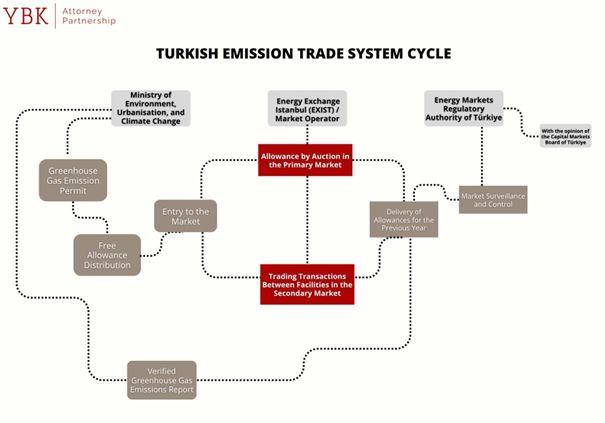
- Turkish ETS Market: The entirety of primary and secondary markets where emission allowances and approved standard contracts that may be subject to related emissions trading are bought and sold. These markets are organised and operated by the authorised market operator. Energy Markets Regulatory Authority (EMRA) of Türkiye granted the Energy Markets Operation License to Energy Exchange Istanbul (EXIST) ("Enerji Piyasaları İşletme Anonim Şirketi" or "EPİAŞ" in Turkish), which is responsible for managing and operating energy markets, including power, gas and environmental commodities under Turkish Energy Law.
- Greenhouse gas emission permit: Under the Turkish ETS, businesses that carry out activities that cause direct greenhouse gas emissions, as defined by regulation, must obtain a greenhouse gas emission permit from the Directorate of Climate Change to continue their activities. The Directorate of Climate Change was established as an affiliated institution of the Ministry of Environment, Urbanisation, and Climate Change with Presidential Decree No. 85 dated 29 October 2021.
- Free allowance: Within specified limits, some facilities may be granted partial free allowance. These allowances are determined based on numerous technical criteria, such as sectoral carbon intensity, technological adequacy, and emissions history.
- Primary Market Transactions: Carbon allowances are sold through auctions in the primary Allowances are a tool that provides liquidity to the market and creates price signals.
- Secondary Market Transactions: Transactions between facilities take place in the secondary market. The spot market is also considered within this scope.
- Verification Process: Each facility must have its annual emissions report approved by authorised verifiers. These verifiers are independent organisations licensed under Circular No. 24128.
- Fulfilment of Obligations: Each facility submits allowances to the official authorities equal to the verified emissions of the previous year.
- Adjustment Mechanism: Facilities that find their allowances insufficient may fulfil their obligations by investing in carbon adjustment projects or purchasing carbon credits.
Within this scope, the Turkish ETS cycle is as follows:
3. Implementation Timetable
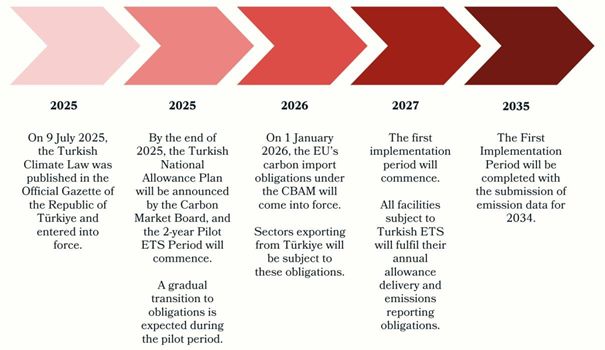
The Turkish Climate Law has structured the transition process in a multi-stage and phased manner. The critical dates are as follows:
4. Obligated Facilities and System Actors
Businesses carrying out activities that cause specific direct greenhouse gas emissions will be included in the Turkish ETS. Obligated facilities will be determined by regulation.
On 22 July 2025, the Directorate of Climate Change published a draft Türkiye Emissions Trading System Regulation (Draft Turkish ETS Regulation). The Draft Turkish ETS Regulation envisages the inclusion in the Turkish ETS of responsible natural persons, legal entities, and public institutions and organisations that carry out activities meeting the thresholds listed in Annexe 1, or that operate and have the right to use the facility. Since the Turkish ETS Regulation has not yet entered into force, it may be subject to changes based on public consultation.
The actors in the system and the relevant legislation are as follows:
- Directorate of Climate Change: Responsible for managing allowance processes and determining the use of carbon credits within the Turkish ETS. Its duties and activities are regulated under Articles 8 and 11 of the Turkish Climate Law.
- EMRA (Energy Markets Regulatory Authority of Türkiye): Responsible for market surveillance and supervision, identifying market-distorting behaviour, and imposing penalties. Its duties and activities are regulated by Article 14 of the Turkish Climate Law, Article 18 of the Electricity Market Law, and the Draft Regulation on the Operation of Carbon Markets.
- EXIST (Energy Exchange Istanbul): "Enerji Piyasaları İşletme Anonim Şirketi" or "EPİAŞ" in Turkish. Responsible for the operation of the primary and secondary markets and financial Its duties and activities are regulated by Article 18 of the Turkish Climate Law and the Communiqué on the Verification of Greenhouse Gas Emission Reports and the Accreditation of Verification Bodies.
- Carbon Market Board: Responsible for determining the scope of the pilot implementation period, preparing the National Allowance Plan, and establishing market Its duties and activities are regulated by Articles 6, 7, and Transitional Article 1 of the Turkish Climate Law.
- Verification Bodies: Responsible for verifying emission Their duties and activities are regulated by the Communiqué on the Verification of Greenhouse Gas Emission Reports and the Accreditation of Verification Bodies.
- Republic of Türkiye Ministry of Trade: Responsible for determining the reporting, scope, content, procedures and principles related to the Turkish CBAM. Its duties and activities are regulated by Article 8 of the Turkish Climate Law.
5. Obligations, Violations and Sanctions
- Greenhouse Gas Emission Permit Obligation
All obligated facilities must obtain a greenhouse gas emission permit under the Turkish Climate Law by 9 July 2028 at the latest. This permit is a prerequisite for continuing activities under the Turkish ETS.
Businesses operating without a greenhouse gas emission permit shall be subject to an administrative fine of 5 Turkish Lira (TRY) per tonne of carbon dioxide equivalent based on the highest reported value, if a verified emissions report is available. If no verified report is available, the imposed administrative fine shall range from TRY 1,000,000 to TRY 10,000,000.
b. Emissions Reporting and Allowance Delivery
Each year, the greenhouse gas emissions of facilities must be reported to the Directorate of Climate Change after being verified by independent verification bodies. The amount of allowance corresponding to the reported emissions must be submitted to the Directorate by the end of the year. The submitted allowances can be covered by the free allowance portion and carbon credits acquired from the market. In the event of insufficient allowances, businesses may fulfil their obligations by investing in carbon adjustment projects or purchasing carbon credits.
Failure to submit the verified greenhouse gas emissions report to the Directorate of Climate Change within the specified timeframe will result in an administrative fine ranging from TRY 500,000 to TRY 5,000,000 being imposed on the business. If this offence is committed by
facilities covered by the Turkish ETS, the administrative fine shall be doubled, and all transactions other than the delivery obligation shall be blocked in the system.
Businesses that fail to fulfil their Turkish ETS allowance delivery obligation for three consecutive years and by at least 80% shall have their greenhouse gas emission permits revoked. These businesses shall not be granted new permits for a period of three to six months.
c. Integration into the Digital Recording and Monitoring System
All facilities and market participants shall report through integration into the national digital recording and monitoring system. Allowance transfers, trading transactions, emission data and compliance tracking shall be conducted through the system.
d. Obligations and Sanctions of Verification Bodies
Organisations responsible for verifying emission reports must be accredited by TÜRKAK (Turkish Accreditation Agency) which is affiliated with the Ministry of Foreign Affairs of Türkiye, and hold Authorised Verifier status. In the event of false, incomplete or misleading statements, the authorisation of verifying organisations may be suspended or revoked.
e. Violations Related to Ozone-Depleting Substances
It is prohibited to use, import, trade or place ozone-depleting substances on the market. If such acts are detected, an administrative fine of TRY 2,500,000 shall be imposed.
Furthermore, providing maintenance, repair, or servicing for products or equipment containing these substances shall result in an administrative fine of TRY 250,000, and failure to comply with labelling requirements shall result in an administrative fine of TRY 120,000.
f. Violations Related to Fluorinated Greenhouse Gases
The use, trade, or supply to the market of fluorinated greenhouse gases is prohibited. If these acts are committed, an administrative fine of TRY 2,500,000 shall be imposed, and a Hydrofluorocarbon (HFC) Control Certificate shall not be issued for a period of three to six months.
The import of HFCs in excess of the quota or without a quota shall result in an administrative fine of TRY 1,000,000 and a reduction in the import quota for the following year.
An administrative fine of TRY 120,000 shall be imposed on those who fail to comply with the labelling provisions for products or equipment containing fluorinated greenhouse gases and those who fail to enter or update their notifications/reports into the database within the specified time. Furthermore, the same amount of administrative fine shall be imposed in the event of unauthorised interference with equipment containing fluorinated greenhouse gases or operating with such gases.
g. Breach of Project Registration Obligation
Pursuant to Article 11(5) of the Turkish Climate Law, if projects related to carbon credit production are not registered in the Directorate of Climate Change carbon credit registration
system within the specified period, project owners shall be subject to an administrative fine of TRY 120,000.
h. Violation of the Obligation to Provide Information and Documents
Failure to provide information, documents, or data requested by the Directorate of Climate Change, or making misleading statements, shall result in an administrative fine of TRY 170,000.
i. Violation of Electricity Market Legislation and Market Disruptive Behaviour
In the context of activities subjected to the Turkish Climate Law, if there is behaviour infringing the electricity market legislation, an administrative fine shall be imposed by EMRA in accordance with the provisions of the Electricity Market Law No. 6446.
Where a conduct detrimental to the proper functioning of the market is identified (such as manipulation, non-disclosure of information etc.), such violations shall be assessed by EMRA. Administrative fines of up to TRY 2,000,000 for natural persons and up to TRY 20,000,000 for legal entities may be imposed. In addition, market activity authorisations may be temporarily suspended in whole or in part.
6. Carbon Border Adjustment Mechanism (CBAM) at the National Level
Another novelty introduced by the Turkish Climate Law is the provision of the necessary legal basis for establishing a CBAM at the national level to address the embedded greenhouse gas emissions of goods imported into the Turkish Customs Territory where deemed necessary by the Turkish Ministry of Trade, as is the case in the EU CBAM. Embedded greenhouse gas emissions refer to direct emissions arising from the production process of a product and indirect emissions resulting from the use of energy such as electricity, heat, steam, cooling and compressed air in the production process of the product.
The Turkish ETS imposes certain obligations on domestic producers. In return, it is essential to prevent circumvention of the obligations imposed by the ETS through imports and the shift of domestic production to countries with no or low emission targets in order to protect market competition and the domestic industry. The explanatory memorandum to the Turkish Climate Law states that the aim is to establish the ETS at the national level to support the fight against global climate change and to protect trade and industry in Türkiye.
In the event of a CBAM at the national level being established, importer companies in Türkiye may face additional financial obligations imposed by the Republic of Türkiye on imports from countries with low emission targets and processes that do not impose ETS-like obligations. Therefore, regulations to be issued by the Turkish Ministry of Trade regarding the Turkish CBAM should be closely monitored, particularly by importing companies.
7. Conclusion and Assessment
The Turkish Climate Law is Türkiye's first concrete legal step towards the targets of reducing greenhouse gas emissions, which have been adopted by the United Nations and many different countries since 1992. In this context, the Emissions Trading System has introduced obligations for facilities with production processes that emit greenhouse gases.
The financial obligations of the European Union's Carbon Border Adjustment Mechanism will come into force in 2026. Furthermore, within the scope of the Turkish Climate Law, the Turkish Ministry of Trade also aims to establish a national Carbon Border Adjustment Mechanism. These two issues may affect exporters and importers based in Türkiye, resulting in additional financial obligations in foreign trade processes.
It is essential for businesses engaged in production and trade in Türkiye, as well as those involved in import and export, to review the obligations introduced by the Turkish Climate Law, plan their activities according to the implementation schedule, and closely monitor the secondary legislation to be issued by the relevant public institutions to avoid administrative sanctions and additional financial obligations.
Sources
- EU Carbon Border Adjustment Mechanism – European Commission website (https://commission.europa.eu/)
(https://taxation-customs.ec.europa.eu/carbon-border-adjustment-mechanism_en#cbam)
- EU Carbon Border Adjustment Mechanism – Turkish Ministry of Trade website (https://ticaret.gov.tr)
(https://ticaret.gov.tr/dis-iliskiler/yesil-mutabakat/ab-sinirda-karbon-duzenleme- mekanizmasi/skdm-bilgilendirme-belgeleri)
- European Union Emissions Trading System – European Commission website (https://commission.europa.eu/)
(https://climate.ec.europa.eu/eu-action/carbon-markets/eu-emissions-trading-system-eu- ets_en)
- European Green Deal – European Commission website (https://commission.europa.eu/)
(https://commission.europa.eu/strategy-and-policy/priorities-2019-2024/european-green- deal_en)
- Efe Murat Bulut, Sena Şahin. "Karbon Ticaretinde Türkiye İçin Önemli Bir Yıl : 2025" [An Important Year for Turkey in Carbon Trading: 2025], 02.06.2025, mondaq (https://www.mondaq.com/)
(https://www.mondaq.com/turkey/oil-gas-electricity/1632444/karbon-ticaretinde-türkiye-İçin- Önemli-bir-yıl-2025)
- Chapter 27: Environment and Climate Change – Republic of Türkiye Ministry of Foreign Affairs Directorate for EU Affairs website (https://www.ab.gov.tr)
(https://www.ab.gov.tr/fasil-27-cevre_92.html)
- Turkish Climate Law – Official Gazette of the Republic of Türkiye website (https://www.resmigazete.gov.tr)
(https://www.resmigazete.gov.tr/eskiler/2025/07/20250709-1.htm)
- Recitals of the Turkish Climate Law and Environment Committee Report – Grand National Assembly of Türkiye website (https://www.tbmm.gov.tr/)
(https://cdn.tbmm.gov.tr/KKBSPublicFile/D28/Y3/T2/DosyaKomisyonRaporunuVerdi/d929e 28a-eafd-472b-a1a7- 21fc0232ac33.pdf?TSPD_101_R0=08ffcef486ab2000500853ab989e43a4b4bdfdcd4ac3e2ea0 85a0703cb5bd00f38200d90f026d46008ac6fef11143000b58436c86891152d9a786a583be78e4
62f65e6d86e2b3a08cabd39bc6294ac202097cb17e6ede739f659140dc6e6976b)
- Green Deal Action Plan – Turkish Ministry of Trade website (https://ticaret.gov.tr) (https://ticaret.gov.tr/data/60f1200013b876eb28421b23/MUTABAKAT%20YE%C5%9E%C4
- Basic Concepts - Directorate of Climate Change website (https://iklim.gov.tr) (https://iklim.gov.tr/sss/temel-kavramlar)
- History of Turkey–EU Relations – Republic of Türkiye Ministry of Foreign Affairs Directorate for EU Affairs website (https://www.ab.gov.tr)
(https://www.ab.gov.tr/turkiye-ab-iliskilerinin-tarihcesi_111.html)
- Türkiye Foreign Trade Country Data – World Trade Organisation website (https://www.wto.org)
(https://www.wto.org/english/thewto_e/countries_e/turkey_e.htm)
- Turkey Emissions Trading System Regulation Has Been Published - Directorate of Climate Change website (https://iklim.gov.tr)
(https://iklim.gov.tr/turkiye-emisyon-ticaret-sistemi-yonetmeligi-taslagi-yayimlandi-haber- 4519)
The content of this article is intended to provide a general guide to the subject matter. Specialist advice should be sought about your specific circumstances.