Termination of employment in Poland is governed by detailed regulations of the Polish Labor Code, which aim to balance the interests of both employers and employees. Whether you're an HR professional, international investor, or an employee working in Poland, understanding the legal framework of employment termination is essential.
From notice periods and mutual agreements to disciplinary dismissal and special protection rules — Polish labor law defines clear procedures and deadlines for ending employment contracts. This guide provides an updated overview of how employment can be lawfully terminated in Poland in 2026, including recent legislative changes impacting work seniority and notice periods.
Termination of employment in Poland
In Poland, the most common form of hiring employees are employment contracts: concluded for a definite or indefinite period of time and also for a trial period.
There are a few ways to terminate the employment contract in Poland. Among them we can distinguish:
- bilateral actions:
- mutual agreement of the parties;
- one-sided actions
- termination with a notice period;
- disciplinary termination by the employer (without notice period);
- disciplinary termination by the employee (without notice period).
If the employment contract was concluded for a fixed amount of time it is also terminated with the lapse of time for which the contract was concluded.
Mutual termination agreement
The employment contract can be terminated by the agreement of both parties. This is the fastest and most amicable way to end the employment relationship.
It allows the parties to agree on the exact terms of termination and to settle all liabilities arising from the employment contract.
In the mutual termination agreement the parties can establish:
- the exact date of the termination of the contract – meaning if it will happen immediately or after the lapse of a certain time period;
- if the employee will be obliged to use the remaining annual leave or will be paid a cash equivalent for the outstanding amount of leave;
- payments between the parties – including the remuneration, severance, compensation, bonuses etc.
- if the employee will be released from the obligation to perform work during the last days of his employment;
- additional obligations of the employee after terminating the contract, e.g. return of the company equipment, non-competition clauses, non-disclosure clauses.
Benefits of a mutual termination
Concluding a mutual termination agreement helps the employer to avoid any possible dispute and part ways amicably.
However it requires both parties to agree on the terms of the agreement, which may prove difficult if there is a conflict between the parties. It is a common practice among the employers that in order to persuade the employee to conclude the mutual termination agreement they offer the employee some additional benefit, e.g. a financial benefit in the amount of one-month remuneration.
Mutual termination agreement can prove useful in a situations where the employee cannot be terminated by notice, because he/she is entitled to the special protection against dismissal provided for by law. In such cases the mutual agreement with the protected employee can still be concluded, because the provisions of law provide the protection only from the termination with a notice period. This opens up a way to terminate the contract with the employee during: pregnancy, maternity leave, holiday leave or in a pre-retirement age.
Required form of the mutual agreement
The mutual termination agreement shall be concluded in writing and be signed by both parties by hand (with a so-called 'wet signature'). Oral form is considered valid but non-recommendable, since the exact terms of the contract would be difficult to prove in case of a dispute.
Termination with a notice period
The most common way to dissolve the employment contract in Poland is termination with a notice period. It is a one-sided action of the employer or the employee, who ends the contract by issuing a letter to the other party about terminating the contract with a notice period.
Polish Labor Code provides for statutory notice periods, which apply to every employment contract, even those concluded for a fixed amount of time. We can distinguish different notice periods depending on the type of the contract and the length of the work seniority of a person who is to be terminated.
Statutory notice periods
From 2026, the calculation of work seniority - which determines the applicable notice period — may include certain periods under civil‑law contracts (e.g., contracts of mandate/zlecenie), periods of self‑employment where social contributions were paid, and certain foreign employment periods where comparable contributions were made.
This can affect which notice period (e.g., 2 weeks / 1 month / 2 months) applies in a given case.
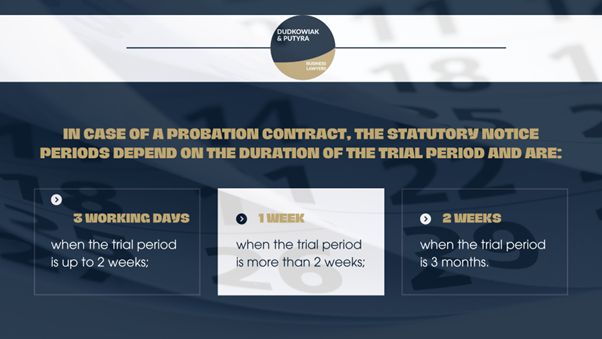
In case of a probation contract, the statutory notice periods depend on the duration of the trial period and are:
- 3 working days – when the trial period is up to 2 weeks;
- 1 week – when the trial period is more than 2 weeks;
- 2 weeks – when the trial period is 3 months.
In case of a definite or an indefinite contract, the statutory notice periods depend on the length of the work seniority (period of employment at a certain enterprise) and are:
- 2 weeks – when the employee works for a certain employer for less than 6 months;
- 1 month – when the employee works for a certain employer for more than 6 months;
- 2 months – when the employee works for a certain employer for more than 3 years.
Notice period counted in months always starts on the first day of the following calendar month and ends after the lapse of the notice period, on the last day of the month.
Notice period counted in weeks always starts on the first Sunday following the delivery of the termination notice and ends on Saturday (after the lapse of 2 weeks' notice period).
Form and delivery of the termination letter
Terminating an employment contract requires a written form of the letter, signed with a hand-written signature (so-called 'wet signature'). It can also have a form of an electronic document, provided that the signing party possesses a qualified electronic signature.
The general rule is that the termination letter shall be delivered to the other party in person, e.g. during a meeting with an employee. However, if is results difficult or impossible, the termination letter can be delivered by post in a form of a registered letter or by email – if the termination letter has a form of electronic document.
What should be included in a termination letter?
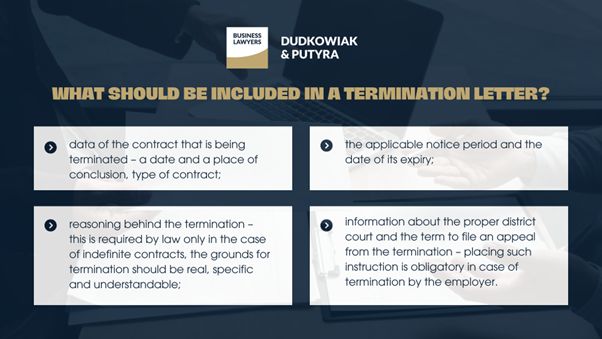
In the termination letter the terminating party shall indicate:
- data of the contract that is being terminated – a date and a place of conclusion, type of contract;
- the applicable notice period and the date of its expiry;
- reasoning behind the termination – this is required by law only in the case of indefinite contracts, the grounds for termination should be real, specific and understandable;
- information about the proper district court and the term to file an appeal from the termination – placing such instruction is obligatory in case of termination by the employer.
Additionally, the employer may include in the termination letter:
- information about the amount of outstanding leave and the obligation to use it during the notice period or alternatively – information about a right to the cash equivalent for the unused leave;
- information that the employee is being released from the obligation to perform work during the notice period – this is entirely optional and at the discretion of the employer;
- additional obligations of the employee after terminating the contract, e.g. return of the company equipment, non-competition clauses, non-disclosure clauses.
Disciplinary termination
The least common and also the least amicable way to end the employment contract is a disciplinary termination, which allows to terminate the contract without adhering to the applicable notice period.
Disciplinary termination may happen only in case of a grave and valid reason, for example when:
- there is a gross violation of the basic duties of the employee, e.g. working under the influence of alcohol;
- the employee can no longer perform work due to the loss of the required license;
- employee commits an offence or a crime during employment.
The employee can also terminate his contract in a disciplinary mode in case of a gross violation of the employer's duties, e.g. when the employer has been in arrears with payment of remuneration for a substantial amount of time.
Requirement for a disciplinary termination
What is important, the disciplinary termination is restricted with a 1 month deadline, counted from the date when the terminating party learned about the grounds for termination.
Disciplinary termination requires the same form and delivery methods as the regular termination letter. It also has a similar content - but differs from the regular termination letter in the obligation to state and explain a serious reason for terminating the contract.
In case of a disciplinary termination, the contract is ended with immediate effect, which – if done by the employer – usually entails the obligation to pay the employee a cash equivalent for unused leave.
Appeal against the termination
Employee has a right to appeal from his termination, regardless if it was made in a regular or a disciplinary mode.
Employee can appeal to the court of law if he/she considers the termination:
- unjustified – e.g. made with no specific reason, with a reason that the employee does not agree with, or with a reason than differs from the actual reason (the reason given on paper differs from reality);
- unlawful - e.g. made without formal requirements for termination of employment.
In case of the dispute before the labor court, the employer will have to prove that the termination was either lawful or justified. In each case the burden of proof is solely on the side of the employer.
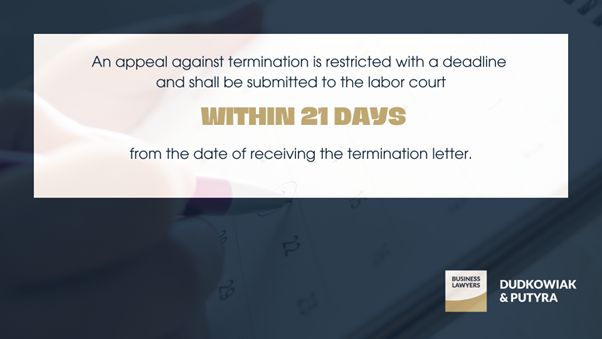
An appeal against termination is restricted with a deadline and shall be submitted to the labor court within 21 days from the date of receiving the termination letter.
In the appeal the employee can demand either compensation or reinstatement to work. The choice of demand is at the discretion of the employee, however, the final decision as to whether the employee will be reinstated or awarded compensation rests with the court.
Special protection against the termination
All employees are protected against termination during holiday leaves and other types of justified absence (e.g. sick leave). However, there are also certain categories of employees that are provided with special protection provided by law:
- employee in pre-retirement age (4 years prior to reaching retirement age);
- female employee during pregnancy or maternity leave (except from the pregnant employee during her trial period, when the trial period is no longer than 1 month);
- member of the company's trade union organizations and trade union officer or other persons designated by the trade union as being protected against termination.
Regular termination made against an employee who is protected is considered null and void. However, it shall be clarified that protection rules do not work against disciplinary termination, they also do not forbid to conclude a mutual termination agreement with the protected employee.
Final thoughts
Navigating employment termination in Poland requires a clear understanding of local legal requirements and procedures. Whether you're an employer aiming to ensure compliance, or an employee protecting your rights, it's crucial to follow the formalities outlined in the Polish Labor Code.
For a broader perspective on hiring, managing, and terminating employees in Poland, be sure to consult our full Employment Law Guide. It provides practical insights and legal foundations essential for employers and HR professionals operating in the Polish market.
The content of this article is intended to provide a general guide to the subject matter. Specialist advice should be sought about your specific circumstances.