What is the EU Retail Investment Strategy?
The EU Retail Investment Strategy is a legislative package which introduces significant changes to the UCITS Directive and AIFMD, as well as MiFID II, the Insurance Distribution Directive and the Solvency II Directive via an omnibus directive (Omnibus Directive). It also makes some key changes to the PRIIPs framework via an amending regulation (Amending PRIIPs Regulation).
With an objective of encouraging retail participation in capital markets, the reforms to the UCITS and AIFMD frameworks and the Amending PRIIPS Regulation are intended to improve the value for money provided by investment products marketed to retail investors as well improving the transparency and quality of disclosures of such products.
In June of this year, the Omnibus Directive and the Amending PRIIPS Regulation were approved by the Council of the EU in COREPER and by the European Parliament in ECON. This was followed in August by the European Commission writing to ESMA to request it to prepare related technical standards by 1 October 2027.
In this briefing, we focus on the key changes to the UCITS, AIFMD and PRIIPs frameworks introduced by the EU Retail Investment Strategy, expected timeframes and some of the key implications of the new framework for UCITS management companies and AIFMs (Fund Managers). Fund Managers with additional individual portfolio management permissions may be subject to additional requirements which go beyond the scope of this briefing.
At a glance, what are the key changes impacting Fund Managers being introduced under the EU Retail Investment Strategy?
-
Introduction of an enhanced new undue costs assessment framework which must be implemented in respect of all funds under management
-
Introduction of a new Value for Money assessment for those funds which are made available to retail investors in the EU. This includes an obligation to compare the fund’s performance and costs against similar funds selected by the Fund Manager for the purposes of performing a peer group comparison
-
Extension of reporting framework to national competent authorities to include information on funds’ costs and performance
-
Introduction of the concept of “simple advice” under the MiFID suitability assessment framework
-
Extension of the scope of entities and natural persons who can choose to “opt up” to a professional client under the MiFID framework
-
Significant changes to the PRIIPS framework which will be relevant to any Fund Manager which makes their funds under management available to retail investors in the EU.
Where are we now?
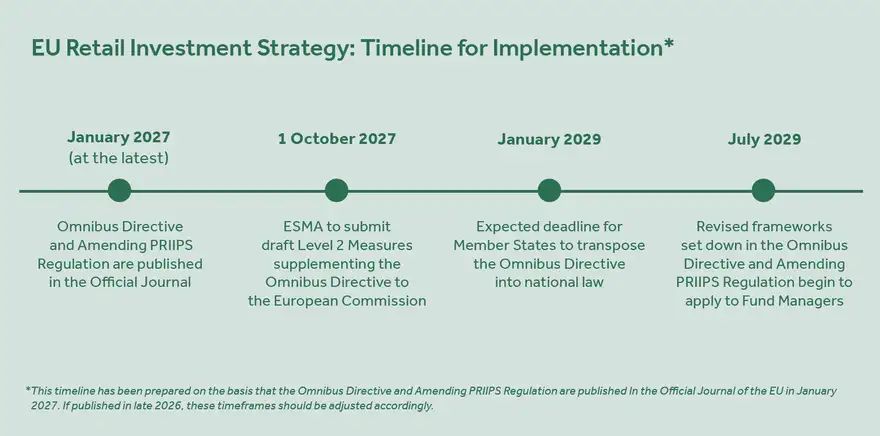
The timeline below outlines the key dates in the legislative journey of the EU Retail Investment Strategy.
Undue Costs Assessment
Under existing rules, Fund Managers are already required to make sure that investors in funds under management are not charged undue costs.
The revised frameworks will put on a legislative footing an obligation on Fund Managers to carry out an undue costs assessment of each fund under management on a periodic basis.
Unlike the Value for Money assessment discussed further below, the undue cost assessment must be carried out by the Fund Manager in respect of all funds under management, regardless of whether or not marketed solely to retail investors in the EU. The assessment must be carried out (i) prior to the fund being authorised and (ii) on an annual basis thereafter.
What does the undue costs assessment comprise of?
This process should comprise of:
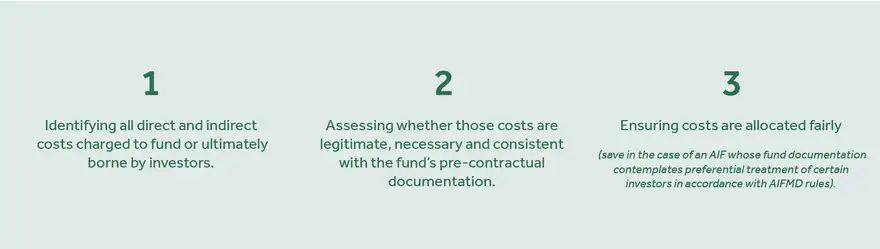
Fund Managers should be able to demonstrate that costs incurred are in line with the fund’s pre-contractual documentation, are necessary to the functioning of the fund and are borne by investors fairly.
The regulatory technical standards which will supplement the Omnibus Directive will set down a list of eligible costs that may be legitimately charged to a fund and its investors.
If it is intended to charge a cost which does not appear on that list of eligible costs, the approval of the fund’s national competent authority (NCA) must be obtained.
What happens if an assessment determines that investors have borne undue costs?
If an assessment determines that undue costs have been charged, impacted investors must be reimbursed.
Importantly, the charging of any such undue costs must also be notified to the relevant NCA, fund auditor and the fund depositary.
The criteria to determine the level of compensation payable will be set down in regulatory technical standards supplementing the Omnibus Directive.
Value for Money Assessments
The undue costs framework outlined above is further supplemented by an obligation on the Fund Manager to carry out an additional Value for Money (VfM) assessment in respect of any UCITS or AIF under management which is made available to retail investors in the EU.
What does the VfM assessment comprise of?
The VfM assessment requires the relevant Fund Manager to assess whether costs borne by retail investors are justified and proportionate having regard to the performance of the fund and the characteristics, objectives, investment strategy and marketing strategy of that fund.
Importantly, this includes carrying out a peer group comparison against other EU funds with similar characteristics to determine how the costs and performance of the fund compare to the costs and performance of those other funds within the peer group. The objective of the peer assessment is to identify and remove outliers which are not in line with the average costs and performance of funds within their peer group.
The assessment (including peer assessment) to be carried out must consider the investment strategy, marketing strategy, risk profile, recommended holding period and whether the fund in question is actively or passively managed. The selection of eligible funds for the composition of the relevant peer group should be selected from the Member State(s) in which the relevant fund will be marketed.
If a Fund Manager cannot identify a relevant peer group for its fund, it must nonetheless carry out a value for money assessment against criteria which will be set down in supplementing regulatory technical standards.
We should have further clarity on the peer group assessments once ESMA delivers its draft regulatory technical standards on the VfM framework to the European Commission on or before 1 October 2027.
The VfM must be carried out before the fund is authorised by the relevant NCA. A regular review must also be carried out thereafter to ascertain whether the fund continues to offer value for money.
What happens if the VfM reveals that the fund’s costs are significantly higher than the average of the peer group?
If the fund is “at a significant distance” from the average of the peer group, additional testing and assessment should be carried out to substantiate that the fund offers value for money. If the Fund Manager cannot confirm that value for money will be ensured, the Fund Manager must take “appropriate action”. This includes either (i) changing the costs structure of the relevant fund or (ii) withdrawing it from the retail investor market.
VfM assessments must also be provided to the relevant NCA on request. If the NCA determines that the fund does not offer value for money, it can require the Fund Manager to take steps to ensure compliance with the “value for money requirement” and/or impose sanctions for failure to do so.
Obligation to report costs and performance information to NCAs
Under the revised frameworks, Fund Managers will, as part of their regular reporting to the NCAs, be required to provide NCAs with information on the costs and charges borne by investors as well information on the performance of the relevant fund. The details of what will need to be reported by each Fund Manager will be set down in regulatory technical standards.
Change of definition of “professional client” under MiFID II
The framework also extends the scope of those who may opt-up to be classified as “professional clients” under the MiFID framework.
For example, under the new framework, transaction size thresholds for assessments of a client’s wealth will be lowered and a legal entity’s balance sheet turnover, net turnover and own funds requirements should be taken into account when determining whether it constitutes a “professional client”. Managers or directors of regulated firms can also be regarded as professional clients where they are directly involved in the relevant investment entity’s investment activity.
This will extend the types of investors in respect of which an AIFM can use its EU marketing passport under AIFMD.
Introduction of the concept of “simple advice” under MiFID II
One other aspect of the Retail Investment Strategy framework which may be of interest to Fund Managers is the introduction of the concept of “simple advice” under MiFID II.
Under this framework, MiFID investment firms will be able to carry out a simplified suitability assessment where they are only offering “well-diversified, non-complex and cost-efficient financial instruments” to their retail clients. An obligation to collect information on their clients’ knowledge or experience of the financial markets or their existing portfolios will not arise in such circumstances.
ESMA is tasked with setting down a definition of financial instruments that qualify as well-diversified, non-complex and cost efficient for the purpose of provision of “simple advice”.
Changes to the PRIIPS Regulation
Key changes proposed to the PRIIPS Regulation which will be of relevance to Fund Managers include:
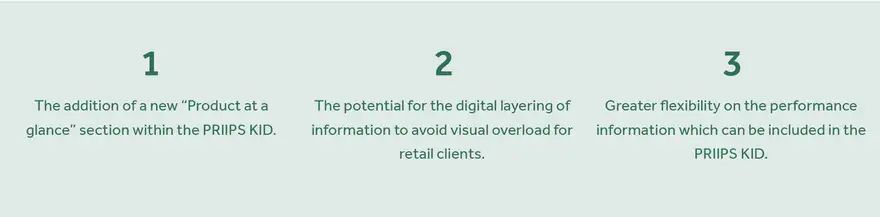
Despite the introduction of the new “Product at a glance” section, the three-page limit will continue to apply.
What happens next?
The Omnibus Directive and Amending PRIIPS Regulation are expected to be formally adopted by the Council of the EU and the EU Parliament in Quarter 4 2026 so we can expect to see the finalised legislation published in the Official Journal of the EU by January 2027 at the latest.
We can also expect the related regulatory technical standards which will provide important clarity on the concepts of (i) undue costs assessments, (ii) VfM assessments (iii) reporting obligations and (iv) the concept of “simple advice” under the MiFID framework to be delivered by ESMA to the European Commission by 1 October 2027. It is worth noting that the European Commission is not bound by ESMA’s advices so we may see a divergence between what is proposed by ESMA and the finalised suite of rules adopted by the European Commission.
As noted above, Fund Managers are likely be required to comply with the new frameworks in full by July 2029.
For the moment, Fund Managers should continue to monitor developments. Once the related regulatory technical standards have been adopted by the European Commission, a full gap analysis to identify changes which may be required to be made to existing governance frameworks and PRIIPs KID ahead of the implementation deadline should be carried out.
The content of this article is intended to provide a general guide to the subject matter. Specialist advice should be sought about your specific circumstances.
[View Source]