Introduction
The dawn of 2026 brings a wave of strategic investments reshaping East Africa's economic horizon across energy, infrastructure, technology, and health sectors. In Uganda and Tanzania, the East African Crude Oil Pipeline (EACOP) has reached 79% completion, creating 12,000 jobs and set to begin crude exports by October 2026, positioning both countries as emerging hubs for energy and regional trade. Rwanda has seen global capital flow into technology infrastructure, with International Holding Company (IHC) acquiring a 70% stake in Peko Holdings, highlighting growing investor interest in scalable digital platforms. In the Democratic Republic of Congo, Ivanhoe Mines has produced its first copper anodes at the Kamoa-Kakula complex, advancing value addition and strengthening the country's role in global copper supply chains. Somalia is entering the offshore energy arena, with Turkey launching its first deep water oil and gas exploration venture in February 2026, signalling opportunities in energy services and upstream partnerships. Meanwhile, South Sudan is enhancing its healthcare infrastructure through a UNICEF and UK FCDO-supported programme, underscoring the role of development projects in fostering stable environments for investment. These developments reflect a dynamic East African investment landscape, offering perse opportunities for foreign investors across energy, infrastructure, technology, and social development sectors.
Trend of the week
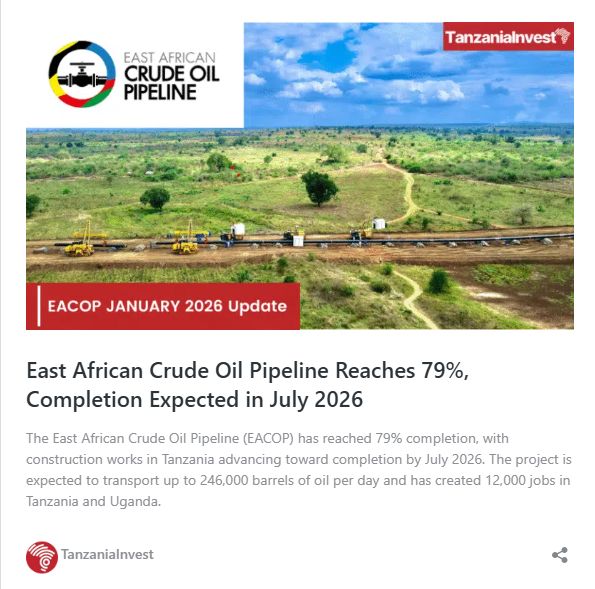
East African crude oil pipeline hits 79% completion
The East African Crude Oil Pipeline (EACOP) has reached 79% completion, with construction in Tanzania on track for full commissioning by July 2026. Stretching from Hoima in Uganda to the Chongoleani terminal in Tanzania's Tanga region, the pipeline is set to transport up to 246,000 barrels of crude oil per day, positioning East Africa as an emerging hub for oil exports. The project has already created approximately 12,000 jobs across Tanzania and Uganda, engaging local youth and communities in construction, logistics, and related support services. Officials from both countries emphasized the strategic economic impact of EACOP. Tanzania's Minister of Energy, Deogratius Ndejembi, highlighted the completion timeline and the operational capacity, while Uganda's Minister of Energy and Mineral Development, Dr. Ruth Nankabirwa, praised the project for driving regional economic transformation and called for the formal identification of skilled workers to participate in future infrastructure initiatives, including planned gas and electricity projects. The pipeline is expected to catalyse growth in energy exports, logistics, industrial clusters, and regional trade, offering long-term investment opportunities in East Africa's energy and infrastructure sectors.
EACOP represents a clear, large-scale infrastructure opportunity with tangible outputs, job creation, and regional integration benefits. The project underscores East Africa's improving investment climate, highlighting government commitment, cross-border collaboration, and a focus on sustainable economic development in energy and industrial sectors.
Tanzania
Uganda-Tanzania mega pipeline project poised to transform regional oil sector
Uganda and Tanzania have confirmed that the East African Crude Oil Pipeline (EACOP) is on track to begin exporting crude oil in October 2026, marking a landmark moment for East Africa's energy and investment landscape. With construction now approximately 79% complete, the 1,443-kilometre heated pipeline will connect Uganda's Lake Albert oilfields to the Tanga Marine Terminal on Tanzania's Indian Ocean coast, with an export capacity of up to 246,000 barrels per day. Beyond oil exports, EACOP is set to catalyse economic transformation: Uganda gains a long-awaited route to monetise its landlocked oil resources, while Tanzania stands to benefit from transit fees, infrastructure development, skills transfer, and local enterprise participation. The project has already created thousands of jobs and engaged SMEs in logistics, hospitality, and support services along the corridor, highlighting its local content impact. Backed by a syndicate of African and international banks, including Afreximbank, Standard Bank, and KCB Bank, the pipeline underscores investor confidence in the region's energy sector. Strategically, EACOP strengthens regional integration, aligns with Tanzania's economic persification goals, and opens new avenues for investment in oil, gas, industrial clusters, and ancillary infrastructure, including roads, power lines, fibre connectivity, and marine terminals. For foreign investors, the project offers tangible exposure to East Africa's emerging oil sector, a robust platform for industrial growth, and opportunities to participate in one of the region's most transformative energy corridors.
Uganda
Uganda enters 2026 with growth potential and structural reform in focus
As Uganda moves into 2026, the country's economic outlook is shaped by cautious optimism and growing expectations around medium-term growth. Economic analysts highlight steady recovery momentum supported by continued public investment, regional trade integration and the anticipated start of oil production later in the year. At the same time, structural challenges remain, particularly around fiscal discipline, revenue mobilisation, foreign exchange pressures and debt management. Government priorities are increasingly focused on strengthening domestic revenues, improving financial stability and sustaining investment in infrastructure and productive sectors to support long-term economic resilience. For foreign investors, Uganda presents a market of opportunity tempered by risk. The approaching oil production milestone and continued infrastructure development offer potential upside in energy, logistics and support services, while broader reforms aim to improve the investment climate. However, policy consistency, macroeconomic stability and execution capacity remain critical variables to monitor. Investors are therefore likely to find Uganda attractive for medium- to long-term positioning, provided risks are carefully priced and engagement is aligned with evolving fiscal and regulatory conditions.
Rwanda
IHC deepens technology bet with 70% Peko acquisition as global capital targets scalable digital infrastructure
Global investment firm International Holding Company (IHC) has deepened its footprint in future-ready digital infrastructure through the acquisition of a 70% stake in Peko Holdings Limited, a technology-driven company delivering an integrated platform that simplifies and automates core business operations. Peko's all-in-one digital solution enables businesses to manage payments, payroll, invoicing, corporate cards, compliance, travel, and administrative workflows through a single interface, significantly reducing operational friction while improving productivity and scalability. Built on a modular, platform-as-a-service model, Peko addresses growing demand among SMEs and mid-market firms for modern, automated infrastructure to replace fragmented legacy systems, underpinned by recurring subscription revenues, strong customer retention, and high scalability. The platform is further strengthened by embedded artificial intelligence, including an AI-powered assistant designed to automate routine functions such as expense management, forecasting, and documentation. For Rwanda, where digital adoption among SMEs continues to accelerate, this investment highlights the rising importance of scalable enterprise infrastructure in supporting business formalisation, efficiency, and growth. The deal signals increasing global capital interest in Africa-relevant digital platforms with strong governance, scalable revenue models, and regional expansion potential reinforcing East Africa's attractiveness as a destination for long-term, technology-led investment.
Democratic of Congo
Ivanhoe advances value addition strategy with first copper anodes at Kamoa-Kakula
Canadian mining company Ivanhoe Mines has achieved a major operational milestone at its Kamoa-Kakula copper complex in the Democratic Republic of Congo, with the production of the first copper anodes from its newly commissioned, 500,000-ton-per-year direct-to-blister smelter. This achievement comes just five weeks after the facility began commissioning and marks a key step in the company's strategy to expand output and advance value addition locally rather than exporting raw concentrate. The project is backed by approximately USD 1.1 billion in capital investment and disciplined execution involving over 18 million man-hours, is expected to process copper feedstock from multiple concentrators at the mine, with the smelter operating at an anticipated 80 % of capacity in 2026. In addition to copper anodes, the facility has also produced its first batch of by-product sulphuric acid, which is forecast to meet strong regional demand, particularly in neighbouring Zambia where imports have been restricted. As ramp-up continues, copper production for 2026 is projected between 380,000 and 420,000 tonnes, with sales expected to exceed production during initial phases. This milestone positions Kamoa-Kakula's smelter as one of Africa's largest integrated copper processing operations, reducing logistics costs, capturing more value on-site, and enhancing long-term competitiveness. This development underscores the DRC's growing role in global copper supply chains and highlights the appeal of large-scale, capital-intensive projects with robust production potential and significant value-adding capacity in frontier markets.
Somalia
Turkey to begin offshore oil and gas exploration in Somalia in 2026
Turkey is set to launch an oil and gas exploration campaign off the coast of Somalia, marking a significant milestone in the country's energy sector and Turkey's first overseas deep water drilling venture. Under a bilateral energy agreement signed in 2024, Turkey's drilling vessel Cagri Bay is expected to arrive offshore Somalia in February, following extensive seismic surveys conducted by the research ship Oruç Reis, which mapped more than 4,000 square kilometres across three offshore blocks on behalf of Turkish Petroleum. According to Turkey's Minister of Energy and Natural Resources, Alparslan Bayraktar, full-scale drilling is scheduled to begin in 2026, with preparations under way to address infrastructure, logistics and security requirements, alongside plans to extend exploration activities to onshore areas. For foreign investors, the campaign signals growing international confidence in Somalia's offshore resource potential and regulatory engagement, opening early-stage opportunities across energy services, logistics, security, infrastructure and future upstream partnerships, while also underscoring the importance of carefully assessing geopolitical and operational risks in a frontier market setting.
South Sudan
Health sector upgrades in South Sudan highlight opportunities for foreign partnerships
UNICEF, in partnership with the United Kingdom's Foreign, Commonwealth & Development Office (FCDO) and the South Sudan Ministry of Health, has launched a six-month programme titled "Building Resilient Primary Health Care Systems: Community Health and Health Facility Support in South Sudan." The initiative focuses on constructing and rehabilitating key health facilities across some of South Sudan's most underserved and crisis-affected states, including Upper Nile, Unity, Jonglei, Lakes, Warrap, Western Bahr el Ghazal, and Eastern Equatoria. Facilities will receive upgrades such as expanded maternity wards, staff quarters, solar power installations, water and sanitation systems, refurbished operating theatres, and cold chain storage for the Expanded Immunisation Programme. The project is expected to be completed and handed over to the Government of South Sudan by March 2026, improving access to essential maternal, newborn, child health, and nutrition services even amid conflicts, displacements, and climate-related shocks.
The programme complements the Ministry of Health's Health Sector Transformation Project (HSTP) by emphasizing climate-resilient infrastructure, improved referral systems, and enhanced working conditions for frontline health workers to boost retention and ensure consistent services in remote areas. UK and UNICEF officials highlighted the importance of sustained domestic investment, noting that while international support including USD 26 million through HSTP and additional funding for the Boma Health Initiative is critical, long-term sustainability depends on increased government commitment to health sector funding. This integrated approach aims to strengthen South Sudan's primary health care system, enhance community-level services, and safeguard vulnerable populations during crises. The initiative signals continued international engagement and development support in South Sudan, highlighting opportunities for partnerships in infrastructure, logistics, and health services projects. Strengthened health systems contribute to workforce stability and community resilience, factors that underpin a more predictable operating environment for businesses and long-term investment in the country's recovery and growth trajectory.
Upcoming event
Central & Eastern European (CEE) Forum 2026
Date: 13–14 January 2026
Venue: Hilton Vienna Park, Vienna, Austria
Agenda:
A high-level gathering uniting governments, financial institutions, corporates, and global investors to shape funding, investment, and financial market development across Central and Eastern Europe.
How to register: Register online through this link- https://theceeforum.com/pricing
Who should attend:
- Finance ministers and senior government officials
- Central bank governors and regulators
- Institutional and global investors
- Banks, asset managers, and financial institutions
- Corporates operating or investing in CEE markets
- Policy makers, advisors, and market strategists
Key features
- The largest and most influential event dedicated to CEE markets
- Over 2,000 delegates from 54 countries (based on the 2025 edition)
- 31-year legacy as the definitive CEE financial markets forum
- High-level policy discussions and market intelligence
- Direct access to decision-makers shaping CEE funding and investment flows
Opinion of the week
"Electric mobility and transport-tech will reshape African cities. Battery innovation and charging infrastructure are unlocking new business models. Investors should watch this space closely."
Patrick Steinemann- Managing Director, Global Mobility Investor
Conclusion
East Africa in 2026 is no longer just a story of potential it is a story of delivery, innovation, and opportunity. From the near-completion of the East African Crude Oil Pipeline driving regional energy exports, to Rwanda's tech sector attracting global capital, the DRC's copper value-addition breakthroughs, Somalia's new offshore energy ventures, and South Sudan's infrastructure-driven development, the region is demonstrating tangible progress across multiple sectors. For foreign investors, this is a moment to engage strategically, explore emerging markets, and position themselves at the forefront of East Africa's growth story. With governments committed to reforms, cross-border collaboration strengthening, and projects delivering real economic impact, 2026 promises a landscape ripe with long-term investment opportunities, innovation, and regional transformation.
Resources
1. Tanzania invest (2026)
2. The East African (2026)
https://www.theeastafrican.co.ke/tea/business-tech/uganda-tanzania-set-october-start-for-first-oil-exports-5317084
3. Monitor (2026)
https://www.monitor.co.ug/uganda/business/prosper/2026-what-lies-ahead-of-uganda-s-economy–5317714#story
4. Tech Africa news (2026)
5. Energy Capital power (2026)
7. Energy Capital Power (2026)
8. Relief web (2026)
https://reliefweb.int/report/south-sudan/unicef-and-uk-government-launch-construction-and-rehabilitation-health-facilities-across-south-sudan
The content of this article is intended to provide a general guide to the subject matter. Specialist advice should be sought about your specific circumstances.