

- in China
- with readers working within the Aerospace & Defence industries
- within Employment and HR, Corporate/Commercial Law and Insolvency/Bankruptcy/Re-Structuring topic(s)
Key information on B2B reclassification in Poland (2026)
|
Area |
Key takeaway |
|
Entry into force |
New rules apply from 8 July 2026 |
|
Scope |
Direct impact on B2B contracts in Poland |
|
Core concept |
Introduction of presumption of employment |
|
Inspector powers |
PIP may issue administrative reclassification decisions |
|
Process |
Inspection → demand to comply → reclassification → 30-day appeal |
|
Fines |
Up to EUR 15,000 per contract |
|
Transition period |
12 months to adjust contracts (no PIP fines) |
|
Abolition |
Applies only to Labour Inspectorate penalties |
|
Tax & ZUS risk |
Independent assessments remain possible |
|
Risk period |
Up to 5 years of backdated liabilities |
|
Key risk |
Misclassification of employment-like B2B models |
|
Recommended action |
Conduct a B2B audit and risk assessment before restructuring |
What changes for B2B contracts in Poland on 8 July 2026?
On 8 July 2026, Poland introduces a new enforcement model significantly expanding the powers of the Labour Inspectorate and directly impacting both B2B contracts and mandate contracts (umowa zlecenie).
The reform is based on the concept of a presumption of employment, meaning that if a contractor operates under conditions typical for employment, the relationship may be treated as an employment contract regardless of its formal structure.
In practice, this means that the factual performance of work prevails over contractual wording, aligning Poland with IR35-type frameworks where substance overrides form.
This reform also signals a broader increase in inspection activity, particularly in sectors relying heavily on flexible workforce models.
Do labour inspectors have authority to reclassify B2B contracts?
Yes - and this is the key regulatory shift.
The Polish Labour Inspectorate (PIP) will be able to issue a binding administrative decision reclassifying a B2B contract into employment.
Previously, such reclassification typically required court proceedings, which significantly delayed enforcement and reduced the immediacy of regulatory intervention.
How does reclassification work in practice? (step-by-step)
1. Inspection is initiated
A labour inspection may be triggered by complaint, internal targeting or sector-based controls.
Inspectors analyse both contractual documentation and the actual working model.
2. Functional assessment of the relationship
The key test focuses on whether the contractor operates under employment-like conditions.
This includes subordination, fixed working hours, integration into teams and lack of business independence, with primary weight given to how work is performed in practice.
3. Formal demand to correct the arrangement
If risks are identified, the inspector issues a formal demand (nakaz) requiring the company to adjust the structure.
This is not a soft recommendation, but a pre-decisional enforcement step, giving the company an opportunity to regularise the relationship before further action.
4. Administrative reclassification decision
Failure to comply allows the inspector to issue a reclassification decision with immediate legal consequences.
This removes the need for prior court confirmation and significantly increases enforcement efficiency.
5. Right to appeal (30 days)
The company may challenge the decision within 30 days before a labour court.
However, court proceedings may take months or years, creating prolonged legal uncertainty.
When can a B2B contract be reclassified as employment in Poland?
The key risk lies in whether the relationship meets the criteria of an employment relationship in practice.
Authorities focus primarily on how work is performed, not how the contract is drafted, meaning that factual working conditions are decisive.
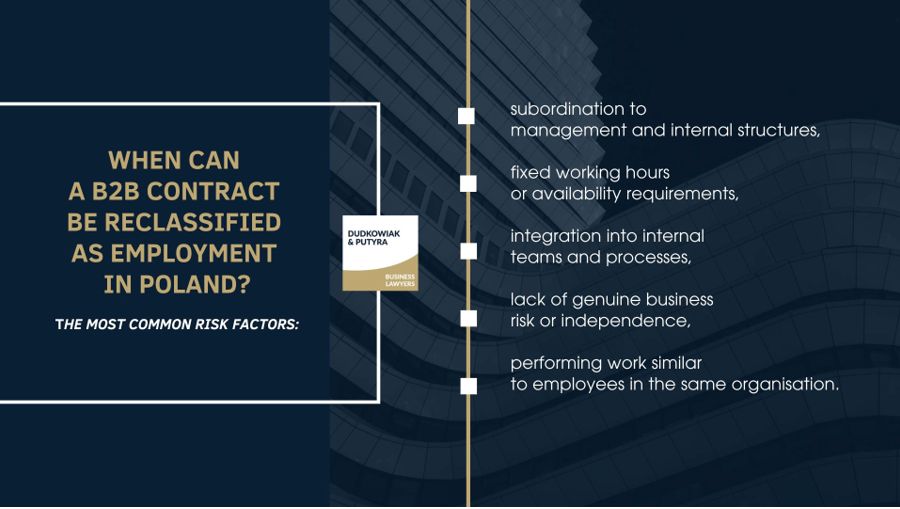
The most common risk factors include:
- subordination to management and internal structures,
- fixed working hours or availability requirements,
- integration into internal teams and processes,
- lack of genuine business risk or independence,
- performing work similar to employees in the same organisation.
The more a B2B arrangement resembles a standard employment setup, the higher the reclassification risk during inspection.
Can companies secure their position? Labour Inspectorate interpretation in Poland
The new framework allows companies to seek an official Labour Inspectorate interpretation regarding the classification of a given working relationship.
Such interpretation may help assess whether a specific B2B model complies with labour law and reduces regulatory uncertainty.
In practice, this mechanism provides a relatively accessible way to obtain the authority's position before a potential inspection, with a low administrative cost.
However, it should be treated as a supporting tool rather than a full safeguard, as it does not eliminate all legal risks, particularly in relation to tax and social security authorities.
Which sectors are most exposed to B2B reclassification in Poland?
While the reform applies across all industries, certain sectors face a higher inspection risk due to the widespread use of contractor models.
Particular attention is expected in industries where B2B arrangements often mirror standard employment structures, especially in:
- IT and tech (long-term contractor roles within teams)
- marketing and creative services
- consulting and professional services
- logistics and operational roles
In these sectors, contractors are frequently integrated into internal processes, which increases the likelihood of being classified as employment-like relationships.
B2B misclassification penalties in Poland
Reclassification is not the main issue - it is the starting point of liability.
Administrative fines may reach up to EUR 15,000 per contract, but in practice they are often only a fraction of the overall exposure.
The real risk arises from how authorities assess the relationship and its broader financial consequences.
B2B transition period and historical liability in Poland
The reform introduces a 12-month transition period starting in July 2026, allowing companies to adjust B2B contracts without PIP administrative penalties.
However, this protection is limited to PIP penalties and it does not protect against tax and social security contributions from five-years backwards if the cooperation is reclassified into employment.
For this reason, automatic conversion of B2B contractors into employment contracts should be treated as a strategic decision, not a default response.
B2B compliance checklist in Poland: key red flags for investors
Before July 2026, companies should verify whether their contractor model can withstand labour inspection scrutiny.
The following red flags significantly increase the risk of reclassification:
- the contractor works under direct supervision or managerial control
- working time and availability are fixed or imposed
- the contractor does not serve other clients
- remuneration is structured similarly to a salary
- the contractor uses company tools and operates within internal structures
If multiple factors are present, the arrangement may be viewed as hidden employment rather than genuine B2B cooperation.
A structured review of these elements is essential to assess whether maintaining or restructuring the model is the optimal compliance strategy.
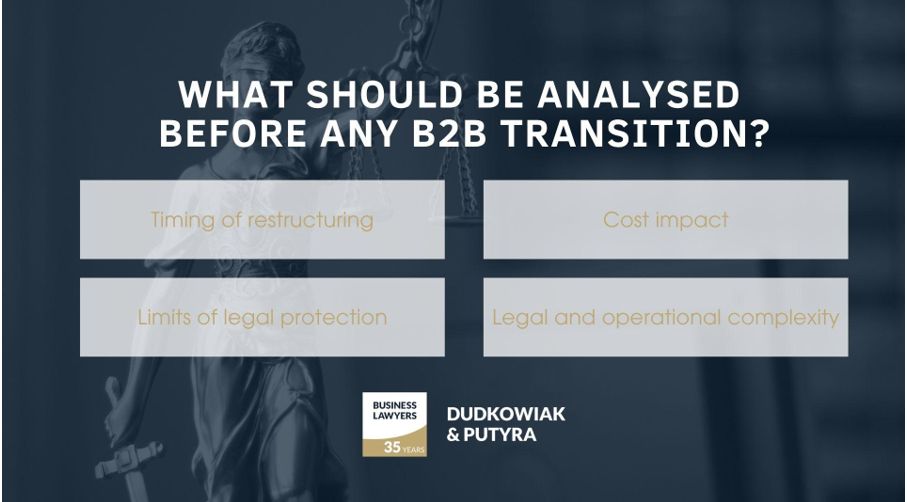
What should be analysed before any B2B transition?
Cost impact
The difference between B2B and employment includes taxes, social security and benefits. Companies should run detailed simulations to assess the total cost structure.
Timing of restructuring
The transition window starting in July 2026 provides the safest implementation period. Early or late action without planning may increase regulatory risk.
Limits of legal protection
The transition does not eliminate exposure related to past arrangements. Historical cooperation remains subject to review regardless of current compliance status.
Legal and operational complexity
Switching to employment requires a full legal reset.
This includes termination of B2B contracts and implementation of employment documentation, including IP and non-compete clauses compliant with labour law.
What should investors do now?
The starting point is a structured B2B audit.
Companies should review both contracts and operational reality to assess whether their model can withstand labour inspection.
July 2026 is the enforcement threshold
The reform sets a clear regulatory deadline.
Delaying action increases the likelihood of forced reclassification and financial exposure once inspections intensify.
Further guidance for investors
For a broader overview of legal risks related to hiring and structuring workforce in Poland, see employment law in Poland and our Investor Zone.
The content of this article is intended to provide a general guide to the subject matter. Specialist advice should be sought about your specific circumstances.
