
May 31, 2026 is the due date for annual reports (“Annual Reports”) required under Canada’s Fighting Against Forced Labour and Child Labour in Supply Chains Act (the “Act”).
In this International Trade Report, we explain what these Annual Reports require, how those requirements have changed for 2026, and other useful guidance for businesses impacted by the Act’s mandatory reporting regime.
Reporting Requirements Under the Act
The Act requires certain businesses (as well as certain public-sector bodies) to publicly report on steps taken in the previous financial year to prevent and reduce the risk of forced labour or child labour in operations and supply chains.
A business that meets two conditions MUST file an Annual Report under the Act (i.e., it is considered a “Reporting Entity”): (1) it must be an “entity”, which is essentially a large business with a commercial presence in Canada (see section 2 for the specific definition) and (2) the entity must produce, sell, or distribute goods in Canada OR import goods into Canada OR control another entity that does either.
The Act – which only came into force in 2024 – dictates that Reporting Entities must submit Annual Reports to Public Safety Canada (“PSC”) by May 31 each year. PSC publishes all Annual Reports in a centralized online registry, and reports to Parliament at year end with market statistics – which it uses to inform its future compliance expectations. Now, in its third year, PSC has started to broadcast a more defined set of expectations for Reporting Entities.
Higher Expectations for Reporting Entities This Year
Based on last year’s Annual Reports, PSC calculated that 96.6% of Reporting Entities had embedded responsible business conduct into internal policies and management systems. 83.4% had identified or started to identify the specific parts of their activities and/or supply chains that carry risk of forced or child labour being used. 75.9% had set up a regular review or audit process related to internal policies and procedures to prevent the use of forced or child labour.
In its updated reporting guidance, PSC makes clear that it expects more from Reporting Entities than it used to. Reporting Entities should demonstrate measurable, year-over-year progress and concrete goals for improved future due diligence.
Potential Upcoming Legislative Changes
While the Act mandates Annual Reports, it does not create real import restrictions. That may soon change.
Under Bill C-251 – currently working its way through Parliament – the Canada Border Services Agency (the “CBSA”) would gain the power to designate specific high-risk countries, regions or corporate entities. If an importer brings in goods from a designated region, the CBSA will automatically presume forced/child labour was used, and goods will be detained at the border. The goods will only be released once the importer satisfies the CBSA that the goods were NOT produced wholly or in part by forced labour or child labour.
Takeaways
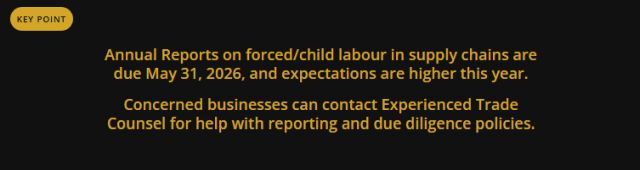
Annual Reports under the Fighting Against Forced Labour and Child Labour in Supply Chains Act are due May 31, and expectations on Reporting Entities are higher this year. The baseline is having a functional, active due diligence framework, with PSC clearly indicating it expects businesses to demonstrate increasing levels of due diligence each year.
Experienced Trade Counsel can assist in aligning internal policies with Public Safety Canada’s compliance and reporting expectations.
Download a PDF copy of this Blog here.
The content of this article is intended to provide a general guide to the subject matter. Specialist advice should be sought about your specific circumstances.
[View Source]