

On 24 April 2025, the Queensland Government directed the Queensland Productivity Commission (QPC) to undertake an inquiry and provide a report in respect of a declining productivity in the construction industry due to a rising demand for housing and key infrastructure.
The inquiry had detailed terms of reference directing the QPC to review the factors driving productivity in the Queensland construction industry, identifying the likely causes of poor productivity and making recommendations for reform of systemic policy and regulatory frameworks which can be influenced by the Queensland Government to improve the productivity.
The QPC released its final report on 21 January 2026, with restrictive land use regulation being identified as one of the likely causes of poor productivity by the construction industry and the key focus of this update.
Land use regulation impeding productivity
The QPC acknowledges that good planning with a focus on public interest is essential for good development. However, it found that there is emerging literature in the United States and New Zealand which suggests that land use regulation can be a significant impediment to productivity in the housing industry.
While the extent to which land use regulation has impacted productivity in Australia was determined to be difficult to assess, the following mechanisms by which land use regulation can impede productivity and increase housing costs were identified:
- restrictions on housing density
- design conditions which add costs to construction
- approval processes
- restrictions on development rights in key locations (close to work, transport and amenity).
The QPC has highlighted that requirements in planning schemes that impose significant costs on construction (for example, minimum parking regulations, height restrictions and blanket character protections) have not been rigorously assessed to ensure the benefits justify those costs. Stakeholder feedback, in this regard, was about good building design being sacrificed to meet the requirements in planning instruments.
Stakeholders also identified land use regulations being, among other things, inconsistent, difficult and uncertain with expensive legal proceedings required to achieve outcomes along with an excessive and time-consuming approval processes.
Recommended reforms and government response
The QPC found that planning regulations are contributing to declining housing affordability and there is a need for greater state involvement and facilitation of a greater supply of development rights. Of its 64 recommendations, we consider eight that are aimed at planning reforms.
The Queensland Government has agreed or agreed in principle to 51 of the QPC's 64 recommendations as set out in its QPC Construction Industry Response.
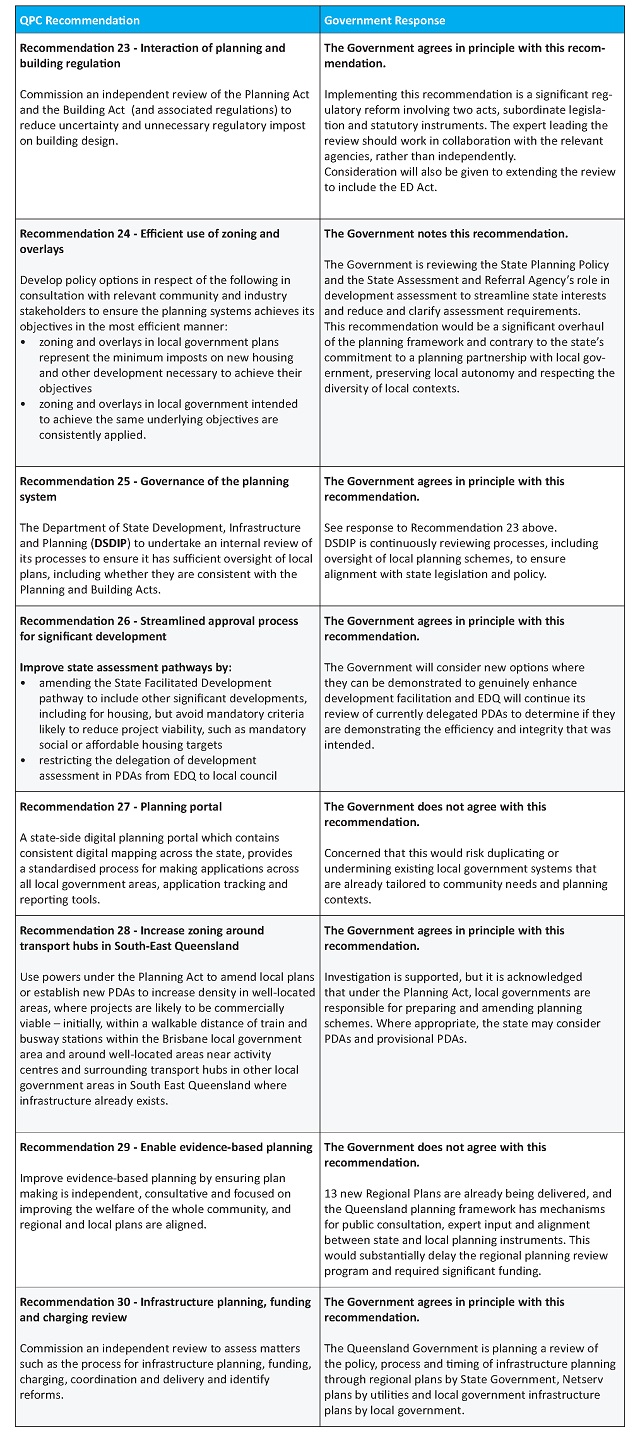
The table below summarises the QPC recommended planning reforms and the key takeaways from the Government's response.
Based upon the Government's response, it appears its focus will be on continuing with the work that is already being undertaken to review the State Planning Policy and the State Assessment and Referral Agency's role in development assessment and delivery of 13 new Regional Plans. Whilst the Government has indicated that it will consider new options to improve that state assessment pathways and review of the Planning Act 2016 (Planning Act), the Building Act 1975 (Building Act), and possibly the Economic Development Act 2012 (ED Act), it is not looking to significantly overhaul the planning framework or interfere with local government autonomy.
What next?
The Government's response indicates that some thoughtful investigations, engagement and reforms may be on the agenda in 2026, which could have implications for assessment and approval pathways at the state level. We will continue to follow and report on any developments.
If you have any questions regarding the QPC's recommendations or how this may affect your business, please contact us here. To receive legal insights and updates relevant to Australia's construction industry, subscribe to our newsletter.
This publication does not deal with every important topic or change in law and is not intended to be relied upon as a substitute for legal or other advice that may be relevant to the reader's specific circumstances. If you have found this publication of interest and would like to know more or wish to obtain legal advice relevant to your circumstances please contact one of the named individuals listed.


