

- within Antitrust/Competition Law, Environment and Privacy topic(s)
FROM WHEN DO THE TRANSPARENCY OBLIGATIONS APPLY AND TO WHOM?
On 2 August 2026, the transparency obligations under Art. 50 of the Regulation (EU) 2024/1689 (“AI Act”) will apply. Providers and deployers of certain AI systems must ensure transparency when they make AI-generated content available to people, including by informing them of AI interactions or exposure and by making AI-generated or AI-manipulated content identifiable or disclosing it as such. As part of the broader digital omnibus simplification package the watermarking obligations for AI-generated content (Art. 50(2) AI Act) have been delayed until 2 December 2026.
To support implementation, the European Commission published the Draft guidelines on the implementation of the transparency obligations for certain AI systems under Article 50 of the AI Act (8 May 2026; “Guidelines”) and a Code of Practice on transparency of AI-generated content (8 July 2026). The Code aims to help providers and deployers of generative AI systems meet the marking and disclosure obligations under Art. 50(2) and (4) AI Act. Compliance is voluntary. The EU has also created icons that deployers may use to label AI-generated content.
Swiss companies placing AI systems on the EU market, putting them into service in the EU, or deploying systems whose output is used in the EU should assess which information, marking and disclosure obligations apply to them and how to implement them.
WHAT DO THE TRANSPARENCY OBLIGATIONS ENTAIL?
Art. 50 AI Act distinguishes between information obligations, machine-readable marking obligations and disclosure obligations:
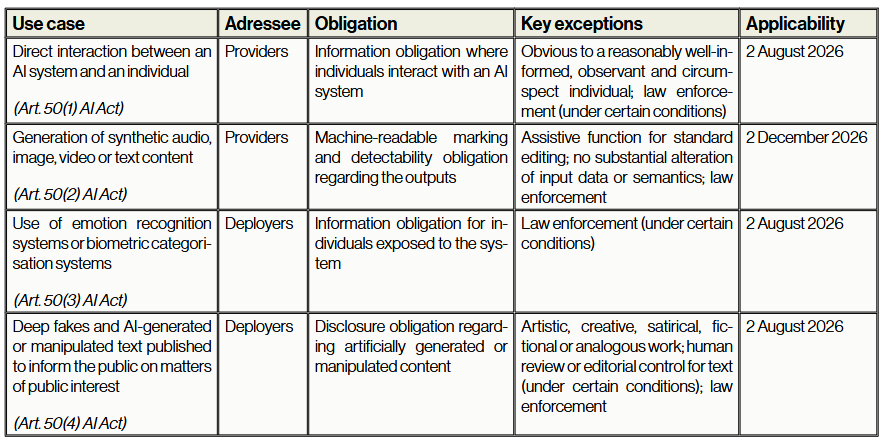
According to Art. 50(5) AI Act the required information must be provided to individuals in a clear and distinguishable manner, and at the latest at the time of the first interaction or exposure.
INFORMATION OBLIGATION WHERE AI SYSTEMS INTERACT DIRECTLY WITH INDIVIDUALS
Providers of AI systems intended to interact directly with individuals must design and develop them so that the persons concerned are informed that they are interacting with an AI system (Art. 50(1) AI Act). A direct interaction requires a real-time or near realtime written, oral, visual or physical exchange between an individual and an AI system; passive data collection (such as facial recognition in access control) or indirect interaction through a third party does not fall within the scope of this obligation.
Examples of systems covered: voice assistants, chatbots (customer support, e-commerce, healthcare, etc.), humanoid robots/cobots, AI companions, robotic companion animals, AI avatars (e.g. VR), social media bots, coding agents and other agentic AI systems.
Users must be able to recognise that they are interacting with AI, for example through textual, acoustic and visual notices. Information hidden in terms and conditions, URLs or documentation, or machine-readable markings not perceptible to users, is insufficient.
Example of a textual notice that can be included in a chatbot: “You are interacting with an AI powered chatbot and not with a human. This system provides automated responses based on your inputs”.
Exception: No notice is required if it is already clear to the average user in the specific context that they are interacting with an AI system. The obligation also does not apply to AI systems lawfully used for criminal law enforcement purposes.
MARKING OF SYNTHETICALLY GENERATED CONTENT
Providers of AI systems, including general-purpose AI systems, that generate synthetic audio, image, video or text content must ensure that outputs are marked in a machine-readable format and detectable as artificially generated or manipulated (Art. 50(2) AI Act).
Synthetic content covers audio, image, video and text. This list is exhaustive but does not exclude combinations of these formats. It does not cover simple copies of existing content, content that people cannot perceive, or content that creates only a very low risk of deception or manipulation.
Examples of non-synthetic content: the selection or arrangement of existing content, such as music playlists, and mere data collection without alteration; outputs not perceptible to humans, such as short numerical or character strings or source code.
Providers must mark AI output in a machine-readable format and ensure that such marking is detectible. This means that people or third parties, such as platforms, researchers or authorities, must be able to verify whether the content has been marked. Marking without a detection mechanism does not suffice.
This can be done by, for example, including watermarks, metadata, cryptographic provenance methods, logging or digital fingerprints, used individually or in combination.
Exceptions: The obligation does not apply where systems are only used as an editing aid, for example to correct grammar, improve formatting or make other minor technical changes without creating new content. It also does not apply where the system does not significantly change the user’s input or its meaning, or where the system is lawfully used for criminal law enforcement purposes.
Examples of cases where no marking obligation applies: purely technical adjustments, such as grammar correction, format conversion, limited colour/brightness corrections, or AI-assisted communication aids for persons with disabilities.
Examples of cases where a marking obligation applies: changes that alter the meaning or message, such as AI translations or summaries, adding or removing objects or information, or blurring faces.
Please note that the Art. 50(2) machine-readable marking obligation has been post-poned to 2 December 2026 for systems placed on the market before 2 August 2026.
EMOTION RECOGNITION SYSTEMS AND BIOMETRIC CATEGORISATION SYSTEMS
Deployers of emotion recognition or biometric categorisation systems must inform exposed individuals of the use of these types of systems (Art. 50(3) AI Act).
Note: Emotion recognition systems are generally highrisk AI systems, unless prohibited in workplace or education contexts under Art. 5(1)(f) AI Act, so Art. 50(3) AI Act applies alongside the high-risk AI requirements. Art. 50(3) AI Act applies to all biometric categorisation systems, whether or not they are high-risk AI systems.
The AI Act does not define a specific form for providing the information. Companies should choose a format that fits the situation, the audience and their relationship with the people concerned. This could include written notices, symbols, oral information or a combination of these.
Exception: The obligation does not apply where the system is lawfully used to detect, prevent, investigate or prosecute criminal offences.
Examples of how to implement the information obligation: a pop-up when launching a computer game, informing users that facial images are recorded for emotion recognition purposes or a sign at the entrance to an exhibition, informing visitors that facial images are captured for age-group categorisation.
DISCLOSURE OF DEEPFAKES AND CERTAIN PUBLICATIONS IN THE PUBLIC INTEREST
Unlike Art. 50(2), which concerns machine-readable marking and detectability by providers, Art. 50(4) requires deployers to make certain AI-generated or AI-manipulated content transparent to individuals.
DEEPFAKES
Deployers of AI systems generating or manipulating image, audio or video content constituting a deepfake must disclose that the content has been artificially generated or manipulated.
The disclosure must be clear and perceptible, without requiring the use of technical tools.
Examples of deepfakes under Art. 3(60) AI Act:
- • An AI-manipulated image of two professional football players in front of a stadium-like building
- • An AI-generated video of a person resembling a politician giving a speech
Examples that do not constitute deepfakes:
- • An AI-generated advertising video featuring talking mice discussing cheese
- • An AI-manipulated radio broadcast involving purely technical audio adjustments, such as volume correction or noise reduction, without any change to the spoken words
Exceptions: For clearly artistic, creative, satirical, fictional or similar works or programmes, the disclosure can be made in a way that does not interfere with how the work is presented or enjoyed. The obligation also does not apply where the system is lawfully used for criminal law enforcement purposes.
AI-GENERATED OR MANIPULATED TEXT ON MATTERS OF PUBLIC INTEREST
Deployers of AI systems generating or manipulating text published to inform the public on matters of public interest must disclose that the text has been artificially generated or manipulated.
This applies when AI-generated or AI-manipulated text is published for a broad, undefined audience to inform people about matters of public interest; disclosure should follow the deepfake approach.
Exception: No disclosure is required where the AIgenerated content has undergone human review or editorial control and a natural or legal person holds editorial responsibility, or where the use is lawful for lawenforcement purposes.
WHAT SHOULD SWISS COMPANIES DO?
Swiss companies that fall within the scope of the AI Act should first identify their role for each AI use case, in particular whether they act as provider or deployer. They should then map each use case against the relevant obligations under Art. 50(1)–(4) AI Act and the Commission’s final transparency guidelines, document the assessment, and update their AI governance processes to ensure that (i) all employees are aware of the applicable obligations and that (ii) the relevant transparency obligations are implemented throughout the organisation by 2 August 2026 and 2 December 2026, respectively. The updated AI governance processes should be reviewed periodically to ensure that they comply with the evolving requirements in the EU.
Companies should also consider using the EU icons for labelling AI-generated content and take into account the Commission’s Code of Practice on transparency of AI-generated content.
The content of this article is intended to provide a general guide to the subject matter. Specialist advice should be sought about your specific circumstances.
[View Source]
