

- within Technology topic(s)
- in United States
- with readers working within the Basic Industries industries
- within Technology, Food, Drugs, Healthcare, Life Sciences and Strategy topic(s)
Foreword
All Boosting efficiency: creating a more intelligent operation at once, retailers are reimagining how we shop, how we connect with brands, how supply chains are managed, and how value is created for consumers. At the center of this transformation is Artificial Intelligence (AI) — a technology surrounded by both excitement and skepticism. Can it truly deliver on the promise of revolutionizing retail, or will it remain a buzzword without substance?
At KPMG, we believe the answer lies in how retailers harness AI to create meaningful change — starting with the consumer. Our conversations with retail leaders around the globe, from grocery to luxury, electronics to health and wellness reveal that AI is already helping to improve customer experiences, boost productivity and unlock new efficiencies.
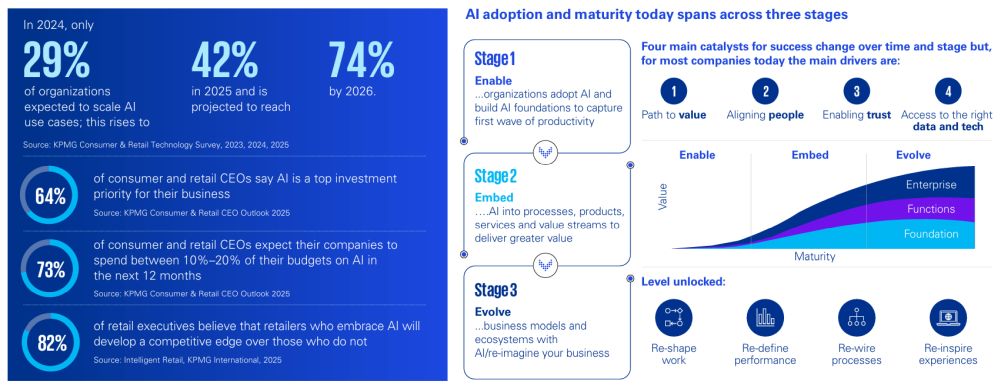
According to the KPMG 2025 Consumer & Retail CEO Outlook, 64 percent of sector executives say AI is a top investment priority. Yet many are only enjoying modest, incremental gains, and are still searching for the right approach to maximize impact. To realize this potential, retailers are rethinking how they design customer journeys, manage inventory, set prices, and engage consumers.
This shift calls for collaboration across functions, new operating models, ethical frameworks, and — above all — a willingness to innovate. Business as usual is no longer an option. Reinvention, workforce upskilling, and embracing AI-driven insights will likely define success in this new era.
This report is not another "why" of AI — the evidence is there in terms of advantage it can bring — but is exploring real-world examples of AI in action and considers both immediate opportunities and longer term transformations. Inside, you'll find benchmarks, practical lessons, and case studies from leading retailers, mapped to each stage of the customer journey. Whether you're looking for inspiration, validation, or a roadmap for transformation, you'll find guidance that is grounded in real-world experience.
Where there was a choice to be optimistic or cautious, we chose optimism. We firmly believe AI can help retailers unlock growth, resilience, and customer centricity — and we want to show you some of the ways they are doing this today.
AI in retail is both the great leveler and the ultimate differentiator: it promises to democratize access to innovation, yet rewards those bold enough to reinvent their business from the ground up. The paradox is clear — while every retailer can harness AI, those who embrace its disruptive potential can truly stand apart. In this new era, success means balancing the certainty of incremental gains with the courage to pursue transformative change."
Isabelle Allen,
Global Head of Consumer, Retail and Leisure KPMG International
About the paper
This paper draws on both practical examples of AI in retail use from around the world, as well as research and insights from a number of KPMG reports, including the KPMG Global Tech Report, the KPMG 2025 Consumer & Retail CEO Outlook, and Intelligent Retail, augmented by the views of highly experienced KPMG retail professionals. We also include several case studies and would like to thank each organization for their contribution.
Retailers are embracing AI at pace
message from the C-suite is unequivocal: AI is no longer a niche technology project but the central pillar of future growth and competitiveness. The numbers are stark: our research shows that 64 percent of retail CEOs now rank Generative AI as their top investment priority, a clear mandate to embed intelligence across every facet of their operations. This isn't a trend; it's a fundamental realignment of capital and strategy toward building a more resilient, efficient, and customer-centric enterprise.
This surge in investment is not driven by a single objective but by a shared belief that AI can solve the industry's most pressing and diverse challenges.
As retail leaders confirm, the goals range from foundational efficiencies to transformative innovation. For some, the focus is on boosting productivity and streamlining the supply chain. For others, particularly in the luxury space, it's about using AI to elevate brand storytelling and deliver hyper-personalized experiences. For all, it represents a powerful engine for creating new value. This broad consensus creates a clear imperative to move from strategy to execution, which is what the following sections will explore.
To view the full article, click here.
The content of this article is intended to provide a general guide to the subject matter. Specialist advice should be sought about your specific circumstances.
[View Source]