

India’s APA Programme Continues Its Growth Trajectory
As India continues to attract global investment, tax certainty remains a key consideration for multinational enterprises. The CBDT's APA Annual Report for FY 2025-26 highlights the growing maturity and global relevance of India's APA programme, while recent reforms under the Income-tax Act, 2025 and Income-tax Rules, 2026 reflect a stronger focus on streamlined processes and faster resolution timelines, reinforcing India's commitment to a predictable and non-adversarial tax environment.
APA PROGRAMME AT A GLANCE –FY 2025-26
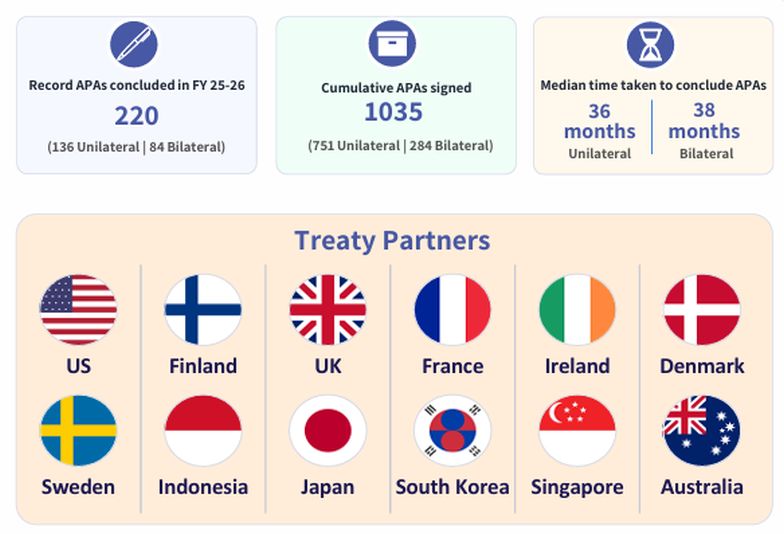
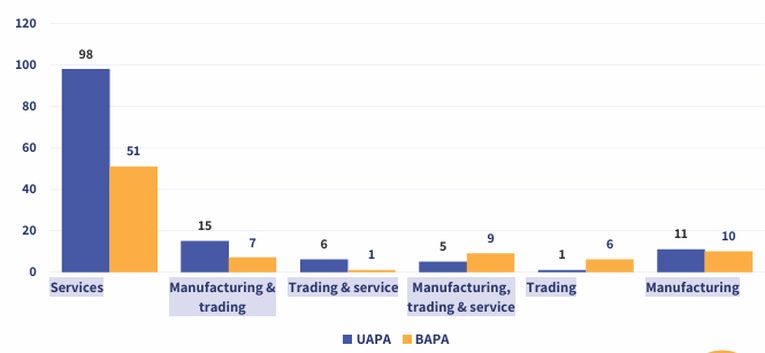
INDUSTRY-WISE SNAPSHOT
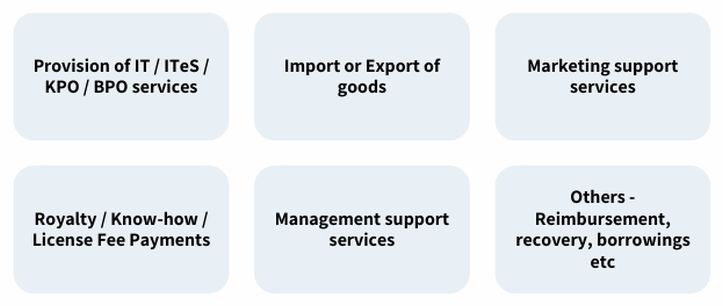
TOP CATEGORIES OF COVERED TRANSACTIONS IN APA
MAP: COMPLEMENTING INDIA'S TAX CERTAINTY FRAMEWORK
- While APAs continue to play a central role in preventing transfer pricing disputes, the MAP programme remains an important treaty-based mechanism for resolving historical disputes and eliminating instances of double taxation arising from international tax and transfer pricing matters under applicable DTAAs.
- Thereport also notes significant progress in reducing India's transfer pricing MAP inventory and improving resolution timelines, reinforcing the broader objective of enhancing tax certainty for multinational enterprises.
SAFE HARBOUR AND APA: EXPANDING THE CERTAINTY TOOLKIT
- The APA Annual Report highlights significant Safe Harbour reforms introduced under the Income-tax Rules, 2026, including an enhanced turnover threshold of ₹2,000 crore and a unified 15.5% margin for IT andITeS services.
- Thesechanges expand the tax certainty options available to taxpayers and may influence the choice between Safe Harbour and APAmechanisms for managing transfer pricing risk.
- Akeydevelopment highlighted in the Annual Report is the CBDT Office Memorandum dated 24 March 2026, which addresses the interaction between APAs and the revised Safe Harbour regime applicable from 1 April 2026. The same was particularly relevant for taxpayers, especially in the IT services sector, whose APA applications covered both pre- and post-1 April 2026 periods and were at advanced stages of negotiation when the revised Safe Harbour provisions were introduced.
- Toaddressthisuncertainty, the CBDT decided that a critical assumption would beintroduced in APAs, permitting taxpayers to enter into APAs for years preceding 1 April 2026 while retaining the flexibility to opt for the revised Safe Harbour regime for eligible future years beginning on or after 1 April 2026. Under this approach, APAs may be suitably revised such that transactions subsequently covered under Safe Harbour are excluded from the APA framework.
- The clarification provides significant flexibility to taxpayers by enabling them to secure transfer pricing certainty for earlier years without foregoing the benefits of the revised Safe Harbour regime prospectively. The development also reinforces the CBDT's broader objective of providing taxpayers with multiple and complementary avenues for achieving advance tax certainty and is noted in the Report as having contributed to the increased conclusion of UAPAcases.
KEY FUTURE THEMES FROM THE CBDT
- Move towards a truly "Advance" Pricing Agreement: CBDT notes that most APA applications are currently filed just before the APA term begins, which makes it difficult to conclude agreements early. The report encourages earlier filing of APA applications and renewals so that certainty can potentially be provided within the first APA year itself rather than several years later.
- FocusonFaster Resolution: The report highlights that around 45% of UAPAs and 25% of BAPAs signed in FY 2025-26 were resolved within 24 months and suggests that the programme should strive to provide tax certainty much earlier in the lifecycle.
- Greater Bilateral Engagement: CBDT specifically mentions that the record number of signing of BAPAs was driven by stronger relationships with treaty partners, more frequent Competent Authority interactions, and continuous engagement.
- Emphasis on Information Symmetry: An interesting observation in the report is that alignment of information provided to both treaty partners and proactive taxpayer engagement are critical to successful BAPA resolution. CBDT indicates it is actively working with treaty partners to reduce delays arising from information asymmetry.
- Continuous Capacity Building: CBDT describes the programme as being at a "pivotal point" where the accumulated experience of taxpayers, advisers, APA teams and Competent Authorities can now be leveraged to deliver certaintymore efficiently.
AURTUS COMMENTS
- The record number of APA signings in FY 2025-26 reinforces the growing confidence of taxpayers in India's APA programme as a mechanism for achieving transfer pricing certainty. The crossing of the 1,000-APA milestone, coupled with the increase in bilateral APA signings, reflects the programme's evolution into a mature dispute-prevention framework with increasing global relevance.
- Equally noteworthy is the Government's focus on improving programme efficiency through the Income-tax Act, 2025 and Income-tax Rules, 2026. The introduction of prescribed timelines, simplified procedures and a fast-track framework for certain IT services cases signals a clear intent to deliver certainty in a timely and predictable manner.
- As the APA programme continues to mature, the focus is expected to shift beyond record signings towards faster resolutions, greater efficiency and improved taxpayer certainty.
The content of this article is intended to provide a general guide to the subject matter. Specialist advice should be sought about your specific circumstances.
[View Source]