

- within Real Estate and Construction, Family and Matrimonial and Transport topic(s)
- with Finance and Tax Executives
- in United Kingdom
- with readers working within the Accounting & Consultancy, Banking & Credit and Technology industries
Summary:
Alternative investment funds (“AIFs”) are privately pooled investment vehicles which raise funds and invest in accordance with a defined investment policy for the benefit of the investors. AIFs established and operating within India (except in the Gujarat International Finance Tec-City (“GIFT City”)) are regulated by the Securities and Exchange Board of India (“SEBI”) under the SEBI (Alternative Investment Funds) Regulations, 2012, as amended (“AIF Regulations”), which allow AIFs to be structured as a trust, a limited liability partnership (“LLP”), a company, or a body corporate1. AIFs set up within GIFT City are governed by the International Financial Services Centre Authority Act, 2019 (“IFSC Act”).
Historically, the AIF-trust structure has gained a preference over the others, due to its lower set-up cost, operational flexibility, easier governance, tax neutrality and a clear separation between the trustee’s legal ownership/administration of trust property and the investors’ beneficial interest. On the other hand, an LLP in India requires incorporation and continuing filings with the Registrar, at least two designated partners, and creates an additional layer of compliance under the Limited Liability Partnership Act, 2008 (“LLP Act”) alongside the AIF Regulations. However, it provides a separate legal identity to the AIF, limiting the liability of the partners of the firm to their contributions in the LLP’s capital. Another important consideration is the tax treatment of the AIF structures. While section 224 of the Income Tax Act, 2025, provides the benefit of tax pass-through to Category I and II AIFs for their non-business income, the trust/LLP choice becomes tax-relevant mainly in relation to the treatment of business income, which is carved out of the pass-through regime.
The most significant recent development relating to the AIF Regulations is the Corporate Laws (Amendment) Bill, 2026 (“Bill”). The proposed Bill provides for flexibility in regulatory compliance of LLPs, a dedicated framework for Specified IFSC LLPs and, more importantly for existing AIF-trusts, a statutory mechanism for conversion of specified SEBI/IFSCA-registered trusts into LLPs. The proposal has the potential to materially reduce the practical friction in moving from a trust to an LLP. However, the interaction of the proposed conversion mechanism with the AIF Regulations, particularly sponsor status, designated partner requirements, continuing interest, investor rights and AIF registration—will need to be considered separately, once the rules are notified as well.
Thus, this note intends to analyze the predominance of the AIF trust structure by drawing a comparison with the AIF LLP structure, the benefits of having an AIF LLP structure in light of the proposed Corporate Laws (Amendment) Bill, 2026 and the procedure proposed for conversion of a Specified Trust2into an LLP.
1. Existing Framework
- AIF Regulations and SEBI Master Circular for Alternative Investment Funds3
The AIF Regulations were introduced in 2012 to provide a framework for privately pooled funds investing in accordance with their investment policies. In addition to the AIF Regulations, SEBI has also issued the Master Circular on AIFs dated June 3, 2026, as amended (“Master Circular”) which compiles all the latest directions, instructions, circulars issued by SEBI under the AIF Regulations.
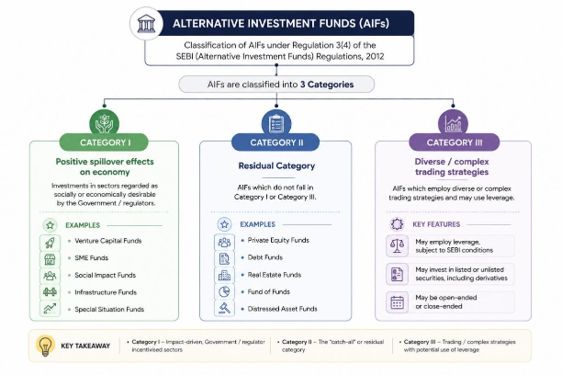
The AIF Regulations make the registration of all AIFs mandatory and places them in one of the following categories:
Registration of the AIF
The applicant seeking registration of the AIF must submit an application in the prescribed Form A specified in the First Schedule of the AIF Regulations. Under the AIF Regulations, SEBI requires the following documents for the registration of the AIF:
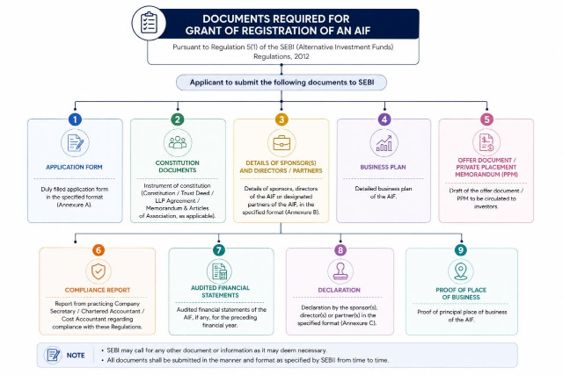
The constitutional documents submitted by the AIF should permit the entity to carry out the activities of an AIF and prohibit the entity from inviting the public to subscribe to its securities. The application is submitted to SEBI through the intermediary portal at https://siportal.sebi.gov.in/.
AIF Structure
AIFs can raise funds — whether from Indian, non-resident Indian, or foreign investors — in the form of dematerialized units, through a private placement memorandum. However, no scheme of the AIF can have more than 1000 investors. Each scheme's corpus must be at least ₹20 crores, with each investor contributing an investment of at least ₹1 crore. The number of units and the rights assigned to investors flow from the contribution agreement entered into between the investor and the AIF (“Contribution Agreement”).
The person who sets up the AIF is the sponsor of the AIF, which includes the promoter in case of a company and a designated partner in case of a limited liability partnership (“Sponsor”). The AIF appoints a manager to manage its investment funds (“Manager”). To have their skin in the game, sponsors/managers must show their continuing interest in the AIF and contribute at least 2.5% of the total corpus or ₹5 crores, whichever is lower (5% or ₹10 crores for Category III AIF)4 (“Continuing Interest”). Prior approval must be taken from SEBI in case of a change of the Sponsor or Manager or a change in control of the AIF.
General Obligations
All the key management personnel (“KMPs”), trustee(s), designated partners, Managers have to abide by the code of conduct specified in the Fourth Schedule5. AIFs have to maintain detailed practices and policies ensuring compliance with the placement memorandum, investor agreements, AIF Regulations and related circulars. The AIF Regulations mandate the Manager/Sponsor to maintain records like the assets under the scheme/fund, valuation policies and practices, investment strategies, particulars of the investors and their contributions6.
Winding-up
The AIF Regulations have also made provisions for winding up of the AIF. Regulation 29 of the AIF Regulations talks about the steps to be undertaken by the AIF depending on their incorporation structure as highlighted below:

An AIF set up as a trust can also be wound up at the direction of the trustee, without the consent of the investors, provided it is in the interest of the investors. However, an AIF set up as an LLP is also subject to the winding-up triggers under the LLP Act.
Once the winding up process under regulation 29 of the AIF Regulations is triggered, the AIF has to undertake the following steps:
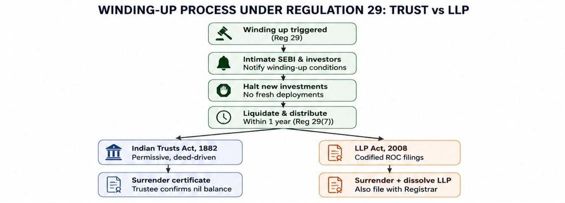
Thus, it can be seen that an AIF set up as an LLP has a regulatory overlap where it has to, in addition to the AIF Regulations, also follow the process of winding up under the LLP Act and intimate the Registrar, in addition to SEBI. This may increase the associated compliance costs.
Guidelines for overseas investment by AIFs
AIFs are permitted to invest in securities of companies incorporated outside India. They have an overall limit of
$1500 million for investing in equity and equity-linked instruments of offshore venture capital undertakings, which is allocated by SEBI on a first-come-first-served basis. Further, such investment shall not exceed 25% of the investable funds7 of the AIF. Investments made by the AIF are subject to the FEMA (Overseas Investment) Rules, 2022, the FEMA (Overseas Investment) Regulations 2022, and the Master Direction-Overseas Investment, as updated.
B. Limited Liability Partnership Act, 2008 (“LLP Act”)-Applicability to AIF LLPs
The LLP Act makes provisions for the formation and governance of LLPs. Under the LLP Act, an LLP is identified as a legal entity separate from its partners, having perpetual succession. An LLP is incorporated by filing an incorporation document with the Registrar, together with a statement of compliance from an advocate, company secretary, chartered accountant or a cost accountant; the LLP agreement is thereafter filed with the Registrar within the prescribed period8. It must have a registered office, and any change in the registered office must be communicated to the Registrar in the manner prescribed by the Act.
An LLP must have at least 2 designated partners, one of whom must be a resident of India. Further, the designated partner must consent to the appointment, and the particulars of the appointment must be filed with the Registrar. Every designated partner must have a Designated Partner Identification Number (DPIN). Any person being admitted as a partner in the LLP must fulfil the eligibility requirements under section 5 of the LLP Act. The liabilities of the designated partners extend to all the acts and obligations that apply to the LLP under the LLP Act, in addition to the liabilities stated in the LLP agreement.
Continuing interest of Sponsor/Manager in an AIF structured as an LLP:
In the context of an LLP-structured AIF, the designated partner(s) assume particular significance because the AIF Regulations identify the designated partner(s) of an LLP as the Sponsor of the AIF. The AIF Regulations also permit the Sponsor of the AIF to be the Manager.
This has implications for the continuing-interest requirement under regulation 10(d) of AIF Regulations. In an LLP-structured AIF, the Continuing Interest would have to be fulfilled by either the Sponsor, i.e., the designated partner(s) of the LLP, or by the Manager appointed by the AIF, based on the commercial understanding and internal structuring. The details of such interests are disclosed in the private placement memorandum (“PPM”) of the AIF scheme. This ensures that the Manager/Sponsor also has a vested interest and is accountable for the investments made through the fund. The AIF Regulations mandate only a minimum investment, leaving no explicit cap on the maximum investment.
SEBI, in its Master Circular, has clarified that the continuing interest may be maintained pro rata to the amount of funds raised (net) from other investors. This provides relief to the Manager or Sponsor by allowing them to scale their commitments against the funds raised from investors, instead of mandating investment of the required amount in full at the outset.
C. Indian Trust Act, 1882 (“Trust Act”)-Applicability to AIF Trusts
Setting up a trust
An AIF can also be constituted in the form of a trust. The Trust Act lays down the provisions for creation and regulation of trusts in India. Under section 4 of the Trust Act, a trust may be created for any lawful purpose by any person competent to contract. The author of the trust must indicate the intention to create a trust, the purpose of the trust, the beneficiary, and the trust property. A trust in India is generally created by registering a trust deed between the author of the trust, the trustee, and the beneficiaries. This is also in line with the requirement for having a registered trust deed in place for registering the AIF under the AIF Regulations.
AIF trusts in India work under a contributory model where the investors commit to contribute capital to the trust in terms of their contribution agreement, against which the investors are entitled to a proportionate beneficial interest (“Beneficial Interest”). This Beneficial Interest is evidenced by the number of units held by the investors, on the basis of which distribution proceeds are distributed. As such a trust is established to facilitate the investment by the contributors, they are the beneficiaries (“Beneficiaries”) of the trust.9
Rights and obligations of trustees and beneficiaries
The Trust Act also sets out the duties and fiduciary obligations of the trustee, requiring the trustee to execute and fulfil the purpose of the trust. Sections 12 to 14 imposes certain obligations on the trustee concerning the trust property, including the duty to inform itself of the state of the trust property, protect the title to such property, and refrain from setting up a title adverse to the beneficiary. These provisions are relevant to an AIF because the trust property is held and administered by the trustee for the benefit of the beneficiaries, i.e., investors. They reinforce the distinction between legal ownership/control of the trust property by the trustee and the beneficial interest of the investors. Section 23 also makes the trustee liable to make good the loss for any breach of trust. The Act allows there to be one or more trustees, not being joint and severally liable unless any breach is jointly committed.
Further, in addition to the rights provided to the investors under the AIF Regulations and the private placement memorandum, the Trust Act also provides certain rights to the beneficiaries (investors under the AIF Trust structure) including the right to specific execution of the trust, right to inspect, right to transfer beneficial interest and the right to have proper trustee appointed.
The Trust Act also contains provisions governing the vacation of office, discharge and replacement of trustees. Sections 70–76 set out the circumstances and mechanisms through which a trustee may cease to hold office and the manner in which a new trustee may be appointed and the trust property vested in such trustee. In the context of an AIF constituted as a trust, these provisions are relevant where there is a resignation, removal or replacement of the trustee. Accordingly, any proposed change in the trustee of an AIF trust would need to be considered at two levels: (i) Trust law: compliance with the provisions of the Indian Trusts Act and the terms of the trust deed relating to the vacation, discharge and appointment of trustees; and (ii) AIF regulatory framework: compliance with the applicable requirements under the AIF Regulations and SEBI's framework for reporting and giving effect to changes in the trustee.
Further, the Trust Act also provides for the extinguishment of the trust. Under the AIF-Trust structure, this should be read in consonance with regulation 29 of the AIF Regulations.
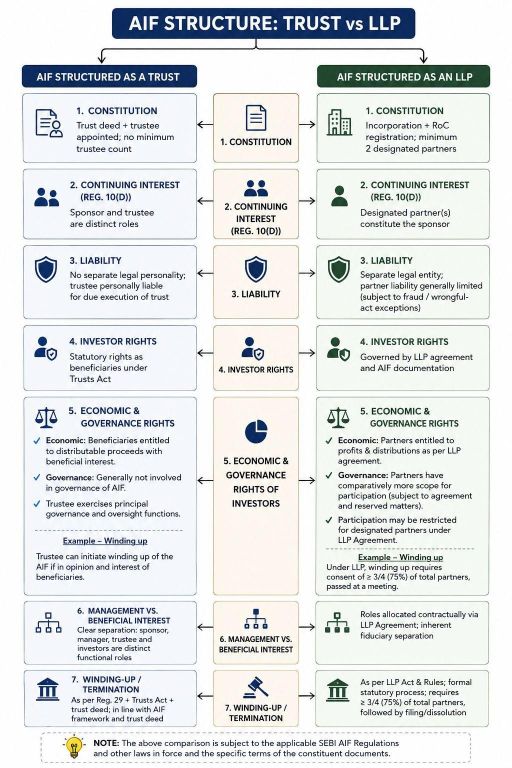
2. Structural Comparison between Trust and LLP as an AIF Vehicle:
- Ease of constitution and regulatory set up:
A trust-structured AIF is constituted merely through execution of a trust deed and appointment of a trustee, with no requirement for a minimum number of trustees. An LLP, being a separate legal entity, must additionally be incorporated and registered with the Registrar under the LLP Act, and requires a minimum of two designated partners (DPs). The trust route is therefore procedurally lighter at formation.
- Continuing Interest:
This structural difference carries into the continuing-interest requirement. In an LLP, the DP(s) constitute the sponsor and must hold the continuing interest in that capacity. In a trust, the sponsor and trustee are distinct roles — allowing the continuing interest to sit with the sponsor while the trustee separately administers the trust.
- Liability and separate legal entity
An LLP's separate legal personality generally limits partner/DP liability, subject to exceptions such as fraud or wrongful acts. A trust has no equivalent separate personality: the trustee is personally liable for due execution of the trust under the Trusts Act, while beneficiaries (i.e., investors) correspondingly hold statutory rights over the trust property. Thus, in an AIF-trust, the trust property is legally held by the trustee, while in an AIF-LLP, the property and assets are held in the name of the LLP entity itself.
- Management and Beneficial Interest
The trust structure cleanly separates function from entitlement — sponsor (continuing interest), manager (day-to-day management), trustee (holds/administers assets), and investors (beneficial interest) are each a distinct role. The trustee holds the trust property for the benefit of the investors and is entrusted with significant oversight responsibilities. While this structure offers operational flexibility, it places the trustee at the centre of the governance. The effectiveness of this structure therefore depends, in part, on the trustee discharging its obligations in accordance with its fiduciary duties and the terms of the trust deed. In an LLP, these same functions are instead allocated contractually through the LLP agreement and AIF documentation, without an inherent fiduciary separation.
- Economic and Governance rights of investors:
Under the trust structure, the Beneficiaries are entitled to distributable proceeds equivalent to their pro-rata capital contribution as their Beneficial Interest. In an LLP structure, by contrast, each investor, by contributing capital, becomes a partner of the LLP and is entitled to the profits and distributions of the LLP as per the terms of the LLP agreement. Under the trust structure, the Beneficiaries are generally not involved in the governance of the AIF, subject to the terms of the trust deed. However, investors under the LLP structure have comparatively more scope for participation in the governance of the AIF, although such participation may be restricted to the designated partners under the LLP Agreement. For instance, the trustee has the power to initiate winding up of the AIF if, in the trustee's opinion and in the interest of the Beneficiaries, such winding up is warranted. However, in an AIF constituted as an LLP, winding up requires the approval of investors representing 75% of the value of their investment in the AIF.
- Winding up and termination:
The two structures also differ significantly at the time of termination. An LLP is a separate registered legal entity and its winding-up and eventual dissolution involve a formal statutory process under the LLP Act, including settlement of liabilities, realisation/distribution of assets and filings with the Registrar before the LLP can be formally dissolved. A trust does not have an equivalent corporate dissolution process. Its extinction is governed principally by the Indian Trusts Act, the trust deed and, in the case of an AIF, regulation 29 of the AIF Regulations.
3. Tax Treatment for AIF Trust Vs AIF LLP
- Tax pass-through for Category I and II AIFs
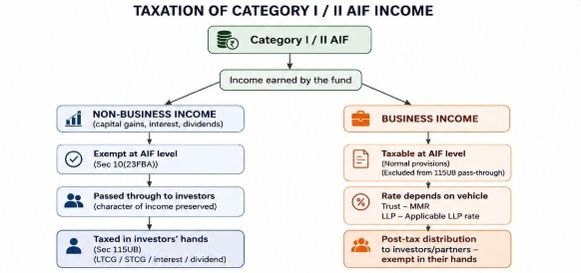
Section 224 of the Income Tax Act, 2025, as amended (“Income Tax Act”) governs the taxation of Category I and II AIFs and treats income as passing through the fund and being taxed directly in investors' hands, regardless of whether the fund is structured as a trust, LLP, or company. Consequently, the availability of the statutory pass-through regime does not depend on whether the AIF is constituted as a trust or an LLP. The one statutory carve-out cuts across both vehicles equally: business income is not passed through and is taxed
at the AIF level before distribution to investors, for both Category I and II funds. This carve-out, rather than the pass-through mechanism itself, is where the trust/LLP choice starts to matter. Tax is charged directly in the hands of the investor rather than at the entity level, to avoid double taxation.
The tax mechanism for a trust vs LLP can be understood using the following chart:
Category III Alternative Investment Funds have no statutory pass-through under the Income Tax Act and are liable both at the entity and investor level. This depends mainly on the structure of the AIF and the nature of the income generated by the AIF.
A Category III AIF structured as a trust will be governed by sections 304–307 of the Income Tax Act under the provisions on taxation of trusts and representative trustees. The tax rate further depends on whether the nature of the trust is determinate, where the beneficiaries and their shares are ascertainable (“Determinate Trust”), or indeterminate, where the beneficiaries or their shares are not ascertainable (“Indeterminate Trust”). If the trust qualifies as an Indeterminate Trust, it will be subject to the maximum marginal rate (“MMR”10); by contrast, for a Determinate Trust, the trust income is charged at the rate applicable to the beneficiary11.
Similarly, if an AIF is structured as a Category III AIF LLP, it will be treated as a ‘firm’ under the Income Tax Act, and sections 324–331 of the Income Tax Act will apply in assessing its tax liability. Section 324 of the Income Tax Act states that the firm will be charged tax on its total income at the rate specified for the relevant tax year (a flat rate of 30% plus applicable surcharge and cess).
- Classification based on ‘Business Income’
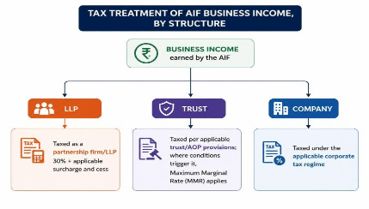
Business income refers to income falling under the head of ‘profits and gains of business.’ A determination of whether securities are held as capital assets or as stock-in-trade is a mixed question of law and fact, depending on the facts and circumstances of each particular case and on whether the activities of the AIF could be regarded as amounting to the carrying on of a business.12 The tax treatment of business income depends on the structure of each entity, similarly to how Category III AIFs are treated. The tax treatment under the different entities is highlighted below:
4. Corporate Laws (Amendment) Bill, 2026 (“Bill”)
The Corporate Laws (Amendment) Bill, 2026 is particularly relevant to the question whether LLPs can become a more viable fund vehicle. The Bill was introduced in Lok Sabha on March 23, 2026 and, as of the date of this note, remains a Bill rather than enacted law. It proposes amendments to the LLP Act and a dedicated framework for Specified International Financial Services Centre LLPs.
- Setting up IFSC LLP
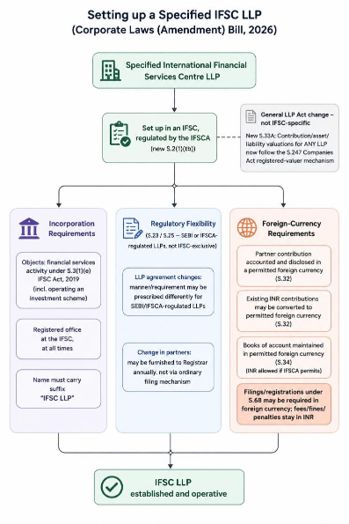
The Bill proposes to set up a new category of LLP called the ‘Specified International Financial Services Centre LLP’ (“IFSC LLP”). An IFSC LLP may be incorporated only to undertake financial services permitted under the IFSC Act. Under the proposed Bill, the IFSC LLP must state in its incorporation document that its objects are to undertake financial services13 permitted under Section 3(1)(e) under the IFSC Act. It will have its registered office in the International Financial Service Centre at all times and include the suffix “International Financial Services Centre LLP” as part of its name.
Such IFSC LLPs must be differentiated from the SEBI-registered domestic AIFs. Domestic AIFs are regulated by SEBI under the SEBI AIF Regulations, whereas funds established in an IFSC are regulated by IFSCA under the applicable IFSCA framework.
IFSC LLPs also benefit from the tax deduction provided under section 147 of the Income Tax Act, which provides a 100% deduction from taxable income to an eligible IFSC unit for specified income under its approved IFSC services.
The Bill proposes flexibility with respect to the regulatory filings. For classes of LLPs regulated by SEBI or IFSCA, the manner and requirement for filing changes to the LLP agreement can be prescribed differently. Additionally, changes in partners for prescribed SEBI/IFSCA-regulated LLPs may be required to be furnished to the Registrar annually, rather than through the ordinary filing mechanism. This potentially allows the MCA/SEBI framework to create special filing requirements for regulated AIF LLPs, instead of applying the ordinary LLP filing mechanics rigidly. However, the exact prescribed rules are yet to be determined.
The most significant IFSC-specific amendment concerns partner contributions in foreign currency. For an IFSC LLP, the monetary value of each partner’s contribution must be accounted for and disclosed in a permitted foreign currency. It also allows the conversion of a partner's existing Indian Rupee contributions to a permitted foreign currency and requires that books and accounts be maintained in the permitted foreign currency.
- Conversion of Specified Trust into LLP
The Bill proposes a new Section 57A and a Fifth Schedule providing a statutory route for conversion of a 'specified trust' into an LLP. A specified trust broadly comprises a trust established under the Indian Trusts Act or another Central/State Act, registered with SEBI or IFSCA and carrying on prescribed activities (“Specified Trust”).
- Eligibility for conversion:
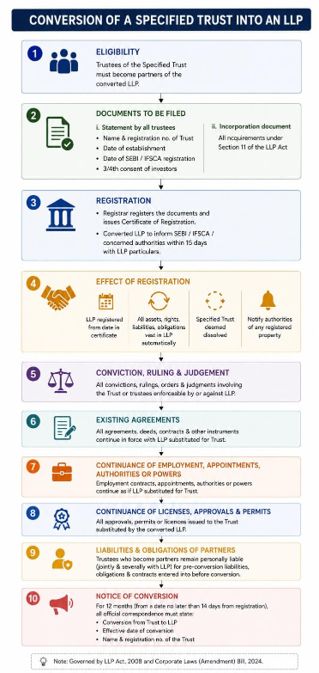
A Specified Trust can apply for conversion to an LLP only if the trustees of the Specified Trust become the partners of the converted LLP.
- Documents to be filed:
The Specified Trust can apply to convert into an LLP by filing the following documents with the Registrar:
- A statement by all the trustees, along with the prescribed form and fees, containing the following
- Name and registration number of the Specified Trust
- Date of establishment of the Specified Trust
- Date of registration of the Specified Trust with SEBI or IFSCA, as
- 3/4th consent of the investors of the trust
- An incorporation document containing all the requirements under section 11 of the LLP Act
- Registration
Once the required documents are submitted to the Registrar, it may register the submitted documents and issue a certificate of registration stating that the LLP has been registered under the LLP Act. On receiving such certificate, the converted LLP must inform the concerned authorities under which the Specified
Trust was established regarding the conversion of the Specified Trust to the LLP along with the particulars of the LLP within 15 days.
- Effect of registration:
The converted LLP shall be registered as an LLP from the date of registration mentioned in the certificate. All the tangible and intangible property, assets, interests, rights, privileges, liabilities, obligations vested in the Specified Trust shall be transferred to the converted LLP without any further assurance, act or deed, and the Specified Trust shall be deemed to be dissolved. Where any property is registered with any authority, the converted LLP shall notify the authority of the conversion, as soon as practicable.
-
- Conviction, ruling and judgement:
Any conviction, ruling, order and judgement by a Court, Tribunal or any authority, involving the Specified Trust or the trustee, shall be enforceable by or against the converted LLP.
- Existing agreements:
All agreements, deeds, contracts and other instruments to which the Specified Trust was a party or which referred to the Specified Trust immediately prior to registration shall, upon conversion, continue in force with the converted LLP substituted for the Specified Trust.
-
- Continuance of employment, appointment authority or power:
All contracts of employment shall continue in force after the date of registration as if the converted LLP were substituted for the Specified Trust as the employer. Similarly, all appointments, authorities or powers granted to or exercised by the Specified Trust or its Trustee in any capacity and subsisting immediately prior to the date of registration shall continue to have effect from that date as if the converted LLP had been appointed or granted such authority or power.
-
- Continuance of licenses, approvals, and permits:
All the approval, permit or licence issued to the Specified Trust shall be substituted by the converted LLP.
- Liabilities and Obligations of the partners:
Every trustee which has become a partner of the converted LLP shall continue to be personally liable (joint and severally with the LLP) for the liabilities and obligations of the specified trust which were incurred prior to the conversion or which arose from any contract entered into prior to the conversion.
- Notice of conversion:
The converted LLP shall, for a period of twelve months commencing no later than fourteen days from the date of registration, ensure that all its official correspondence prominently states: (a) that it was converted from a Specified Trust into an LLP with effect from the date of registration; and (b) the name and, where applicable, the registration number of the Specified Trust from which it was converted.
The flowchart below represents the key steps proposed for the conversion of the Specified Trust into an LLP.
- Key issues arising from the proposed Bill
- The LLP Act requires a minimum of 2 partners. If a Specified Trust has a sole trustee, the conversion cannot result in a valid LLP, since only the trustees may become partners on conversion and the Fifth Schedule to the proposed Bill restricts the admission of new The joint parliamentary committee (“JPC”) is instead considering making investors in the AIF trust partners in the LLP, arguing that the legal ownership structure should reflect the economic ownership of the investment vehicle.14 However, even if investors are permitted to become partners of the converted LLP, the LLP Act continues to require a minimum of two designated partners. Accordingly, the conversion framework would still need to ensure compliance with the statutory requirement relating to designated partners.
- If the trustees of the Specified Trust become the partners/designated partners of the converted LLP, the implications for sponsor status and the continuing-interest requirement under regulation 10(d) must be separately examined. The Bill does not itself amend regulation 10(d) of the AIF Regulations. Accordingly, conversion under the LLP Act should not be treated as automatically resolving the AIF’s sponsor, designated-partner or continuing-interest requirements.
- A further issue is investor protection. Although the Bill expressly requires consent of three-fourths of investors, the proposed conversion provisions do not, on their face, create a separate statutory exit/redemption mechanism for dissenting The consequences of conversion for the trust deed, placement memorandum, investor rights and SEBI registration would therefore require careful consideration.
- While the Corporate Laws (Amendment) Bill, 2026 provides a statutory mechanism for conversion of a Specified Trust into an LLP, the Bill does not presently contain corresponding amendments to the Income-tax Act to expressly exempt such conversion from capital gains tax. Unlike conversions expressly covered by the existing transfer-exemption provisions (for example, section 70(1)(z) of the Income Tax Act), a trust-to-LLP conversion is not presently recognised as a tax-neutral conversion. Accordingly, the potential capital-gains implications of the statutory vesting of assets in the LLP require consideration. Further, although the Fifth Schedule provides for vesting of assets in the LLP without further assurance, act or deed, the stamp-duty implications, particularly for immovable property, would need to be examined under the applicable State stamp legislation.
5. Conclusion
The table below highlights the key differences between an AIF structured as a Trust and an LLP
|
Particulars |
Trust |
LLP |
|
Establishment/Constitution |
Constituted by executing and registering a trust deed and appointing a trustee. No minimum number of trustees mandated |
Requires incorporation and registration with Registrar through a registered partnership agreement. Mandates at least 2 designated partners. |
|
Setting up cost |
Generally lower |
Comparatively higher |
|
Annual compliances |
Relatively light. Compliances under the AIF Regulations and the terms of the trust deed |
Relatively more. Compliances under the LLP Act, AIF Regulations and the terms of the LLP agreement |
|
Separate legal personality and liability |
Trust itself does not have a separate legal personality in the same manner as an LLP; trustee holds legal title to trust property and bears fiduciary responsibilities. |
Separate legal entity with limited liability of partners, subject to statutory exceptions such as fraud/wrongful acts. |
|
Clear fiduciary separation |
Yes |
Primarily contractual |
|
Governance Structure |
Clear separation between sponsor, manager, trustee and investors. Trustee holds and administers trust property for beneficiaries and has fiduciary obligations. |
Governance is primarily contractual through the LLP agreement and AIF documentation. The LLP has separate legal personality and designated partners have statutory responsibilities. |
|
Sponsor/DP linkage |
Sponsor and trustee are separate roles; continuing interest can therefore be maintained by the sponsor independently of the trustee |
Designated partner(s) constitute the sponsor and must satisfy the applicable continuing-interest requirement. |
|
Tax pass-through for Category I/II for non-business income |
Yes |
Yes |
|
Business-income implications |
Vehicle-specific trust taxation issues. |
LLP tax treatment |
|
IFSC suitability |
No proposed framework yet |
Bill proposes dedicated IFSC LLP framework |
|
Particulars |
Trust |
LLP |
|
Trust-to-LLP migration |
Possible but structurally complex; |
Bill proposes a statutory conversion route (new Section 57A and Fifth Schedule); tax neutrality, stamp duty and continuing-interest treatment remain unresolved. |
|
Winding up |
Governed principally by the trust deed, Indian Trusts Act and regulation 29 of the AIF Regulations. No equivalent Registrar dissolution process. |
Requires compliance with regulation 29 of the AIF Regulations and the LLP Act winding-up/dissolution framework, including Registrar filings. |
The decision to structure an AIF as a trust or an LLP ultimately depends on the fund’s investor base, governance requirements, investment strategy, and the desired degree of structural flexibility. A trust may remain preferable where the fund seeks a familiar and well-established AIF structure, particularly where investors are passive beneficiaries and the separation between the sponsor, manager, trustee, and investors is commercially desirable. The trust structure may also be preferable where simplicity of investor participation and established market practice are important considerations.
An LLP may, however, be preferable where the fund requires a separate legal personality, limited liability at the vehicle level, greater contractual flexibility in determining the rights and obligations of participants, and a governance structure that permits investors or other stakeholders to participate more directly in the vehicle.
Further, an LLP, in particular an IFSC LLP, will be the preferable investment vehicle for setting up a fund, specifically in GIFT City, where the Sponsor anticipates raising funds in a permitted foreign currency and availing of the deduction available for IFSC units under the Income Tax Act.
Footnotes
1 SEBI (Alternative Investment Funds) Regulations, 2012, § 2(b).
2 Corporate Laws (Amendment) Bill, 2026, cl. 12.
3 SEBI, Master Circular for Alternative Investment Funds, No. HO/19/34/11(6)2025-AFD-POD1/I/12928/2026 (June 3, 2026).
4 AIF Regulations § 10(d).
5 AIF Regulations § 20.
6 AIF Regulations § 27.
7 “Investable funds” means corpus of the scheme of Alternative Investment Fund net of expenditure for administration and management of the fund estimated for the tenure of the fund, AIF Regulations § 2(p).
8 LLP Act § 11.
9 ITO, Mumbai v. Milestone Army Navy Trust [Income Tax Appellate Tribunal, 2018, MANU/IU/0271/2018]
10 Income Tax Act § 307.
11 Income Tax Act § 304.
12 Nat'l Inst. of Sec. Mkts., Workbook for NISM Series-XIX-C: Alternative Investment Fund Managers Certification Examination (Dec. 2023).
13 ‘Financial services’ to include establishing or operating an investment scheme, IFSC Act § 3(1)(e)
14 JPC Weighs Key Changes to Corporate Laws Bill, Reviews AIF-to-LLP Conversion and CSR Norms, Econ. Times (July 20, 2026).
The content of this article is intended to provide a general guide to the subject matter. Specialist advice should be sought about your specific circumstances.
