

Ask a legal team how contracting is going and the answer is usually a number: contracts reviewed, deals closed, NDAs signed. These figures are easy to report and worth knowing but, on their own, they leave the harder question open: is Legal adding value or just keeping up?
A contract reviewed in two hours and one reviewed in two weeks look identical in a volume count, even when one carried far more risk or missed commercial upside. And when “matters handled” is the headline figure, the only answer to rising demand is to hire, a hard case to make when budgets are tight and headcount is frozen.
The fix is a change in what you measure. Activity metrics count the work. Impact metrics track what the work changed.
|
Activity metrics |
Impact metrics |
|
|
Answers |
How much did Legal do? |
What did Legal change? |
|
Example |
Contracts reviewed, matters closed |
Cycle time, revenue leakage, adoption rate |
|
Drives |
Headcount requests |
Process fixes |
|
Convinces |
Legal itself |
CFO, CEO, Board |
The metrics that actually matter
A contracting team is busy across the whole lifecycle, from intake to what happens after signature. A small set of metrics mapped to that lifecycle shows whether the work is creating impact. The five metrics below are the ones I have found most reliably tie contracting to business value. They are a good place to start.
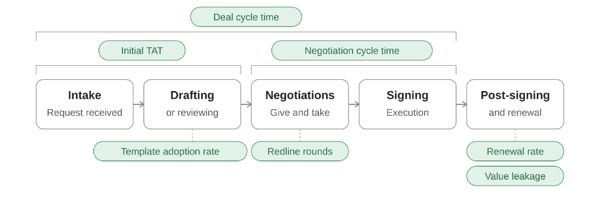
- Deal cycle time (intake to signature): Shorter cycles mean revenue is recognised sooner, the counterparty starts benefiting faster, and, more generally, everyone waiting on the deal has a better experience.
- Redline rounds: Fewer, sharper rounds free up time on both sides and make Legal easier and more decisive to work with.
- Template adoption rate: When people use the approved templates, fewer deals drift from agreed risk positions and fewer surprises turn up later.
- Renewal rate: Catching renewals before the notice deadline protects revenue and the relationship, so nothing lapses into default terms by accident.
- Value leakage: This is the gap between what was negotiated and what the business actually realises after signing. World Commerce & Contracting puts the average cost of poor contract management at 8.6–11% of contract value. Closing that gap puts real money back on the table.
Turning metrics into improvement
The value comes from what you do with the numbers. You don’t need a new system, a big budget, or a transformation programme to start. What follows is a simple loop any team can run today, and it gets easier each time around.
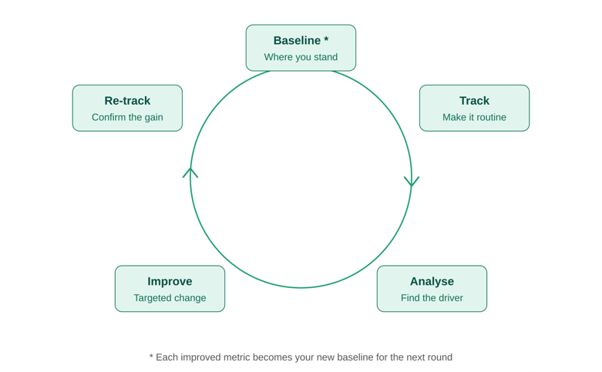
Baseline: Find out where you stand. With a CLM, most of these numbers are already there. Without one, they still exist: negotiation time and redline rounds can be rebuilt from an email thread, signature dates from the e-signature log. This was once a tedious manual job but, now, with AI, a short script can complete the task in a few minutes. A missing system is no longer a reason to fly blind.
Track: Measure on a regular basis, so the number updates as work flows through and the trend becomes visible. Template adoption can be as light as a tag on each matter; redline rounds can be counted from email threads. Consistency counts for more than sophistication.
Analyse: A number tells you where to look but it won’t tell you what to fix. A long negotiation cycle with a high redline count usually points upstream – to a weak template or lack of context at intake – more than to the negotiation itself. Low template adoption often suggests that people don’t trust the templates or don’t know they exist. The metric asks the question; the analysis answers it.
Improve: The fix is usually small, and rarely needs new technology. Better intake is the clearest example. It gives Legal the right context at the point of request: what the deal is, who the counterparty is, what has been agreed. Legal can then sit the ground running instead of chasing information. This leads to a drop in turnaround time. The same change cuts redline rounds later, since the first draft is written with the full picture. One fix at the front improves two metrics downstream. Usually the fix is spotting the small frustrations people have learnt to live with, and taking them away.
Re-track: Measure again to confirm the change actually moved the number. This closes the loop and gives you something concrete for the business: instead of “we’ve been busy,” you can say “cycle time is down 20% since last quarter.” That number becomes the baseline for the next round.
A few habits make this loop easy to run and keep it turning: a dashboard to hold the numbers in one place, a regular review (monthly within Legal, quarterly with the business), and a light governance forum to pick the next metric and keep someone accountable. If these habits are kept small and consistent, they can turn good intentions into a steady rhythm.
From activity to impact
Counting activity tells the business how busy Legal is but measuring impact tells it what Legal is worth. Run the loop a few times and the effect builds. Every improvement is tied to a number. You also avoid the familiar traps: the big overhaul that stalls, the metrics tracked but never acted on, the wins nobody outside Legal hears about.
A team that knows its cycle times and leakage, and can show them improving, stops looking like a cost centre and starts looking like a team that protects revenue and moves deals faster. That is the case Legal can put to a CFO, and it takes no new system or big programme to make. A few numbers and the will to act are enough.
The content of this article is intended to provide a general guide to the subject matter. Specialist advice should be sought about your specific circumstances.
