
- within Government and Public Sector topic(s)
- in North America
- within Real Estate and Construction topic(s)
PART I — INSIDE THE WASHINGTON ACCORDS: WHAT WAS SIGNED AND WHAT IT REALLY MEANS
The signing of the Washington Accords for Peace and Prosperity between the Democratic Republic of Congo and Rwanda in Washington on 4 December 2025 is being presented as a turning point for the Great Lakes region, but to understand what is really happening you have to go beyond the celebratory language and unpack the legal and strategic architecture that sits underneath the photo opportunity. At its core, this "peace deal" is not a single agreement, but a layered package: a Joint Declaration that politically rebaptises an earlier peace agreement and declaration of principles; a highly detailed Regional Economic Integration Framework (REIF) between DRC and Rwanda; a Strategic Partnership Agreement between the United States and the DRC which reorganises the governance of minerals, infrastructure and energy; and at least two additional security-focused Memoranda of Understanding whose texts are not publicly available for scrutiny.
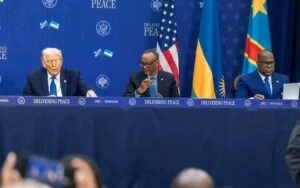
What is striking is that this architecture is consciously branded in Washington as the "Washington Accords for Peace and Prosperity", an umbrella term used in the Joint Declaration to consolidate the Declaration of Principles of April 25, the Peace Agreement of June 27, the REIF and their implementing arrangements into a single political package, and explicitly to express "deep gratitude" to President Donald J. Trump for his "significant contributions" to normalizing DRC–Rwanda relations. This branding is not accidental: it inscribes the United States as the central guarantor and beneficiary of both the peace and the economic order that is meant to flow from it.
The Joint Declaration itself is relatively short, but politically important. It reaffirms the two presidents' "unwavering commitment" to peaceful relations, mutual respect, and cooperation, and it states clearly that they will address security concerns, foster economic integration, and promote the safe return of displaced persons and refugees. It then recognizes the Declaration of Principles, the Peace Agreement and the REIF, "together with any implementing agreements or arrangements", as the Washington Accords and states that these constitute a "strong foundation for mutual respect and the advancement of peace in the region".
In legal terms, this Declaration does not create new enforcement mechanisms; it is a political act that elevates prior agreements and bundles them into a new, more visible framework, witnessed by a third party head of state. Its value is therefore largely symbolic and diplomatic: it signals that Kigali and Kinshasa are willing to be seen together, to acknowledge their obligations in front of the United States and other regional leaders, and to tie their political reputations to an agenda of normalization. Its weakness, however, is the same weakness that has characterised many past Great Lakes instruments: without credible monitoring, verification, and clear consequences for non-compliance, it remains dependent on the political will of two leaders whose relations have historically fluctuated between tactical cooperation and open hostility.
If the Joint Declaration is the political cover, the REIF is the technocratic heart of the DRC–Rwanda component of the deal. It is an extensive framework that articulates a shared vision grounded in sovereignty, mutual respect and regional cooperation, but very concrete about its objectives: combating illicit mineral trade, fostering industrialization, building cross-border infrastructure, and developing joint mechanisms for energy, tourism, public health and environmental protection.
The REIF is organised around thematic pillars—energy, infrastructure, mineral supply chains, national park management and tourism, public health and other areas like agribusiness and education—and for each pillar it sets both policy commitments and phased "implementation measures". In energy, the countries commit to joint development of hydropower (notably Ruzizi III) and exploitation of methane gas from Lake Kivu, linked to regional power pools and cross-border electrification. In infrastructure, they pledge to enhance road, lake and air transport, develop trade facilitation systems, implement one-stop border posts aligned with COMESA, EAC and AfCFTA instruments, and coordinate investment in ICT and logistics to support the Lobito Corridor and broader regional connectivity.
The most sensitive pillar is mineral supply chains, where the REIF directly confronts the history of conflict financing through tin, tantalum, tungsten, gold and other minerals. The two states commit to prevent conflict financing, implement OECD Due Diligence Guidance and the ICGLR Regional Initiative, reform tax regimes to remove incentives for smuggling, formalize artisanal and small-scale mining, and deepen cooperation between customs, law enforcement and financial intelligence units. There is a clear attempt to move from rhetoric about "conflict minerals" to an integrated regulatory ecosystem in which taxation, certification, border management and anti-corruption are aligned in both jurisdictions.
Institutionally, the REIF recognises that none of this can work if policy remains trapped in capitals. It establishes an Annual High-Level Regional Economic Integration Summit, a REIF Steering Committee, technical working groups, subnational coordination mechanisms that include provincial authorities and communities, and a Private Sector Input Mechanism. This means that on paper, there is a multilevel, multi-stakeholder machinery designed to turn high-level commitments into actual projects and reforms. Whether those mechanisms will be empowered or undercut by political interference will be one of the decisive tests of the REIF's credibility.
Parallel to this DRC–Rwanda integration agenda, the Strategic Partnership Agreement between the United States and the DRC represents a separate but interlocking track that effectively reconfigures Congo's relationship to global mineral supply chains. From the preamble onwards, the Agreement explicitly ties the partnership to U.S. strategic interests in building secure, reliable and durable supply chains for critical minerals, supporting reindustrialization, and maintaining competitiveness in defense, energy, advanced technologies and automotive sectors.
Substantively, the Agreement does several things. First, it recognises the DRC as a "strategic partner" of the United States and outlines four broad areas of cooperation: economic (with a heavy emphasis on mining, energy, infrastructure and beneficiation), security and defense, scientific and educational exchanges, and institutional and governance cooperation including judicial reform and anti-corruption measures. Second, it creates a powerful institutional body, the Joint Steering Committee (JSC), composed of senior officials from both sides, which becomes the primary platform for implementation and oversight. The JSC is mandated to review compliance, oversee investment processes, coordinate technical cooperation, set offtake guidelines and even weigh in on ownership changes in strategic projects.
Third, the Agreement introduces the concept of a Strategic Asset Reserve (SAR), an evolving list of critical mineral assets, gold assets and unlicensed exploration areas designated by the DRC in consultation with the U.S., for which U.S. companies receive a right of first offer. The DRC undertakes to avoid imposing any obligations or administrative procedures on SAR projects beyond those set by law, and the JSC is given a central role in managing eligibility and offtake alignment with U.S. national security objectives. In practical terms, this gives U.S. actors a privileged position in accessing some of the most valuable mineral opportunities in Congo, with a governance framework tailored to de-risk their investment.
Fourth, the Agreement contemplates a Strategic Minerals Reserve (SMR) located in the DRC to ensure predictable offtake for the U.S. market, and links this to the development of the Sakania–Lobito Corridor and Grand Inga hydropower projects as anchors for energy-intensive industrialization. It also commits the U.S. to provide technical assistance on mining governance, processing, data evaluation, and formalization of artisanal mining, while the DRC commits to legislative and fiscal reforms including a renewable fiscal stabilization clause, fast VAT reimbursements and a one-stop-shop (guichet unique) for investors.
When you place the REIF and the Strategic Partnership side by side, it becomes clear that the "peace" narrative is inseparable from a deep restructuring of the economic and regulatory environment in which minerals are discovered, extracted, processed, transported and taxed. The DRC–Rwanda framework seeks to integrate and sanitize regional supply chains, while the U.S.–DRC framework seeks to secure preferential access and influence over those now-regularised chains. That is not necessarily negative if it results in more transparency, more local value addition and better governance, but it does mean that peace is part of a broader geo-economic bargain rather than an isolated moral commitment to end violence.
The picture is completed by the additional security instruments referenced in the official media note issued by the U.S. Department of State. In addition to the Washington Accords and the REIF, the note lists a "Memorandum of Understanding Between the Government of the United States and the Government of the Democratic Republic of the Congo Concerning an Expanded Security Partnership" and a "U.S.–Rwanda Framework for Shared Economic Prosperity", signed and hosted by the U.S. side. The two MOUs relating to security were signed, but their full texts are not available for analysis here. That absence is not a mere technicality: it means that we cannot see the precise commitments around military cooperation, intelligence sharing, counter-insurgency support or conditionalities that may exist behind the public narrative of peace. We can infer that such instruments are meant to operationalise the security dimension of the peace architecture—possibly including joint operations against armed groups, capacity-building for state forces, or specific obligations regarding non-support to proxies—but without the text, any evaluation of their human rights safeguards, accountability mechanisms or implications for sovereignty remains speculative.
So, does the United States deserve the credit it is claiming? The answer is mixed. On the one hand, it is undeniable that Washington has provided a diplomatic platform, political pressure and technical frameworks that brought two deeply hostile neighbours to sit together, sign detailed economic and regulatory arrangements and accept a complex institutional apparatus to manage their relationship. On the other hand, the structure and content of the agreements make it clear that U.S. engagement is driven by strategic self-interest—especially in securing critical mineral supply chains—and that African sovereignty, while constantly invoked, is being redefined within a framework where U.S. preferences on ownership, offtake, taxation and project selection carry enormous weight.
In that sense, the Washington Accords are best understood not as a generous act of conflict mediation, but as a grand bargain: peace and regional integration in exchange for a reorientation of Congo's and Rwanda's economic and security ecosystems toward U.S. strategic priorities. Whether this bargain ultimately serves the interests of the populations of North Kivu, Ituri, Goma, Gisenyi or Bukavu will depend less on the elegance of the texts than on implementation: whether illicit networks are dismantled rather than merely rebranded, whether communities see tangible improvements in security and livelihoods, and whether African institutions—not just external partners—exercise meaningful oversight over this new architecture.
The content of this article is intended to provide a general guide to the subject matter. Specialist advice should be sought about your specific circumstances.
[View Source]