

- within Transport topic(s)
Regional Court of Düsseldorf, default judgment dated December 22, 2025 – 14c O 64/25
The Regional Court of Düsseldorf (LG Düsseldorf) has, as far as is known, become the first German court to apply the partly new principles established by the European Court of Justice (ECJ) in Mio/konektra on the copyright concept of a “work” in relation to works of applied art to a specific infringement case. In a default judgment dated December 22, 2025, the 14c Civil Chamber affirmed the copyright protection of the body of the electric guitar “Stratocaster”, designed by Clarence Leonidas “Leo” Fender in 1954, and ordered a Chinese company to cease the distribution of near-identical replicas via the platform AliExpress.
The decision is noteworthy for several reasons: it undertakes to harmonize the existing case law of the German Federal Court of Justice (FCJ) with the new requirements set by the ECJ, providing a detailed and vivid description of the creative elements of a utility object. At the same time, it places the recalibrated infringement test established by the ECJ in the context of German case law tradition for the first time.
1. Background: The landmark decision of the ECJ in Mio/konektra
To understand the judgment, it is necessary to consider the ECJ’s decision dated December 4, 2025 (GRUR 2026, 72). The joined cases concerned, on the one hand, a dispute before a Swedish appeal court regarding the copyright protection of dining tables from the “Palais Royal” series and a detailed catalogue of questions (Case C-580/23), and, on the other hand, questions subsequently referred by the FCJ on the protection of the modular furniture system “USM Haller”, in particular on the relationship between design and copyright protection (Case C-795/23, cf. FCJ GRUR 2024, 132 – USM Haller).
The ECJ answered the referred questions with three key findings:
First, the Court clarified that there is no relationship of rule and exception between design protection and copyright protection. When assessing the originality of subject matter of applied art, no higher threshold is to be applied than for other types of works (paras 56–58). The ECJ thereby definitively rejected the “tier theory” (Stufentheorie) – a result which the FCJ had already anticipated in its Geburtstagszug decision (FCJ GRUR 2014, 175) in 2014.
Second, the Court specified the requirements for the originality assessment. A “work” within the meaning of Directive 2001/29/EC is an object that reflects the personality of its author by expressing that author’s free and creative choices (para 82). The ECJ emphasized that the creativity of such choices must not be presumed but must be sought and identified by the court in the shape of the subject matter (para 65). At the same time, it made clear that a pronounced aesthetic or artistically significant visual effect is not, as such, sufficient to confer copyright protection (paras 67–68). Circumstances such as the author’s intentions, sources of inspiration, the likelihood of an independent similar creation, or recognition among professional circles are neither required nor decisive for the assessment of originality (para 82).
Third – and of particular importance for the infringement test – the ECJ rejected the comparison of the “overall impression” as the test for establishing copyright infringement. This criterion, the Court held, pertains to design protection. What matters, rather, is whether creative elements of the protected work have been incorporated in a recognizable manner into the allegedly infringing subject matter (paras 86–87). Nor does the scope of copyright protection depend on the degree of creative freedom available to the author or on the level of creativity (Gestaltungshöhe) (para 88).
2. The decision of the Regional Court of Düsseldorf
2.1 Facts
The claimant, Fender Musical Instruments Corporation Inc., has been the owner of the copyright exploitation rights of the “Stratocaster” body since 1985. Leo Fender had designed it in 1954.
The defendant, a Chinese company, distributed an electric guitar via the platform AliExpress under the name “SHUFFLE Musical Instruments Store”, the body of which was a near-identical reproduction of the Stratocaster. A test purchase carried out in April 2025 established distribution within Germany. The defendant failed to file a defense in time, and a default judgment was issued in the written preliminary proceedings.
2.2 Harmonization of the concepts of a “work”: ECJ and FCJ on the same page
The Regional Court of Düsseldorf bases its classification of the work on the case law of both the ECJ and the FCJ and considers both lines of reasoning to be consistent in their outcome.
At the European level, the Court relies on the Mio/konektra decision handed down only a few weeks earlier, recalling the requirements established therein: the existence of an “original” in the sense of an author’s own intellectual creation reflecting that author’s personality (originality), and the identifiability of the subject matter with sufficient precision and objectivity (identifiability). The court also follows the ECJ in holding that a pronounced aesthetic or artistically striking “visual effect” is not, as such, sufficient.
At the national level, the Regional Court of Düsseldorf cites the established FCJ case law, most recently clarified in the Birkenstocksandale decision dated February 20, 2025 (GRUR 2025, 407 – I ZR 16/24). According to this, a personal intellectual creation is a creation of individual character whose aesthetic content has reached a level at which, in the view of circles receptive to art and reasonably familiar with artistic standards, it can be considered an “artistic” achievement (para 18). The court adopts the clarification made there that “artistic achievement” means nothing more and nothing less than a creative, original achievement in the field of art that reflects the individual personality of its author (para 23).
In the result, the Court considers both tests to be equivalent: both require that the individual personality of the author is reflected in the subject matter. Whether the FCJ will in future adhere to the terminology of “artistic” achievement is expressly left open by the Court – a pragmatic solution that insulates the decision against challenges from either side.
2.3 Qualification as a work of the Stratocaster body
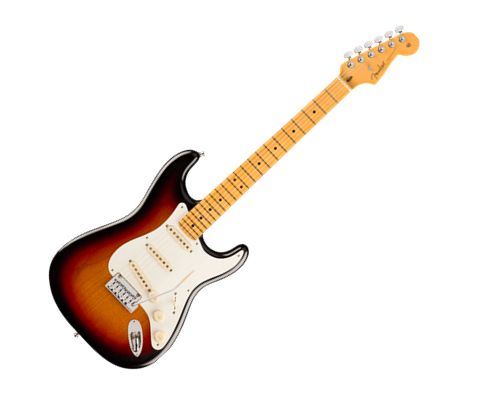
The Court classifies the body as a work of applied art pursuant to Section 2 (1) nos. 4 and (2) of the German Copyright Act (UrhG) and supports this with a detailed and vivid description of the specific design elements in which it identifies Leo Fender’s free creative choices:
- The edgeless basic shape lends the body soft curves, evoking associations with a female torso with hips, waist, and arms.
- The asymmetric S-curves – the left side being more elongated, so that the radii on each side run unevenly – create not merely an asymmetric shape, but the impression of a dynamic tilt, comparable to a dancer leaning to one side.
- The differently elongated horns – the left one, reminiscent of an arm, reaching further than the right – reinforce the impression of a stretching movement.
- The three-dimensional modelling, with a flattening of the front left side – suggestive of a pelvis tilted backwards – and a narrower left rear, further emphasizes this impression.
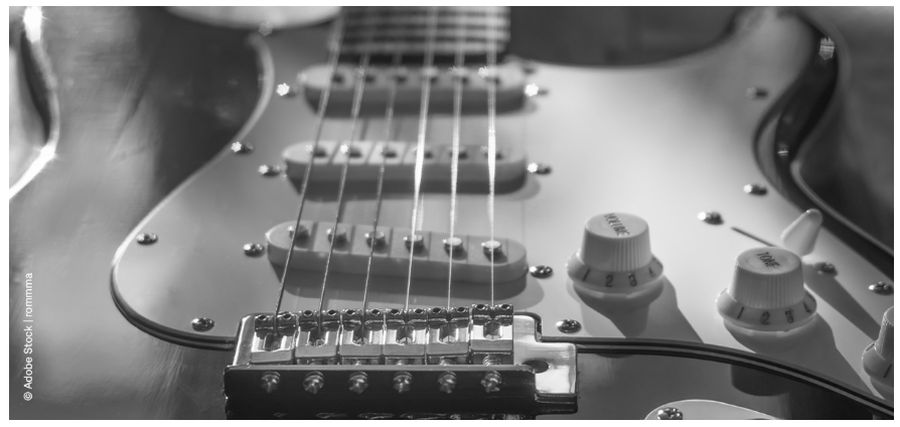
- The pickguard echoes the curves of the body at an offset and thereby highlights the characteristic individual shape, as does the cable outlet, which is arranged parallel to the lower right contour of the pickguard.
The Court further finds that such a futuristic, elegant, and timeless design had no counterpart in the existing prior art at the time of creation in 1954. Only Leo Fender’s own earlier models – the “Broadcaster” (later “Telecaster”) and the “Precision Bass” – hinted at the elements of the asymmetric basic shape, which were further developed into the shape described in the Stratocaster. The Court ultimately concludes that the body constitutes “an outstanding, free creative achievement” that “clearly reflects the personality of its author”.
2.4 The infringement test: A recalibrated standard
Of particular practical relevance is the adjustment of the infringement test. The Regional Court of Düsseldorf achieves a synthesis here:
Under the previous FCJ case law, the comparison of the respective overall impressions of the designs in question was decisive. According to the FCJ, where the overall impression of the new design diverges from the overall impression of the earlier work to such an extent that, viewed as a whole, the elements giving rise to copyright protection of the earlier work fade – i.e. are no longer recognizable – in the new design, the new design does not fall within the scope of protection of the earlier work (FCJ GRUR 2023, 571 – Vitrinenleuchte, para 29). In effect, the FCJ had thus combined the overall impression test with that of recognisability.
The ECJ in Mio/konektra, by contrast, clarified that the comparison of the overall impression is not decisive for the infringement test in copyright law, as this criterion pertains to design protection (para 87). What matters is solely whether creative elements of the protected work have been recognizably incorporated into the challenged object (para 86).
The Regional Court of Düsseldorf has now effectively combined both approaches: since free and creative choices often lie precisely in the combination of elements, and it is this combination that reflects the author’s personality, the overall consideration of these elements is likely to retain its significance. In other words: not the “overall impression” as such, but the examination of the incorporated creative elements in their interplay remains relevant.
In the specific case, the court finds that the challenged guitar reproduces the creative elements of the Stratocaster near-identically – the shape of the body, the shape and attachment of the pickguard, the shape and position of the cable outlet – and this not only in proportions, but even in the exact dimensions, including the flattening of the left rear in near-identical width. The absence of the “Fender” label on the pickguard and the different color scheme are, the court holds, irrelevant both for the question of reproduction under Section 16(1) UrhG and for copyright protection as a whole.
3. Assessment and practical implications
The judgment of the Regional Court of Düsseldorf is, as far as is known, the first German decision to apply the ECJ’s principles from Mio/konektra to a specific case of applied art. The Court succeeds in building a convincing bridge between the European and German case law traditions.
The assessment of qualification as a work corresponds precisely to what the ECJ demanded: the court seeks and identifies the creative choices in the shape of the subject matter (cf. ECJ, paras 65 and 73) and avoids relying on mere aesthetics or external circumstances such as museum exhibitions or recognition among specialist circles – factors which the ECJ expressly declared to be neither required nor decisive. At the same time, the court places the subject matter in the context of the historical prior art, without thereby – in the manner of design law and the individual comparison applicable in that context – merely inferring individual character. Rather, the distance from the prior art in its entirety serves as evidence that Leo Fender’s specific design choices were free and creative.
In the infringement test, the court consistently implements the ECJ’s requirements from Mio/konektra: it effects the departure from the “overall impression” as the infringement test both terminologically and doctrinally, whilst preserving the practical functionality of the existing FCJ approach by focusing on the overall consideration of the incorporated creative elements. In the present case of a near-identical copy, both tests lead to the same result – a clear copyright infringement. The question remains open as to how courts will in future deal with cases in which only individual creative elements are taken over and the overall impression and individual element test might lead to different results.
A comparison with the Birkenstocksandale decision reveals a contrast: there, the FCJ denied copyright protection for the sandal models “Madrid” and “Arizona” because the designs remained within the realm of a shoemaker’s artisanal skill and no creative utilization of the existing creative freedom could be identified. The Regional Court of Düsseldorf, by contrast, succeeds in vividly identifying Leo Fender’s creative choices. The Stratocaster is not merely a functionally and commercially designed product, but a design which, against the background of the prior art existing at the time, represented something fundamentally new and, in its combination of asymmetric lines, three-dimensional modelling, and the interplay of body and pickguard, clearly reflects the individual personality of its creator.
4. Conclusion
The judgment of the Regional Court of Düsseldorf merits attention as an exemplary application of the Mio/konektra principles in practice. The decision demonstrates that a careful identification of specific creative elements “in the shape” of the subject matter – as required by the ECJ – can be achieved within the framework of existing German doctrine, without necessitating a break with FCJ terminology. Whether the default judgment will stand remains to be seen; however, its substantive treatment of the qualification as a work and the infringement test sets a standard for the future case law on works of applied art in European and German copyright law.
The content of this article is intended to provide a general guide to the subject matter. Specialist advice should be sought about your specific circumstances.
[View Source]