

- with readers working within the Construction & Engineering industries
Part 1: Navigating the Opportunity
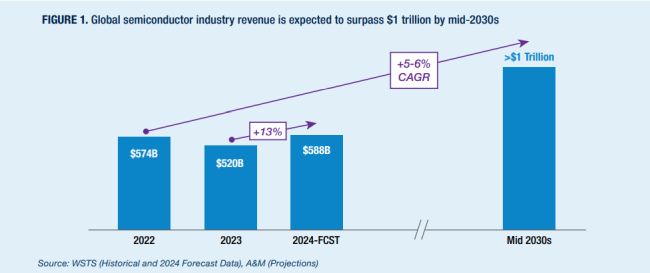
The semiconductor industry is on the cusp of a new growth cycle. A&M sees a path to a staggering $1 trillion global revenue in the sector by the mid-2030s, up from the record revenue of $574 billion achieved in 2022.1
The remarkable expansion and opportunity are set against a backdrop of increasing complexity within both the industry's own evolving dynamics and the broader geopolitical landscape. Such complexity is expected to usher in an era of change, challenging companies to adapt the ways they operate in all aspects of the business while adapting to the shifting customer and value chain landscapes.
Join our team as we embark on a series of papers first seeking to understand the sources of the opportunity as well as the increasing complexity and key implications, then exploring specific strategic areas. The series will explore, among some of the topics, how companies can:
- Adapt their talent recruitment and development processes;
- Improve their selection and execution of research and development (R&D) projects;
- Better hone their go-to-market efforts; and
- Make more strategic capital expenditure (CapEx) decisions
A Trillion-Dollar Global Industry
The global semiconductor industry reached a peak revenue of $574 billion in 2022 while 2023 saw a 9.4 percent decline — not unexpected in a typically cyclical industry. We are now on a new growth path fueled by advancements in artificial intelligence (AI) and other innovative applications like automotive Advanced Driver Assistance Systems, or ADAS, and many more. The speed at which these technologies are expanding is considered rapid even by seasoned industry experts.
The World Semiconductor Trade Statistics (WSTS), which tracks data and trends in the industry, expects a rebound from 2023 and forecasts 2024 revenue growing at 13% and topping the previous record at $588 billion, driven by a strong recovery of the memory segment and robust performances by logic and microelectronic semiconductors. A&M's expectation is that the growth will continue beyond 2024 and, despite the inevitable corrections in between, we expect the industry to surpass the $1 trillion mark by the mid-2030s (Figure 1).
Semiconductors are and will continue to be at the core of the key technologies that ensure our productivity, national security and way of life, and new and exciting applications will almost certainly drive specific market sub-segments.
The first major driver appears likely to come from technology players and their customers who are racing to develop artificial intelligence platforms and use cases. The first step is to establish the hardware platform — the actual foundation on which complex models can be trained and run. We see this effort not only in the recently released quarter earnings from one of the early AI semiconductor leaders, NVIDIA, showing a staggering 265 percent revenue growth from the prior year,2 but also in the reports that Sam Altman, CEO of OpenAI, is seeking partners to enter the semiconductor design and manufacturing business directly.3 More evidence indicating a focus on the foundational hardware is Intel's recent announcement that it will develop custom chips for Microsoft4 and in the $52 billion CHIPS and Science Act that the U.S. Government has allocated to the industry.
The second step, once the foundational hardware is available, is for companies to go beyond the hype and develop robust use cases for AI. Despite the dream of a true artificial general intelligence (AGI) promising to solve any kind of problem, companies still need to hone the models and perfect the platforms for their own environments. This will spur even more requirements for the hardware and continue the cycle of innovation.
The Automotive segment is another very promising end market. We expect the segment to reach $300 billion by the mid-2040s, up from approximately $40 billion to $50 billion at the beginning of this decade. Despite some short-term woes, the interest in electric vehicles continues to grow5 and the momentum of Chinese manufacturers, especially in Asia and Europe, will help drive prices down and demand up.6
Finally, it is important to remember that while leading-edge technologies often trigger exciting news, segments like industrial and even some automotive applications rely on more proven technologies still manufactured on 200 mm wafers, and the investment opportunity lies in strengthening or expanding the ecosystem, as we argued in our prior papers.7
Dissecting the Complexity: Understanding the Variables
Semiconductor design and manufacturing have always pushed the limit of what is possible. When Intel co-founder Gordon Moore predicted in 1965 that transistors on an integrated circuit (IC) would double every year for the next 10 years (later revised to two years), it was amazing to have up to 100 transistors per IC. Today, companies are working on "50 billion transistors on a chip the size of a fingernail" and features as small as 1 and 2 nanometers,8 essentially the diameter of a human DNA strand! The innovation and resources that make it possible to design and manufacture at such a small scale cannot be underestimated. To put this in perspective, today there is only one company in the world, ASML, that can manufacture the key EUV (extreme ultraviolet) lithography tool that makes this possible.
Designing at such small scales requires novel design and simulation techniques,9 new packaging materials and layouts, such as 3D stacking and heterogenous packaging, and new testing techniques. In each one of these areas, we see incredible feats of innovation and the early adoption of new tools and techniques.
New design architectures could emerge that can potentially upend the industry, exactly what happened when ARM embraced a different architecture for mobile devices in contrast with Intel's approach at the same time. Additionally, on top of the complexity of designing and manufacturing these small devices with repeated and economically viable yields and cost at scale, the industry faces increasingly harsher and more demanding requirements, such as in automotive or consumer applications.
The industry complexity doesn't show any sign of slowing down and the players will need to continue investing resources in the form of money and talent to remain competitive.
Industry and Geopolitical Dynamics: a Closer Look
As wonderfully recounted by Professor Chris Miller in his book "Chip War: The Fight for the World's Most Critical Technology," the semiconductor industry that was originally encouraged by the U.S. government has evolved into a complex, globally connected and highly interdependent business requiring billions of dollars to continue to grow. Globalization in the industry, companies locating certain steps of the supply chain in lower-labor-cost and economically-friendly countries and businesses specializing in specific sub-steps within the value chain made the industry the size it is today.
Unfortunately, recent years' events highlighted the challenges resulting from such globalization and interdependence coupled with the high costs that prevented any redundancy. Issues ranging from climate-driven challenges that constrained water usage at the leading foundry10 to global pandemics, accidents11 and frigid winter conditions12 that forced the closure of key manufacturing facilities have strained the existing supply chain.
This, in turn, triggered the panicked reaction of customers and manufacturers that induced a massive bull-whip effect and huge order backlogs. Geopolitical instability created another layer of challenges. Prolonged wars have limited certain raw materials while trade tariffs and outright trade limitations lowered or prevented shipments of certain devices to specific countries and customers.13
Governments all over the world have responded with investments to prop up manufacturing on national soil, but this is unlikely to completely solve the issue given the prohibitive amount of money needed to open new Fabs. This opens the door for private investment to step in and reap the benefits of expanding the ecosystem, as we outlined in prior papers.
Implications on the Semiconductor Industry
The increased complexity and geopolitical uncertainty are forcing companies to devise new ways to do business. The increased costs to build new advanced manufacturing facilities have forced companies to move past statements such as "real men have Fabs."14 Additionally, semiconductor talent is no longer as easily available as it once was — the Semiconductor Industry Association predicts a shortage of up to 67,000 workers by 203015 — and job opportunities have extended beyond the core industry into automotive and technology companies, thus increasing competition for the available talent. While there was a time when Chinese customers represented a great new opportunity for semiconductor companies, this situation has been limited by trade restrictions and China's development of its own supply chain.
This is an opportunity for companies to think about their supply chains, their investments, their customers and their talent in a new way.
Challenges and Opportunities for the Industry and its Investors
We recently discussed how the U.S. CHIPS Act is creating novel investment opportunities for Private Equity investors both in the U.S. and in Latin America.16 We now contend that companies have the opportunity to rethink their overall business strategies. For example, they can reconsider their go-to-market approaches by updating which customers they serve and how, their supply chain plans by deciding where to manufacture or source their products, their R&D investments and their talent management policies, among others.
As the industry changes, existing proven approaches may no longer work in the sector; for example, employees' benefits structures and hiring processes might need to change and new growth and investment areas might appear.
We believe that a time of change is a time of opportunity.
Join us as we explore the implications of the increased complexity and uncertainty that the industry must navigate as it grows toward the trillion-dollar mark.
Footnotes
2. NVIDIA Corporation - NVIDIA Announces Financial Results for Fourth Quarter and Fiscal 2024
3. Sam Altman Seeks Trillions of Dollars to Reshape Business of Chips and AI - WSJ
4. Intel Launches World's First Systems Foundry Designed for the AI Era :: Intel Corporation (INTC)
5. People want to buy EVs. Why are electric car sales so sluggish? : NPR
6. China's electric carmakers take on Europeans on their own turf : NPR
9. What is AI Chip Design? – How it Works | Synopsys
10. The Chip Shortage Is Bad. Taiwan's Drought Threatens to Make It Worse. - WSJ
11. Japan's Renesas sees fire-damaged chip plant back to full capacity by mid-June | Reuters
12. Severe Winter Weather In Texas Will Impact Many Supply Chains Beyond Chips (forbes.com)
13. Exclusive: Russia's attack on Ukraine halts half of world's neon output for chips | Reuters
14. Real men have fabs...or do they? - EE Times
Originally published by 26 March, 2024
The content of this article is intended to provide a general guide to the subject matter. Specialist advice should be sought about your specific circumstances.

