

Effective August 22, 2026, the United States began imposing additional 50% tariffs on certain products of Canada under Section 338 of the Tariff Act of 1930. The duties were imposed through three Presidential Proclamations, issued on July 20, 2026, addressing alleged Canadian discrimination against U.S. products including dairy, alcoholic beverages, and motor vehicles.
The tariffs were originally scheduled to take effect on August 19. On August 18, President Trump temporarily suspended their implementation for three days while negotiations with Canada continued, moving the effective date to 12:01 a.m. Eastern Time on August 22, 2026.
That temporary reprieve has now expired, and U.S. Customs and Border Protection (CBP) has issued guidance explaining how importers, customs brokers, and filers should handle affected entries.
What Is Section 338?
Section 338 of the Tariff Act of 1930, codified at 19 U.S.C. § 1338, gives the President authority to impose additional duties of up to 50% when a foreign country discriminates against U.S. commerce or imposes certain unreasonable or unequal restrictions that place U.S. commerce at a disadvantage.
Although Section 338 has existed for nearly a century, its use against Canada represents an unusual application of the statute.
The 50% Tariffs Cover Far More Than Alcohol, Dairy, and Cars
The July 20 proclamations invoked Section 338 in response to three categories of alleged Canadian discrimination: alcoholic beverages, dairy, and motor vehicles.
But the products subject to the resulting tariffs extend far beyond those three industries.
Section 338 does not require the imported product subject to the additional duty to have a direct connection to the discriminatory practice the United States is seeking to offset.
As a result, the products subject to additional tariffs are much broader than their titles might suggest.
For example, the annex associated with the motor vehicle action includes products such as natural honey, dormant tulip bulbs, fresh-cut orchids, essential oils, certain makeup preparations, candles, plywood, envelopes, cigarette paper, silver jewelry, hand tools, smartphones, video game consoles, fishing rods, and certain antiques.
In other words, a company does not need to be importing automobiles to be affected by the Section 338 action concerning Canada’s treatment of U.S. automobiles.
That makes an HTS-level review essential.
How the New Section 338 Duties Work
CBP’s August 21 guidance establishes five new Chapter 99 headings for affected Canadian goods.
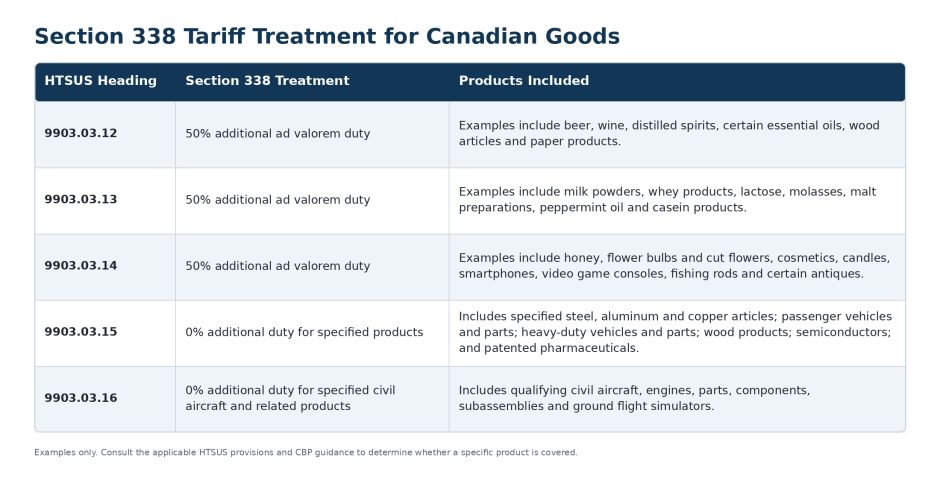
Importers should not rely on a general product description when determining whether their merchandise qualifies for the 0% treatment. The analysis should be performed using the applicable HTSUS classification and the product lists incorporated into the Section 338 measures.
Section 338 Duties Can Stack With Other Duties
The new tariffs also do not necessarily replace other duties already owed on imported merchandise.
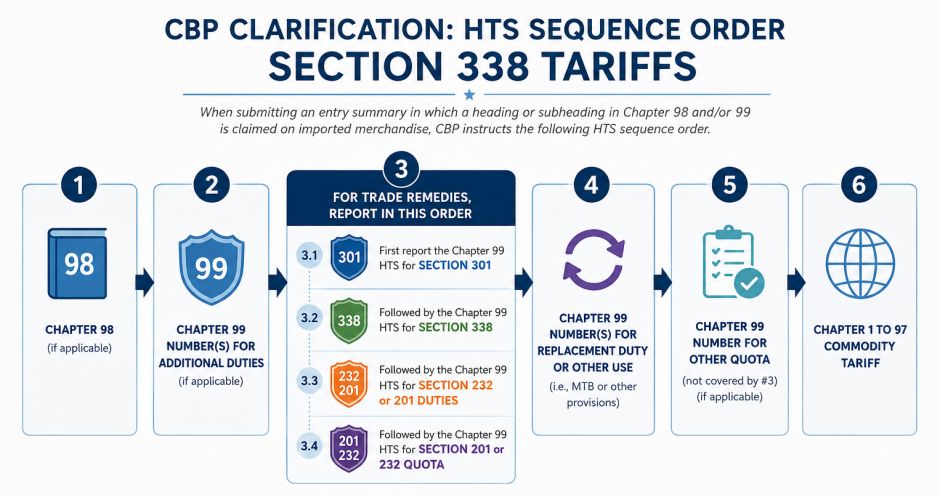
CBP states that merchandise covered by headings 9903.03.12 through 9903.03.16 remains subject to applicable antidumping duties, countervailing duties, other duties, taxes, fees, exactions, and charges, in addition to the applicable Section 338 treatment.
Drawback Is Available
There is some potentially helpful news for affected importers.
CBP’s guidance states that the additional Section 338 duties are eligible for drawback. CBP also provides instructions regarding Chapter 98 treatment and merchandise admitted into U.S. foreign trade zones.
Companies importing affected Canadian products that are subsequently exported or destroyed should therefore evaluate whether drawback may provide an opportunity to recover Section 338 duties.
Canada Responds With Retaliatory Tariffs on U.S. Goods
Canada has now announced its response to the new U.S. tariffs.
On August 25, 2026, the Canadian government announced that it will impose additional tariffs on $27.6 billion of U.S. goods, matching the value of Canadian goods affected by the new U.S. Section 338 tariffs. Canada described the response as matching the U.S. tariffs “dollar for dollar” and “rate for rate.”
The Canadian counter-tariffs will take effect at 12:01 a.m. on September 8, 2026, and will impose additional duties of 15%, 25%, or 50%, depending on the product. The affected products are drawn from goods targeted by the United States under both Section 338 and Section 232, with Canada generally applying a rate corresponding to the U.S. tariff on the same goods.
The countermeasures cover a wide range of U.S.-origin products, with Canada identifying steel, dairy, appliances, agricultural equipment, pulp and paper, and electronics among the sectors targeted. Certain steel and aluminum products, furniture, and clothing and apparel will face 50% counter-tariffs, while products subject to 25% tariffs include appliances, dairy products such as cheese, fish and seafood, and certain steel and aluminum derivatives.
Importantly, the counter-tariffs apply only to goods originating in the United States under Canada’s applicable country-of-origin rules. U.S. goods already in transit to Canada when the countermeasures take effect will not be subject to the new tariffs.
Canada’s previously imposed counter-tariffs, including those applicable to automobiles, also remain in place. The Canadian government has indicated that its existing tariff-remission framework will remain available for businesses seeking exceptional relief.
What Should U.S. Importers Do Now?
The immediate priority should be determining whether Canadian-origin merchandise in your supply chain appears in the relevant Section 338 product lists.
Importers should consider:
- Reviewing all Canadian-origin imports by HTSUS classification, rather than limiting the review to dairy, alcohol, and automotive products.
- Determining whether merchandise falls under 9903.03.12, 9903.03.13, or 9903.03.14 and therefore faces the additional 50% duty.
- Determining whether merchandise qualifies for the 0% treatment under 9903.03.15 or 9903.03.16.
- Confirming the accuracy of existing classification and country-of-origin determinations.
- Evaluating the interaction between Section 338 and any other duties already applicable to the product.
- Reviewing contracts and Incoterms to determine which party bears responsibility for the additional tariff cost.
- Recalculating landed costs and evaluating whether sourcing or pricing strategies need to change.
What Should U.S. Exporters Do Now?
U.S. companies exporting goods to Canada should determine whether their products appear on Canada’s retaliatory tariff list before the September 8 effective date.
Companies engaged in U.S.-Canada trade should:
- Review tariff classifications at the product level.
- Confirm country of origin.
- Review goods currently in transit and upcoming shipments.
- Evaluate contracts and Incoterms.
- Consider available mitigation strategies.
The scope of both countries’ measures makes product-level tariff classification and country-of-origin analysis critical. Diaz Trade Law assists importers with tariff classification, customs compliance, tariff mitigation strategies, and navigating rapidly changing U.S. trade measures.
The content of this article is intended to provide a general guide to the subject matter. Specialist advice should be sought about your specific circumstances.
[View Source]