
The Nigerian Upstream Petroleum Regulatory Commission (“NUPRC” or “Commission”) formally announced the commencement of the 2025 Licensing Round, which began on 1st December 2025. The round offers 50 oil and gas blocks spanning frontier, onshore, shallow-water, and deep-water acreages. The blocks are located across Nigeria’s sedimentary basins, namely the Niger Delta Basin, Chad Basin, Benue Trough, Anambra Basin, and Dahomey (Benin) Basin. The Niger Delta Basin accounts for the majority, with 35 blocks comprising 16 onshore, 18 shallow-water, and 1 deep-offshore acreage. The Dahomey (Benin) Basin offers three onshore blocks, while the Anambra (frontier) Basin, Benue Trough, and Chad Basin each present four onshore blocks for bid Participation in the 2025 Licensing Round is governed by the Petroleum Industry Act, 2021 and the Nigeria 2025 Licensing Round Guidelines (the “NUPRC Guidelines” or “Guidelines”) released by the Commission.1 The NUPRC Guidelines set out a structured roadmap outlining the eligibility criteria, prequalification requirements, bidding procedures, evaluation metrics, and post-award obligations applicable to prospective bidders. These Guidelines are central to ensuring transparency, competitiveness, and regulatory compliance throughout the licensing process.
It is against this backdrop that this Article seeks to provide practical guidance and highlight key regulatory, commercial, and procedural considerations that prospective bidders should be mindful of when participating in the 2025 Licensing Round.
1. Eligibility and Participation
- Only companies incorporated on or before 27 February 2026 are eligible to participate in the Licensing round2
- While an applicant may be a foreign company, a Petroleum Prospecting Licence (PPL) can only be awarded to a company duly incorporated in Nigeria;3 accordingly, any successful foreign applicant must incorporate a Nigerian company prior to award4
- Applicants may bid individually or as part of a consortium5
- Where a consortium is formed, the members must;
- Submit a valid Consortium Agreement identifying a lead member to the Commission;
- Execute a Power of Attorney appointing an authorised representative on behalf of the
- At least one member must be designated as Operator, with a minimum participating interest of 30%, and any change of Operator requires the Commission’s approval6
Where a PPL is held by an unincorporated joint venture, members’ liabilities shall be joint and several.
2. Stages of the Bidding Process
The Commission has structured its Licensing Round Guidelines to promote a transparent, competitive, and merit-based process for the award of petroleum exploration and production rights. To this end, the Licensing Round is divided into two distinct phases: the Qualification Stage, where applicants demonstrate their financial, technical, legal, and operational readiness, and the Bid Stage, where pre-qualified applicants submit their technical and commercial proposals for evaluation. The Guidelines clearly define the requirements and expectations at each stage and provide applicants with a structured framework to demonstrate their technical competence, financial strength, and commitment to industry best practices.
A. The Qualification Stage
During the Qualification Stage, applicants must demonstrate that they meet the financial, technical, legal, and health, safety, and environmental (HSE) criteria outlined in the NUPRC Guidelines. Each of these requirements are examined in turn below;
- Financial Criteria:
This requires providing verifiable evidence of the applicant‛s financial capacity by providing verifiable evidence of compliance through one or more of the following:
-
- A minimum average annual turnover of US$100 million for deep offshore blocks, and US$40 million for onshore and shallow water blocks;
- A minimum cash in bank of US$100 million (deep offshore) or US$40 million (onshore/shallow water);
- A bank guarantee of US$100 million (deep offshore) or US$40 million (onshore/shallow water); or
- For newly incorporated entities, a parent company guarantee of the same amounts7
- Technical Criteria
To pre-qualify, an applicant or the designated operator in a consortium must have at least three years’ experience in key technical areas, including geological and geophysical work, drilling, well engineering, production technology, or reservoir management across deep offshore, onshore, or shallow water operations. For new companies, pre-qualification may rely on the experience of the management team, technical partner, or parent company. Where a technical partner is engaged, the applicant must provide a formal agreement outlining the partnership and its terms.8
- Legal Criteria
To satisfy the legal pre-qualification requirements, an applicant must submit key corporate and compliance documents, including evidence of incorporation with the Corporate Affairs Commission, details of its shareholding and directorship, beneficial ownership information, a Letter of Good Standing, valid tax clearance certificates, its constitutional documents, and information on its corporate structure and management.9
Only a company incorporated in Nigeria under the Companies and Allied Matters Act is eligible to be awarded a Petroleum Prospecting Licence. Also, where the applicant is a consortium, each consortium member must provide the requisite documents. In addition, where a special purpose vehicle is incorporated to hold the PPL, the same documentation must be submitted in respect of that entity.
- Health, Safety and Environmental Criteria
Applicants must demonstrate robust Health, Safety, and Environmental (HSE) standards by submitting summaries of their safety and environmental policies and management systems, together with a clear disclosure of their safety and environmental performance over the past five years, including any major incidents, regulatory breaches, enforcement actions, or civil or criminal proceedings.
B. The Bid Stage
Pre-qualified applicants are required to submit both their technical and commercial bids, which will be evaluated in accordance with the criteria and parameters prescribed under the Guidelines.
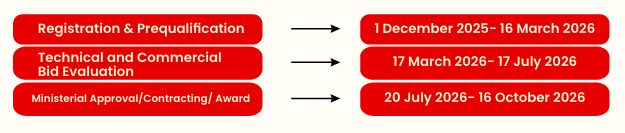
Timeline of the Bid Stage
- The Guidelines set out a clear timeline for the completion of each stage of the Licensing Tentatively, the entire process is scheduled to span approximately 11 months, commencing on 1 December 2025 and concluding on 16 October 2026.
3. Registration and Applicable Fees
The Guidelines mandate interested applicants to register on the licensing round portal on the commission’s website. Applicants are expected to submit all required legal, technical, and financial information through the licensing round portal.10
- Registration Fee: Applicants are required to pay a one-off, non-refundable fee of USD $10,000 at the Expression of Interest stage. Please note that this fee applies to all
- Bid Fees: Applicants are further required to pay an Application and Processing Fee of USD $25,000 per An applicant may apply for up to two blocks only, and where an applicant chooses to bid for two blocks, the fee of USD 25,000 applies per block.
- Data Prying Fee: The Commission provides access to National Data Repository Data for a data prying fee of USD 10,000, which is optional, while the mandatory data leasing fees must also be paid as stipulated by the Commission11 Please note that applicants must execute a Confidentiality Agreement before gaining access to the Data Room.
- Signature Bonus: Bidders are required to pay a minimum of US$3m and a maximum of $7m per block for onshore, shallow water and deep offshore blocks.
- Bid Guarantee: Each Commercial Bid must be accompanied by a bid guarantee equivalent to five per cent (5%) of the proposed Signature Bonus, issued as an on-demand payment bond payable in Nigeria. The guarantee must be issued by a qualifying international or Nigerian bank with an approved “BBB” rating and shall remain valid for 120 days following the Commercial Bid Conference and conform to the standard form prescribed by the Commission. In limited circumstances, and at the Commission’s discretion, a parent company guarantee of equivalent standing may be accepted12
All applications for the 2025 Nigerian Licensing Round must be submitted electronically via the Licensing Round Portal.13 The deadline for submission is 4:30 p.m. on 27 February 2026, although the Commission may grant extensions in exceptional circumstances. Applications submitted after this deadline will be automatically rejected, regardless of t h e reason for the delay.14
Applicants are required to ensure that all statutory declarations and formal attestations, including the Beneficial Ownership Declaration, are duly notarised prior to submission. Other supporting documents, such as curriculum vitae, memoranda of understanding, bank guarantees, financial statements, Corporate Affairs Commission documents, and tax clearance certificates should be submitted as certified true copies or originals. Where applicable, a single consolidated notarised affidavit may be used to authenticate multiple declarations, provided that each statement is explicitly referenced.
4. Parameters Used In Determining The Winning Bidder
Pursuant to the Guidelines, the Commission is required to satisfy itself that bidders have complied with the following key requirements:
- Signature Bonus: This payment is a core commercial determinant and signals the bidder’s financial capacity and seriousness of Failure to pay in full within the stipulated timeframe of 60 days15 constitutes a ground for forfeiture of the award.
- Work Programme Commitment: The Work Programme Commitment reflects the bidder’s proposed technical plan for exploration or development of the block, including seismic acquisition, drilling activities, timelines, and expenditure The Commission evaluates this commitment to assess the bidder’s technical competence, operational readiness, and alignment with national upstream development objectives.
- Minimum of 1% of Performance Security: The requirement for a minimum of one per cent (1%) performance security is a financial assurance mechanism tied to the bidder’s Work Programme This security serves to protect the Commission against non-performance or default and may be called upon where the bidder fails to execute its agreed obligations in accordance with the licence terms.
- Weighted Technical and Commercial Score: This represents the composite evaluation framework used by the Commission to determine the preferred bidder. Rather than relying solely on the highest financial offer, the Guidelines apply a weighting system that balances technical competence (such as experience, work programme quality, and operational capability) against commercial strength (including Signature Bonus and financial guarantees). The bidder with the highest aggregate weighted score emerges as the winning bidder.
Conclusion
The 2025 Nigerian Licensing Round is a clear and deliberate signal of the Federal Government’s renewed commitment to revitalising the upstream sector and increasing Nigeria’s crude oil production capacity. That this represents the second licensing round conducted in less than three years underscores a policy shift towards sustained asset allocation, accelerated exploration, and improved reserve replacement, all aimed at strengthening Nigeria’s position within the global energy market.
That said, the opportunity presented by the Licensing Round should not be mistaken for an invitation to hurried participation. The regulatory framework governing the process is exacting, the evaluation criteria are multi-layered, and the consequences of non-compliance, both at the bid stage and post-award are significant. Accordingly, success will depend less on enthusiasm for acreage and more on disciplined preparation, strategic bid calibration, and a clear understanding of the legal, financial, technical, and operational obligations embedded in the NUPRC Guidelines.
Investors who approach the process holistically by carefully interrogating the rules, aligning consortium and financing structures with regulatory expectations, and ensuring readiness for post-award execution will be best positioned not only to secure licences but to develop assets sustainably and preserve long-term value under Nigeri a’s evolving petroleum regulatory regime.
Footnotes
1 nigeria-2025-lr-guidelines-upload-version-2-pdf
2 Paragraph 1 of the NUPRC Guidelines.
3 Section 78 of the Companies and Allied Matters Act,
4 Paragraph 2 of the NUPRC Guidelines.
5 Paragraph 3 of the NUPRC Guidelines.
6 Paragraph 6.4 of the NUPRC Guidelines
7 Paragraph 2(a)(i)-(iv) of the NUPRC Guidelines
8 Paragraph 3(a) of the NUPRC Guidelines
9 Paragraph 4 (a)(i)-(ix) of the NUPRC Guidelines
10 Paragraph 10 of the NUPRC Guidelines
11 Schedule F of the NUPRC Guidelines
12 Paragraph 7 of the NUPRC Guidelines
13 Paragraph 1 of the NUPRC Guidelines
14 Paragraph 2 of the NUPRC Guidelines.
15 Schedule F of the NUPRC
The content of this article is intended to provide a general guide to the subject matter. Specialist advice should be sought about your specific circumstances.
[View Source]