

- within Employment and HR topic(s)
- in United States
- with readers working within the Retail & Leisure industries
- within Employment and HR topic(s)
- with Finance and Tax Executives and Inhouse Counsel
- in United States
The recent amendment to the Act on the State Labour Inspectorate marks a notable shift in how labour law in Poland is enforced, particularly in relation to flexible forms of engagement. It strengthens the position of the State Labour Inspectorate and reflects a broader regulatory trend toward closer scrutiny of non-employment arrangements.
For international businesses, this development is especially relevant in the context of the B2B model and mandate contracts (umowa zlecenia, a Polish civil law service contract), which remain widely used in Poland.
While these structures continue to be legally permissible, they are now more likely to be reassessed in practice. For readers familiar with the US market, these arrangements may be broadly compared to Anti-Avoidance of Employment Contract Act, although the legal framework and enforcement mechanisms in Poland differ in important respects.
Importantly, the reform does not alter the statutory definition of an employment relationship. Instead, it reinforces the enforcement of labour law, equipping the State Labour Inspectorate with more direct and effective tools to challenge misclassification.
Key Change: Administrative Determination of Employment Relationship – When Is a B2B Contractor Considered an Employee?
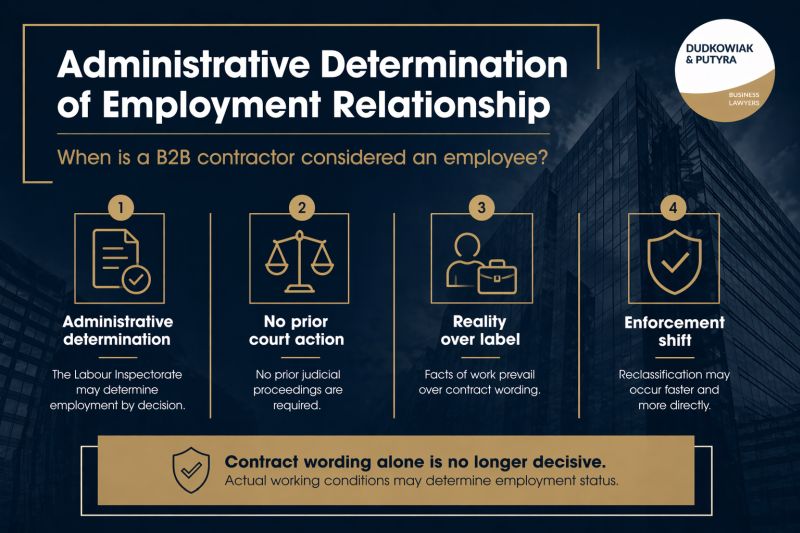
At the core of the reform is the introduction of administrative determination of employment, allowing the National Labour Inspectorate to establish the existence of an employment relationship through an administrative decision.
Under the previous regime, determining an employment relationship required court proceedings, even where inspection findings clearly indicated misclassification. In practice, this limited the effectiveness of enforcement.
The new framework changes this dynamic. The National Labour Inspectorate may now independently assess how work is actually performed and issue a binding decision. In practice, this creates a functional presumption of employment, where the factual conditions of work take precedence over the contractual label.
From an employer's perspective, this is a material shift. Employment status may now be determined more quickly and without prior judicial involvement, significantly altering the enforcement landscape.
Inspection Procedure – How Does a Labour Inspection Work Under the New Framework?
The revised inspection procedure follows a more streamlined administrative path, making enforcement more immediate than under the previous system.
An inspection is initiated by the State Labour Inspectorate, which examines the actual performance of work. In practice, the assessment focuses on factors typically associated with employment relationship, such as subordination, working time organisation, and integration within the company's structure.
If inconsistencies are identified, the authority may first require the entity to remedy the situation. Where the findings indicate that the statutory criteria of employment are met, the inspector may proceed to issue an administrative decision establishing the relationship.
Although such decisions may be challenged through administrative appeal procedures, the expansion of labour inspectorate powers significantly reduces the time needed to enforce compliance compared to court-based mechanisms.
Scope of Application – How Does the PIP Reform Affect B2B and Civil Law Contracts?
The reform primarily targets arrangements where there is a gap between contractual form and operational reality, particularly within the B2B model. This includes self-employed individuals who, in practice, operate under conditions similar to employees.
Mandate contracts (umowa zlecenia) and other civil law contracts are also covered by the new framework. While these remain valid legal instruments, they are now subject to more intensive verification by the National Labour Inspectorate.
The decisive factor is how the work is actually performed. This means that the legal qualification depends on whether the working conditions align with the statutory characteristics of employment, reinforcing the importance of working conditions vs contractual form.
Presumption of Employment – What Has Not Changed Under the Reform?
Despite the enhanced enforcement tools,the legal definition of an employment relationship, as reflected in employment contracts under Polish law, has not been modified. The criteria set out in the Polish Labour Code continue to apply without change.
The reform does not eliminate or restrict the use of the B2B model or civil law contracts. These forms of cooperation remain lawful, provided they reflect genuine independence in the provision of services.
Accordingly, the concept of presumption of employment should be understood in procedural rather than substantive terms. It does not introduce automatic reclassification but facilitates more effective identification of situations where existing legal criteria are already met.
Expanded Powers of the State Labour Inspectorate (SLI)
The reform substantially strengthens the labour inspectorate powers of the State Labour Inspectorate, extending its role beyond traditional supervisory functions.
In addition to issuing administrative decisions on employment status, the authority now has broader enforcement capabilities. This is further reinforced by enhanced cooperation with institutions such as the social security authority (ZUS) and tax administration.
At the same time, increasing use of data analysis and digital tools supports more targeted inspections and systematic detection of irregularities, contributing to a more proactive compliance environment.
Practical Implications and Key Takeaways for Employers – Reclassification of Civil Law Contracts
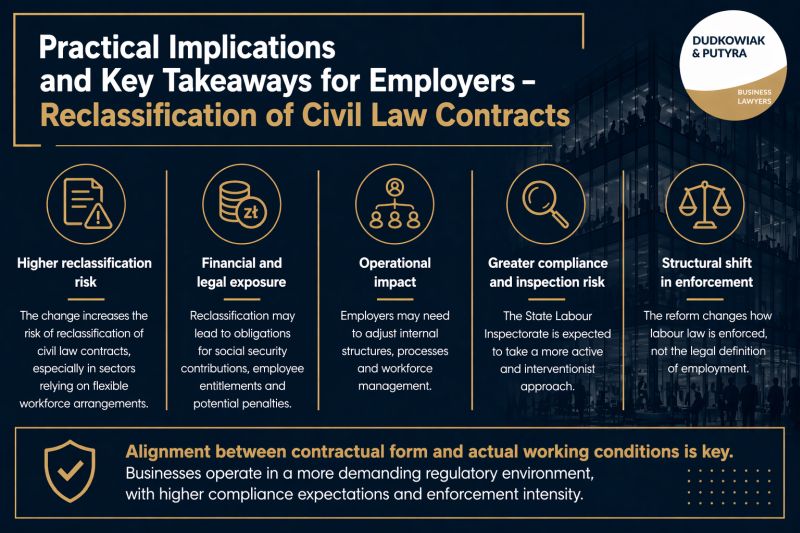
In practice, for employers, this change increases the risk of reclassification of civil law contracts, particularly in sectors that rely on flexible workforce arrangements.
Such reclassification may result in financial exposure, including obligations related to social security contributions, employee entitlements, and potential administrative penalties. It may also require adjustments to internal organisational structures.
Overall, the impact on employers is reflected in higher compliance risks and a greater likelihood of inspection. Businesses should expect a more active and interventionist approach from the State Labour Inspectorate.
From a broader perspective, the reform represents a structural shift in the enforcement of labour law, rather than a change to the underlying legal definition of employment. For businesses, this means operating in a more demanding regulatory environment, where alignment between contractual form and actual working conditions becomes increasingly important.
Recommended Actions and How to Navigate the New Framework for B2B and Civil Law Contracts
In light of the new framework, companies should consider a B2B contract audit and review their broader contractual arrangements, particularly those involving B2B cooperation and mandate contracts.
An internal audit should assess whether the actual working conditions correspond to the contractual model. Where inconsistencies are identified, appropriate alignment measures should be implemented to reduce exposure to reclassification.
Beyond immediate compliance steps, companies should ensure they are prepared for potential inspections, including maintaining appropriate documentation and aligning internal practices. A proactive approach can help mitigate regulatory risk.
From a broader perspective, adapting to the new regulatory environment requires not only a review of existing contractual models but also a practical understanding of how they function in day-to-day operations.
We support businesses in assessing contractor structures, identifying potential risks, and aligning contractual arrangements with actual working conditions in line with Polish labour law.
The content of this article is intended to provide a general guide to the subject matter. Specialist advice should be sought about your specific circumstances.
