



Introduction
Investing in distressed assets is not a new phenomenon but current market conditions and the significant quantity of distressed assets remaining on bank and other balance sheets are undoubtedly giving rise to increased distressed trading opportunities globally.
As an onshore, EU and OECD member state with an extensive double tax treaty network, Ireland has emerged as a favoured location for establishing vehicles to invest in or hold a wide variety of financial assets, including distressed assets, due to its special tax regime for SPVs. In particular, Ireland has become a domicile of choice for onshore SPVs in Europe, as a preferred alternative to the traditional offshore SPV jurisdictions.
For example, Ireland has been used as a domicile on many occasions for credit derivatives and synthetic securitisations involving European banks where no withholding taxes arise but the use of an offshore SPV was viewed negatively by the banks concerned. Types of transactions that have used Irish SPVs have included plain vanilla securitisation or repackaging of receivables, mortgages, non-performing loans, less straightforward synthetic transactions and more unusual securitisations such as the financing of infrastructure projects such as toll roads.
Many of the leading international banks, distressed/credit/special situations investors, private equity funds, hedge funds and others have availed of Irish structures in the acquisition, disposal and/or financing of investments worldwide. These include Lone Star, Shinsei Bank, Gazprombank, TPG, The Blackstone Group, Cerberus, Fortis, Grove and many others, with the two main structures being used being:
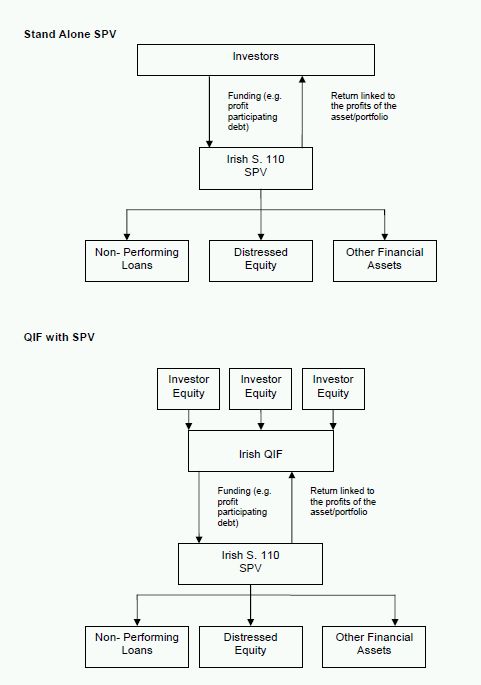
- the standalone Irish SPV; and
- the Irish QIF (Qualifying Investor Fund) with an SPV below it to improve treaty access.
Both structures are explained in detail below.
Key Highlights
Although addressed in more detail below, the main highlights of the Irish SPV and QIF structures suitable for distressed asset investing are:
- most Irish SPV transactions can be structured to be profit and tax neutral, with a variety of straightforward profit extraction mechanisms available
- double tax treaty access to avoid / reduce withholding taxes on income/gains from the assets, Ireland having 56 treaties with more due for signature later this year
- variety of exemptions from withholding tax on payments (e.g. interest) made by the SPV to its investors
- wide variety of financial assets can be facilitated (not direct real estate) - Ireland's EU and OECD membership, "white listed" for OECD purposes
- in most cases, no Irish stamp duty and no (or minimal) VAT
- where required, can use Irish regulated tax exempt QIF (Qualifying Investor Fund) with underlying SPV to improve treaty access. Now a commonly used structure, particularly for debt/loan products
- QIF has no leverage/borrowing constraints and very few investment restrictions, is a regulated fund, should comply with current AiFMID proposals and benefits from a fast track authorisation process
- QIFs have* minimuim subscription requirement of Euro 100,000 and can be invested in by professional investors (as per MiFID criteria) 5
- all liquidity arrangements facilitated (open-ended, limited liquidity and closed-ended)
- SPVs and QIFs can be easily listed on Irish Stock Exchange
- to be formalised shortly
The Irish SPV
The Irish SPV (often called "section 110 vehicle") operates under a special tax regime for structured finance transactions pursuant to section 110 of the Taxes Consolidation Act, 1997 (as amended).
The Irish SPV is a taxable entity which, at current rates, pays tax at 25% on its profits. However, provided it satisfies particular conditions, it can utilise various techniques to strip profit out on its underlying investments and can reduce or eliminate the tax it is required to pay. The SPV company can invest in a wide range of qualifying assets though it must be invested to a minimum value of Euro 10 million (or its foreign currency equivalent) on the first day on which it purchases such a qualifying asset (i.e. first day only test).
Irish SPVs are normally established as private limited or unlimited companies with nominal share capital and are usually financed via profit participating debt (i.e. a note or bond linked to the performance of the SPV's portfolio).
As shown in the diagrams below, such vehicles can be established as a standalone structure or as an investment vehicle within a new or existing, Irish or non-Irish fund structure. The key features of the section 110 vehicle, along with details of the most commonly used Irish fund structures, are outlined in more detail below.
Qualifying Company Requirements
To avail of the special tax regime, the SPV must qualify as a "qualifying company" which requires that the SPV must:
- be resident in Ireland;
- acquire "qualifying assets" (see definition below) or, as a result of an arrangement with another person, hold or manage qualifying assets or enter into a legally enforceable arrangement with another person and the arrangement is itself a qualifying asset (such as a derivative);
- carry on in Ireland the business of the holding and/or management of qualifying assets;
- apart from activities ancillary to that business, carry on no other activities;
- undertake the first transaction resulting in the holding and/or management of qualifying assets for a value of not less than Euro 10m;
- notify the Irish tax authorities that it is a company to which points (a) to (e) apply; and
- carry on no transaction other than by way of a bargain made at arm's length (the legislation specifically excludes profit participating loans from satisfying this requirement).
Qualifying Assets
A "qualifying asset" means an asset which consists of, or of an interest (including a partnership interest) in, a "financial asset" which includes shares, bonds and other securities, futures, options, swaps, derivatives and similar instruments, invoices and all types of receivables, obligations evidencing debt (including loans and deposits), leases and loan and lease portfolios, hire purchase contracts, acceptance credits and all other documents of title relating to the movement of goods, and bills of exchange, greenhouse gas emissions allowances, contracts for insurance and contracts for re-insurance, commercial paper, promissory notes and all other kinds of negotiable or transferable instruments.
Tax/Profit Neutrality
One of the advantages of the Section 110 vehicle fulfilling the above requirements is that, although often passive vehicles and liable to corporation tax at a rate of 25% on taxable profits, their taxable profits are calculated using trading principles. This means that most transactions involving an SPV can be structured to be profit and tax neutral.
Such tax neutrality is achieved in an SPV if its expenses are deductible for tax purposes and if book/tax differences in the taxation of deductibility of income and expenditure are minimal. Generally, provided that interest is not paid to a company within the charge to Irish corporation tax as part of a tax avoidance scheme, interest on debt securities issued by the SPV as part of such transactions should be deductible for tax purposes (see "Profit Extraction" section below).
It is important to note that although the SPV must notify the Revenue Commissioners of its existence, no special rulings or authorisations are required in Ireland in order for the SPV to achieve this tax neutral status.
Tax Residence
There are two tests of tax residence in Ireland:
- a central management and control test; and
- an incorporation test.
The tests can be quite complicated but suffice it to say that if the SPV is owned by a charitable trust (thus not having to consider any group ownership for the purposes of the test) then it is most likely that the SPV would be regarded as tax resident in Ireland under the incorporation rule.
The central management and control test is not defined in Irish legislation and its meaning is taken from UK case law (which is not legally binding in Ireland but is regarded as persuasive). The UK case law meaning of central management and control is, in broad terms, directed at the highest level of control of the business of the company and is to be distinguished from the place where the main operations of the business are to be found.
The case law has established that the location of certain functions is relevant in determining where the central management and control of a company is exercised, the most important of 10 which is the location of directors' meetings. This assumes that such meetings are the medium through which major and strategic decisions are taken by the company. Therefore, an SPV will be regarded as tax resident in Ireland if meetings of the board of directors are held in Ireland and major policy and strategic decisions of the company are taken at those meetings.
Carrying on Business in Ireland Test
One of the "qualifying company" requirements is that the SPV carries on in Ireland the business of the holding and/or management of qualifying assets that is satisfied via the participation of (typically) two Irish resident directors in the affairs of the SPV and the appointment of an Irish based corporate administrator to the SPV. The role of the Irish administrator is generally limited (but can be wider if required) to keeping books and records of the SPV, preparing accounts, providing directors etc.
Limit on Activities
Another of the "qualifying company" requirements is that the SPV must not carry on any other activities (apart from those that are ancillary to the business of the holding and/or management of qualifying assets). This is to ensure that the SPV is only used for particular types of activities so as to confine the favourable tax treatment afforded to Irish SPVs to qualifying assets.
Financing and Withholding Tax
Typically debt is used to finance the Irish SPV. There are no tax restrictions on what form of debt is used (i.e. whether the SPV raises monies by means of a loan, the issue of notes or bonds etc.).
Interest payments made by the SPV may be made free of Irish withholding taxes provided the recipient of the interest is tax resident in a country with whom Ireland has a double taxation agreement or, in a country with which Ireland has signed but not yet ratified a double taxation agreement or is tax resident in a Member State (other than Ireland) of the EU. Ireland's current double taxation treaties are set out in the Appendix.
SPVs can also take advantage of the "Eurobond" exemption to pay interest gross. A "Eurobond" is defined in the tax legislation as a security which is quoted on a recognised stock exchange and carries a right to interest (i.e. zero coupon bonds do not qualify). Interest on Eurobonds may be paid free of Irish withholding tax if the paying agent is not 11 based in Ireland or, if they are, the Eurobonds are held in a recognised clearing system. Similar to swap payments below it should be noted that a technical exposure to Irish income tax (as opposed to withholding tax) may still arise on interest arising on Eurobonds. However, in practice, it is not an issue and the Eurobond route is an attractive route for those SPVs wishing to raise finance from a wide range of persons resident in different countries.
In addition, Irish SPVs can take advantage of Ireland's "wholesale debt" exemption for avoiding Irish withholding taxes. This exemption will apply to debt securities issued by a company where:
(A) If the person by or through whom the payment is made is resident in Ireland:
(a) the debt security has a maturity of less than 2 years; and
(b) either (i) the debt security is held in a recognised clearing system and issued in minimum denominations of US$500,000 or €500,000 or its foreign currency equivalent or (ii) the person beneficially entitled to the interest is resident in Ireland and has provided their tax reference number to the person making the payment, or (iii) the person who is the beneficial owner of the debt security and who is entitled to the interest is not resident in Ireland and has made a declaration to that effect.
OR
(B) If the person by or through whom the payment is made is not resident in Ireland:
(a) the debt security has a maturity of less than 2 years; and
(b) the notes are held in a recognised clearing system; and
(c) the notes are issued in minimum denominations of US$500,000 or €500,000 or its foreign currency equivalent.
A number of profit extraction mechanisms are available as set out below.
(i) Profit Participating Loans/Notes
Interest payments (even those which vary with the SPVs profits) made by the SPV on moneys raised to enable it to hold or manage qualifying assets will be tax deductible provided that payments of interest are not made to a 75% non-Irish tax resident parent company or sister company (to the extent to which both companies are 75% subsidiaries of a third non-Irish resident company).
However, even if interest payments are made to a non-resident group company it may be possible to still claim a tax deduction, as most of Ireland's double tax treaties will override the domestic Irish tax provision prohibiting such a deduction. In addition, there is a statutory override for interest payments to EU resident companies.
If a trustee on behalf of a charitable trust holds the SPV's share capital, interest payments to group companies will not arise.
(ii) Total return swaps
Another common mechanism used to extract profits from the SPV in a tax efficient manner is via total return swaps (TRS). The SPV enters into a TRS with a group company of the promoter(s) of the SPV (the swap counterparty) where the SPV undertakes to effectively swap all its receipts to the swap counterparty in return for the swap counterparty providing it with enough monies to discharge its liabilities.
In addition to being a very simple mechanism for extracting profits, this has the added advantage of no Irish withholding tax on swap payments made to non-Irish residents.
There may be a technical liability to Irish income tax for recipients (i.e. the swap counterparty) who are not resident in a country with which Ireland has a double tax treaty but, in practice, this liability is not enforced by the Irish tax authorities.
(iii) Other mechanisms
Other mechanisms such as deferred consideration, servicing fees, management fees and arrangement fees may also be possible if properly structured (from an Irish tax perspective).
Stamp Duty
For so long as the SPV remains a qualifying company (within the meaning of Section 110 TCA), no charge to Irish stamp duty arises when bonds or notes are issued by an SPV. In addition, no Irish stamp duty arises on the transfer of such notes or bonds. Stamp duty on the creation and transfer of mortgages and charges executed on or after 7th December 2006 has also been abolished.
Value Added Tax (VAT)
An SPV will not be subject to Irish VAT on its securitisation activities. However, to the extent to which it suffers any Irish VAT (which if structured properly should be minimal), it may be able to recover all or a percentage of its VAT costs depending on where the securitised assets are located. If the SPV is securitising non-EU assets, it will be able to recover 100% of any Irish VAT input costs.
Transfer Pricing
The Finance Act 2010 introduced transfer pricing rules into Ireland. These rules only apply to domestic or international trading transactions entered into between associated entities. The transfer pricing rules have no application in the context of an SPV.
Encashment Tax
The Revenue Commissioners have power to relieve collecting agents of the obligation to deduct income tax at the standard rate on encashment of foreign sourced dividend and interest income payable to Irish residents in circumstances where they deem it appropriate. The Revenue Commissioners have recently given this relief to collecting agents (subject to certain conditions) in circumstances where they would otherwise be obliged to deduct tax in respect of such dividends or interest, where the person to whom the payment is made is a "qualifying company" within the meaning of section 110 TCA.
Revenue Notification
In order to avail of Section 110 status, the SPV must complete and submit to the Irish Revenue Commissioners a Form 110 before the end of its first accounting period. This is a one-page notification containing minimal detail with no return approval or Revenue ruling required.
International Accounting Standards (IAS)
Due to concerns raised over the treatment of various items in the financial statements under IAS accounting, which could compromise the profit neutrality of an SPV, representations were made by the industry to the Irish Revenue. As a result of these representations the legislation was amended to permit SPVs to continue to use profits as per accounts drawn up in accordance with Irish GAAP (as they existed as at 31st December 2004) as the starting point for calculating taxable trading income.
Nevertheless, these SPVs may also base their taxable profits on accounts drawn up in accordance with IFRS as the starting point for calculating taxable trading income by making a specific election to do so. Once an SPV elects to use IAS accounting (for tax purposes) it will not be entitled to revert to GAAP accounts. 1
SPV Corporate Structure and Related Matters
Irish SPVs can be established as either limited or unlimited private or public companies under the Companies Acts 1963-2009.
Up until 2006, many structured finance and securitisation transactions required the use of a public limited company where there was a "public" offer of securities but this changed following the enactment of the Investment Funds, Companies and Miscellaneous Provisions Act, 2006 (the "2006 Act") in December 2006. Private limited companies are the most commonly used structure now.
Debt Offers
Private companies can make the following types of offers of debt securities:-
- an offer addressed solely to qualified investors;
- an offer addressed to less than 100 persons (other than qualified investors);
- an offer where the minimum consideration is at least Euro 50,000 per investor for each separate offer;
- an offer of debt securities whose denomination per unit amounts to at least Euro 50,000;
- an offer of debt securities where the offer limits the amount of the total consideration for the offer to less than Euro 100,000;
- an offer of classes of instruments which are normally dealt in on the money market (such as treasury bills, certificates of deposit and commercial papers) having a maturity of less than 12 months.
The most common exemption for securitisation/structured finance transactions is where the profit participating notes or bonds issued by the Irish SPV with a minimum denomination of Euro 50,000. This is usually the case for non-retail offerings to get around the provisions of the Transparency Directive.
In the case of a fund-SPV/master-feeder structure, other exemptions may also be available (e.g. qualified investors only and/or less than 100 persons).
Private Companies
The essential features of a private limited company are that the liability of shareholders is limited to the amount of share capital subscribed and certain obligations imposed on public limited companies do not apply to private limited companies.
The main advantages of using a private limited company are that:
(i) it usually takes no more than five working days for a private company to be registered with the Companies Registration Office;
(ii) the minimum number of shareholders is 1;
(iii) the minimum issued share capital is €1 (the requirement for a PLC is approximately Euro 40,000);
(iv) there is no requirement to obtain a certificate of entitlement to do business/trading certificate and so the SPV can be ready to start trading with five working days;
(v) for US federal income tax purposes, a private company may elect to be treated as a flow-through or corporate entity (whereas public limited companies automatically default to corporate tax treatment).
Public Companies
Public limited companies (PLCs) have the same essential characteristics as private limited companies (i.e. the liability of members is limited to the amount of nominal capital subscribed) but there are certain key differences, many of which, as touched on above, are significant in the context of securitisation and structured finance transactions. In addition, there is no restriction on the number of members in a PLC but the minimum number is seven; shares may be issued to the public and may be listed on a stock exchange and certain additional reporting and capital requirements apply to such companies.
It can take up to three weeks from the date of filing registration documentation with the Companies Registration Office for a certificate of entitlement to trade to issue for a plc.
Audit Committee Exemptions
Statutory Instrument No. 220 of 2010 entitled "The European Communities (Statutory Audits) (Directive 2006/43/EC) Regulations, 2010 (the "Regulations") was published on 20th May 2010. The Regulations give effect in Ireland to Directive 2006/43 EC on statutory audits and contain provisions on many aspects of auditing.
Public Interest Entities are required under the Regulations to establish an audit committee, "Public interest entities" being (a) companies whose transferable securities are admitted to trading on a regulated market of any Member State (in Ireland this means the Main Securities Market of the Irish Stock Exchange), (b) credit institutions and (c) insurance undertakings. This requirement commences six months after the date of making the Regulations, giving an operative date of 20 November 2010.
This is unlikely to be relevant for many of the private distressed asset vehicles that have been formed in Ireland, except where the Irish SPV has listed its debt on a regulated market of an EU member state. However, in such circumstances, if the sole business of the Irish SPV relates to the issuing of "asset backed securities" (as defined in Commission Regulation (EC) No 809/2004), the SPV may be able to avail of an exemption from the requirement to establish an audit committee (under Regulation 91(9)(d) of the Regulations). In order to do so, the Irish SPV must include a statement in its annual report explaining why it considers that the establishment of an audit committee is not appropriate for it.
Ongoing Obligations
An Irish SPV, as well as having to file annual tax returns, will also have to prepare and file annual audited accounts with the Companies Registration Office.
An SPV will also need to file details of all "charges" over its assets with the Companies Registration Office within 21 days of the creation of such charges to preserve their priority.
In addition, an Irish SPV must have a registered office located in Ireland and maintain its books and records at a designated location. An SPV must have a minimum of one director resident in the EEA (which is a state that is a contracting party to the Agreement on the European Economic Area signed in Oporto on 2 May 1992) although in practice there are normally two Irish resident directors in order to ensure that the SPV is tax resident in Ireland under the central management and control test.
It should be noted that the maximum number of directorships which a person may hold in a private company is 25 so this should be borne in mind when selecting an appropriate director of the SPV.
The SPV will generally not be regulated by the Irish authorities but "public offer" and other regulatory requirements may be relevant depending on the scope of the offer and whether the securities issued by the Irish SPV are to be listed. The nature of the activities and the assets held by the SPV will also determine whether other regulatory requirements apply. For example, reinsurance SPVs, which are becoming increasingly common in Ireland, must be authorised by the Irish Financial Regulator.
Regulation EC No. 24/2009 of the European Central Bank concerning statistics on the assets and liabilities of financial vehicle corporations ("FVCs") engaged in securitisation transactions (ECB/2008/30) (the "FVC Regulation") imposes reporting obligations on many categories of FVCs resident in a Member State that are involved in securitisation transactions. This may not be relevant to all distressed asset vehicles.
Listing SPV's Debt on the Irish Stock Exchange
A number of years ago, the Irish Stock Exchange introduced rules regarding the listing of specialist debt securities. These rules, which were updated following the implementation of the Prospectus Directive, have provided a relatively inexpensive and timely listing process and have proved very popular for many arrangers since their introduction (not just for Irish domiciled SPVs but also non-Irish domiciled SPVs).
The Irish Stock Exchange has a turnaround time of maximum of 3 working days on the initial draft followed by a 2 day turnaround on subsequent drafts.
Irish QIF Structure
In addition to being a domicile of choice for onshore SPVs, Ireland is one of the leading international domiciles for regulated investment funds offering a variety of fund structures with differing levels of investment and borrowing restrictions, investment mechanics, minimum subscription requirements, service provider requirements and authorisation timeframes depending on the proposed portfolio composition and targeted investor profile for a particular project.
QIFs
Due to the types of exposures taken, liquidity constraints, leverage requirements and investment techniques, distressed asset funds are most frequently established as non- UCITS Qualifying Investors Funds (or "QIFs") which have very few investment and no leverage or borrowing limits.
QIFs are subject to a minimum subscription requirement of Euro 100,000 per investor and are available to "professional investors" (using the MiFID definition).
There are no restrictions imposed in terms of strategy, with Irish QIFs being suitable for directional equity / long short equity products, equity arbitrage, equity statistical arbitrage, event driven, fixed income and fixed income arbitrage, global macro, managed futures, distressed securities and convertible arbitrage strategies, amongst others. In addition, investment by QIFs in underlying funds (including limited partnerships, joint ventures, etc.) may be made in both regulated and unregulated funds, leveraged or unleveraged funds, open ended / limited liquidity / closed-ended funds, underlying funds subject to "lock-up" periods as well as in master feeder structures.
QIFs using Trading Subsidiaries/SPVs
It has become common to use an Irish SPVs below a QIF to improve treaty access as Irish regulated funds are tax exempt and, as such, there is always some uncertainty as to whether they are able to access Ireland's double taxation treaties (similar treaty accessibility issues arise for non-Irish funds). If there is withholding tax applied at the level of the Irish fund's investments, the fund may not, for that reason, be able to avail of reduced rates.
The resultant tax leakage at the level of the QIF's investments may be reduced through the establishment of an Irish intermediate trading vehicle (or similar vehicle in another 20 jurisdiction) which benefits from/qualifies for the section 110 SPV regime detailed above and which, in many cases will give access to most of Ireland's double-taxation treaties.
There may be other reasons why an Irish fund may choose to invest through a trading conduit, normally structured as limited or unlimited liability companies. For example, restrictions on foreign ownership may result in the fund being unable to invest in a particular market other than through a local company, in which case the fund may choose to establish a wholly owned subsidiary in the relevant country.
The primary regulatory requirement governing the use of a trading subsidiary that the QIF effectively "control" the subsidiary. This requires that the QIF's board forms a majority of the trading subsidiary's board and, generally speaking, in order to avoid substantial quantitative investment restrictions on the extent to which the QIF can invest in such entities, the QIF must be the sole owner of the subsidiary. In addition, the Financial Regulator applies certain regulatory requirements to the operation of these arrangements on a look-through basis and so will require that the custodian of the QIF must be appointed to custody the assets of the entity in accordance with the custody rules applicable to the QIF, the administrator of the QIF must value the assets of the entity in accordance with the rules applicable to the QIF.
Regulatory Regime
The Irish Financial Services Regulatory Authority (the "Financial Regulator") is the competent authority responsible for the authorisation and ongoing supervision of all regulated Irish fund structures, including hedge funds and FoHFs as well as UCITS.
The legislative basis for Non-UCITS funds in Ireland is found in Part XIII of the Companies Act, 1990, in the Units Trusts Act, 1990, in the Investment Limited Partnership Act, 1994 and in the Investment Funds, Companies and Miscellaneous Provisions Act, 2005, expanded upon by a series of Non-UCITS related notices issued by the Irish Financial Regulator (the "NU Notices") and with further clarification provided for in a series of Financial Regulator guidance notes ("Guidance Notes"), each of which – the legislation, the NU Notices and the Guidance Notes – have evolved and been amended over time.
Fast Track Authorisation for QIFs
QIFs benefit from a fast track authorisation procedure – a self certification regime which allows for a 1 day authorisation process.
Principal Legal Structures
The legal structures within which regulated hedge funds can be housed are variable capital investment companies, unit trusts, investment limited partnerships (rarely used) and common contractual funds. The investment company and unit trust structure are those most frequently used (natural persons cannot invest in common contractual funds).
Umbrella type investment companies can be established with statutory based segregated liability between sub-funds within the umbrella. Segregated liability between funds within umbrella unit trusts is based on the concept of each fund being a separate trust.
Liquidity Options
QIFs can be structured as open-ended, open-ended with limited liquidity, limited liquidity or closed-ended schemes. Gates, deferred redemptions, holdbacks, in-kind redemptions and side pockets can all be facilitated within these types of funds.
Listing Funds on the ISE
Irish domiciled hedge funds authorised by the Financial Regulator automatically meet the majority of the Irish Stock Exchange's ("ISE") listing criteria. As a result, their shares or units can easily be listed within the same timeframe as the fund's authorisation, if a listing is required or considered beneficial. A listing on the ISE meets the "exchange listed" criteria of many European counterparts/investors.
The content of this article is intended to provide a general guide to the subject matter. Specialist advice should be sought about your specific circumstances.