Real estate companies, managing agents and facilities/services providers alike have all been faced with uncertainty over the last 18 months as to the applicability of the Transfer of Undertakings (Protection of Employment) Regulations 2006 (TUPE) to property transactions.
This arose from first instance decisions in Hunter v McCarrick and later in Taurus Group Ltd v Crofts and another which each held that TUPE applied where there was a change of both client, typically the property leasehold or freehold owner, and a change to the provider of the services to the property in questions, typically a managing agent, security or cleaning contractor.
On appeal in the Employment Appeal Tribunal (EAT) in both Hunter v McCarrick and Taurus Group Ltd v Crofts and another, the EAT has held that this is the wrong approach and that there is no service provision change under TUPE on a change of services provider where there is also a change in the owner of the property.
Facts
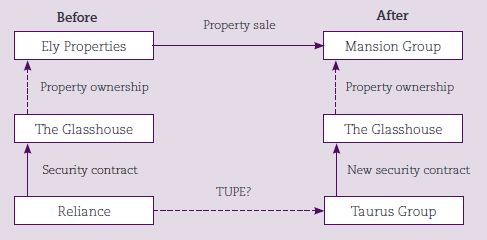
In Taurus, Mr Crofts was employed by Reliance as a security officer at a student accommodation property known as The Glasshouse. Reliance's contract to provide the security services at The Glasshouse was with the property owner, Ely Properties. Ely went into administration and The Glasshouse was subsequently acquired by Mansion Group. Reliance lost the security services contract to Taurus. Reliance informed Mr Crofts that his employment had automatically transferred to Taurus under TUPE, but Taurus disagreed and Mr Croft's employment was terminated. Mr Crofts brought an unfair dismissal claim against Reliance and Taurus.
Legal Issues
Under TUPE, a 'service provision change' will apply where a contract to provide a business service (such as managing agent services, cleaning or security) to the client is either:
Outsourced to a service provider having been provided in-house
Re-let to a new service provider
Ended with the bringing in-house of the business service in question
Mr Crofts argued that for the service provision change under TUPE to apply, the client did not have to remain the same entity. Any other interpretation would undermine the purpose of TUPE, i.e. to protect the rights of employees when contracts transfer. Taurus argued that since the client had changed, there was no service provision change within the meaning of TUPE.
Employment Tribunal decision
The Employment Tribunal rejected Taurus' argument, finding that, for the purposes of TUPE, the client was the person who from time to time required the provision of security services in this case firstly Ely Properties and latterly Mansion Group. The Tribunal therefore ruled that Mr Croft's employment had transferred to Taurus and consequently any liabilities for unfair dismissal passed to Taurus under usual TUPE principles. Taurus appealed.
EAT decision
The EAT focussed on its earlier judgment in Hunter v McCarrick, where it was held that, for there to be a services provision change under TUPE, the activities carried out by different service providers before and after the transfer must be carried out for the same client. The EAT therefore overturned the employment tribunal's decision based on the Hunter judgment. The EAT stated that the correct interpretation of the service provision change definition required the services carried out before and after the change to be on behalf of the same client.
Impact
This is significant for real estate transactions and where ownership of a commercial property changes and the facilities services providers are changed, those facilities staff (such as cleaners or security guards) will not transfer to the new provider. Further, liability for termination of those individuals' employment will remain with the existing services provider, unless they can establish that there was a business transfer (i.e. the economic entity to which the employee is attached is transferred to a new business and retains it identity post-transfer) for the purposes of TUPE.
It is important to note that Hunter has been appealed to the Court of Appeal and is due to be heard in October 2012. In the meantime, however, services providers should seek to address their now considerable risk via indemnities in any services agreements with the property owner. Likewise, property owners may wish to consider renegotiating services agreements now before the Court of Appeal hearing to exclude any indemnification of service providers in respect of the TUPE liabilities.
The content of this article is intended to provide a general guide to the subject matter. Specialist advice should be sought about your specific circumstances.