
United States: A Year-End Rush for the Exit? Tax Uncertainty and Transactional Planning in Q3/Q4 2012
Last Updated: August 15 2012
Article by David B. Strong, Bernie J. Pistillo and John S. Harper

EXECUTIVE SUMMARY

A combination of pending actual and potential tax increases effective in 2013 may have a significant impact on transactional planning in the third and fourth quarters of 2012. These potential tax increases may affect deal terms and also motivate some buyers and sellers to move quickly to close transactions by year-end. Affected parties should evaluate their inventory of pending transactions and identify those transactions for which closing in 2012 may be of critical importance. Please feel free to direct any questions regarding the matters discussed in this client alert to any of the attorneys listed below under the heading Morrison & Foerster Contacts.

POTENTIAL TAX INCREASES

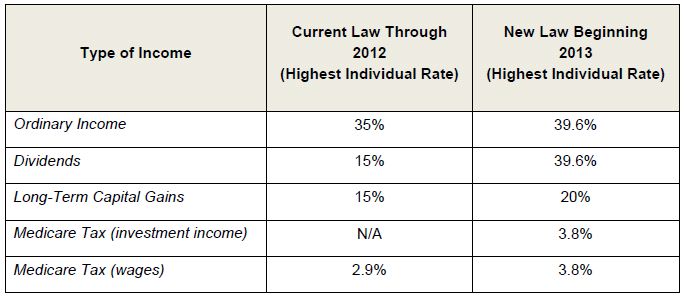
The "Bush tax cuts" are currently set to expire on December 31, 2012. As a result, absent affirmative Congressional action, on January 1, 2013, the highest tax rate applicable to an individual taxpayer will increase from 35% to 39.6% for ordinary income, 15% to 39.6% for dividends, and 15% to 20% for long-term capital gains. At the same time, the already enacted tax increases under the 2010 healthcare reform package will take effect. Of particular significance to transactional activity will be the new 3.8% additional Medicare tax imposed on the investment income of individuals earning more than $200,000 and couples earning more than $250,000. The healthcare reform package also increases the existing Medicare tax on wages and salaries in excess of $200,000 for individuals and $250,000 for couples by 0.9% (from 2.9% to 3.8%). Each of these potential tax increases is summarized in the table below.
POTENTIAL IMPACT ON TRANSACTIONS

  • Closing Date. The combined effect of the sunset of the Bush tax cuts and the new Medicare tax on investment income would result in an overall increase in the effective maximum federal tax on long-term capital gains recognized by individuals by 8.8 percentage points to 23.8% (as compared to the current 15% rate). This would be a material incremental tax cost that could motivate affected buyers and sellers to push hard to close transactions before the end of 2012. In addition, the spending cuts (so-called "sequestrations") required by the Budget Control Act of 2011 and the looming prospect of another potential fight over the debt limit in early 2013 could create increasing concerns regarding the general state of the U.S. economy. Any growing concerns regarding the overall U.S. macroeconomic climate may further prompt buyers and sellers to move quickly to close in 2012.
  • Tax-Deferred Equity Consideration. In light of the pending 8.8% increase in the federal tax rate on individual long-term capital gains, it may make sense for some sellers who plan to close transactions in 2012 to receive any potentially tax-deferred equity consideration on a taxable basis rather than on a non-taxable basis. This approach may be particularly beneficial if the stock received in 2012 is likely to be sold within a relatively short period of time following the closing date, because the value of the tax deferral to the seller may not offset the cost of the effective tax rate increases. Depending on the facts and circumstances, converting a non-taxable transaction into a taxable one often can be accomplished without changes to the economic terms, and requiring only slight modifications to the legal form. A taxable transactional pattern may also have the potential to deliver incremental tax-basis benefits to the buyer, which in turn can allow the seller to press for payment of an additional premium.
  • Escrow / Earn-Out Provisions and Installment Sale Deferrals. Once again, in light of the pending 8.8% increase in the federal tax rate on individual long-term capital gains, it may also make sense for some sellers to structure escrow or earn-out provisions so that payments can be accelerated to some degree in the event that the Bush tax cuts are not extended. For example, a seller might agree to receive a reduced series of one or more earn-out payments beginning on or before December 31, 2012, in the event that the 15% long-term capital gains rate is not extended, in lieu of the buyer making a potentially larger series of one or more earn-out payments that would otherwise begin sometime in 2013. Absent an actual acceleration provision of some kind, sellers can also potentially elect out of installment reporting as late as the extended due date for their 2012 returns and effectively accelerate deferred payments into income for 2012 if there is an adverse rate change (but such a strategy requires careful analysis, especially when there is a high degree of potential variability in the contingent payments that may be made). Electing out of installment sale treatment also requires planning for cash flow needs to pay the 2012 taxes that would be due April 15, 2013.
  • Dividend Distributions. As previously noted, if the Bush tax cuts are not extended, the maximum federal tax rate on dividends will jump dramatically from 15% to 39.6% beginning in 2013. This could, in turn, have a significant impact upon certain types of corporate recapitalization or reorganization transactions where the cash received by a shareholder may be characterized as a dividend rather than long-term capital gain. This can occur, for example, in certain minority investment recapitalization transactions where the pre-existing shareholders receive a distribution of some or all of the newly invested cash and do not simultaneously experience a meaningful reduction in their level of ownership or control of the corporation. In such a situation, it may make sense to attempt to restructure the terms of the transaction to avoid dividend characterization. By comparison, through the end of 2012, an individual shareholder may be indifferent as between receiving consideration that is characterized as a dividend rather than long-term capital gain, given the 15% rate that is currently applicable to both types of income.
  • Incentive Compensation. Finally, if Congress does not act to preserve the current tax rate structure, the highest individual tax rate on ordinary income will increase from 35% to 39.6% beginning in 2013 (or 40.5% after including the additional 0.9% Medicare tax on wages and salaries in excess of $200,000 for individuals and $250,000 for couples). As a result, a meaningful spread will continue to exist between ordinary income and long-term capital gains rates, and individual incentive compensation planning should continue to take that spread into account, as well as evaluate the benefit of compensation deferrals past 2012 in light of the increasing rates. Another continuing source of uncertainty exists in the area of incentive compensation with respect to the potential for passage of "carried interest" legislation that would tax certain flow-through capital gains at ordinary income rates. This issue may receive renewed attention in Congress in late 2012 or early 2013.

CONCLUDING OBSERVATIONS

  • Most commentators have remarked that Congress is unlikely to take any action with respect to tax rates prior to the November elections. After the elections only a very short time period will remain for any potential legislative action, and during that time financial markets may be subjected to an even higher degree of uncertainty and dislocation.
  • Given the potential for tax increases and continued macroeconomic instability, affected parties should evaluate their inventory of pending transactions and identify those transactions for which closing in 2012 may be of critical importance. Steps should then be taken to consummate such transactions in an expeditious and tax-efficient manner. Planned transactions should also take into account the increased backlog that may develop toward year-end with respect to transactions that may be subject to regulatory approvals.

Because of the generality of this update, the information provided herein may not be applicable in all situations and should not be acted upon without specific legal advice based on particular situations.

© Morrison & Foerster LLP. All rights reserved

The content of this article is intended to provide a general guide to the subject matter. Specialist advice should be sought about your specific circumstances.

To print this article, all you need is to be registered on Mondaq.com.

Click to Login as an existing user or Register so you can print this article.

 
In association with
Related Video
Tools
Print
Font Size:
Translation
Channels
Mondaq on Twitter
 
Register for Access and our Free Biweekly Alert
Email Address
Company Name
Password
Confirm Password
Mondaq Topics -- Select your Interests
Accounting and Audit
Anti-trust/Competition Law
Consumer Protection
Corporate/Commercial Law
Criminal Law
Employment and HR
Energy and Natural Resources
Environment
Family and Matrimonial
Finance and Banking
Food, Drugs, Healthcare, Life Sciences
Government, Public Sector
Immigration
Insolvency/Bankruptcy, Re-structuring
Insurance
Intellectual Property
International Law
Litigation, Mediation & Arbitration
Media, Telecoms, IT, Entertainment
Privacy
Real Estate and Construction
Strategy
Tax
Transport
Wealth Management
Regions
Africa
Asia
Asia Pacific
Australasia
Canada
Caribbean
Europe
European Union
Latin America
Middle East
U.K.
United States
Worldwide Updates

Terms & Conditions and Privacy Statement

Mondaq.com (the Website) is owned and managed by Mondaq Ltd and as a user you are granted a non-exclusive, revocable license to access the Website under its terms and conditions of use. Your use of the Website constitutes your agreement to the following terms and conditions of use. Mondaq Ltd may terminate your use of the Website if you are in breach of these terms and conditions or if Mondaq Ltd decides to terminate your license of use for whatever reason.

Use of www.mondaq.com

You may use the Website but are required to register as a user if you wish to read the full text of the content and articles available (the Content). You may not modify, publish, transmit, transfer or sell, reproduce, create derivative works from, distribute, perform, link, display, or in any way exploit any of the Content, in whole or in part, except as expressly permitted in these terms & conditions or with the prior written consent of Mondaq Ltd. You may not use electronic or other means to extract details or information about Mondaq.com’s content, users or contributors in order to offer them any services or products which compete directly or indirectly with Mondaq Ltd’s services and products.

Disclaimer

Mondaq Ltd and/or its respective suppliers make no representations about the suitability of the information contained in the documents and related graphics published on this server for any purpose. All such documents and related graphics are provided "as is" without warranty of any kind. Mondaq Ltd and/or its respective suppliers hereby disclaim all warranties and conditions with regard to this information, including all implied warranties and conditions of merchantability, fitness for a particular purpose, title and non-infringement. In no event shall Mondaq Ltd and/or its respective suppliers be liable for any special, indirect or consequential damages or any damages whatsoever resulting from loss of use, data or profits, whether in an action of contract, negligence or other tortious action, arising out of or in connection with the use or performance of information available from this server.

The documents and related graphics published on this server could include technical inaccuracies or typographical errors. Changes are periodically added to the information herein. Mondaq Ltd and/or its respective suppliers may make improvements and/or changes in the product(s) and/or the program(s) described herein at any time.

Registration

Mondaq Ltd requires you to register and provide information that personally identifies you, including what sort of information you are interested in, for three primary purposes:

  • To allow you to personalize the Mondaq websites you are visiting.
  • To enable features such as password reminder, newsletter alerts, email a colleague, and linking from Mondaq (and its affiliate sites) to your website.
  • To produce demographic feedback for our information providers who provide information free for your use.

Mondaq (and its affiliate sites) do not sell or provide your details to third parties other than information providers. The reason we provide our information providers with this information is so that they can measure the response their articles are receiving and provide you with information about their products and services.

If you do not want us to provide your name and email address you may opt out by clicking here .

If you do not wish to receive any future announcements of products and services offered by Mondaq by clicking here .

Information Collection and Use

We require site users to register with Mondaq (and its affiliate sites) to view the free information on the site. We also collect information from our users at several different points on the websites: this is so that we can customise the sites according to individual usage, provide 'session-aware' functionality, and ensure that content is acquired and developed appropriately. This gives us an overall picture of our user profiles, which in turn shows to our Editorial Contributors the type of person they are reaching by posting articles on Mondaq (and its affiliate sites) – meaning more free content for registered users.

We are only able to provide the material on the Mondaq (and its affiliate sites) site free to site visitors because we can pass on information about the pages that users are viewing and the personal information users provide to us (e.g. email addresses) to reputable contributing firms such as law firms who author those pages. We do not sell or rent information to anyone else other than the authors of those pages, who may change from time to time. Should you wish us not to disclose your details to any of these parties, please tick the box above or tick the box marked "Opt out of Registration Information Disclosure" on the Your Profile page. We and our author organisations may only contact you via email or other means if you allow us to do so. Users can opt out of contact when they register on the site, or send an email to unsubscribe@mondaq.com with “no disclosure” in the subject heading

Mondaq News Alerts

In order to receive Mondaq News Alerts, users have to complete a separate registration form. This is a personalised service where users choose regions and topics of interest and we send it only to those users who have requested it. Users can stop receiving these Alerts by going to the Mondaq News Alerts page and deselecting all interest areas. In the same way users can amend their personal preferences to add or remove subject areas.

Cookies

A cookie is a small text file written to a user’s hard drive that contains an identifying user number. The cookies do not contain any personal information about users. We use the cookie so users do not have to log in every time they use the service and the cookie will automatically expire if you do not visit the Mondaq website (or its affiliate sites) for 12 months. We also use the cookie to personalise a user's experience of the site (for example to show information specific to a user's region). As the Mondaq sites are fully personalised and cookies are essential to its core technology the site will function unpredictably with browsers that do not support cookies - or where cookies are disabled (in these circumstances we advise you to attempt to locate the information you require elsewhere on the web). However if you are concerned about the presence of a Mondaq cookie on your machine you can also choose to expire the cookie immediately (remove it) by selecting the 'Log Off' menu option as the last thing you do when you use the site.

Some of our business partners may use cookies on our site (for example, advertisers). However, we have no access to or control over these cookies and we are not aware of any at present that do so.

Log Files

We use IP addresses to analyse trends, administer the site, track movement, and gather broad demographic information for aggregate use. IP addresses are not linked to personally identifiable information.

Links

This web site contains links to other sites. Please be aware that Mondaq (or its affiliate sites) are not responsible for the privacy practices of such other sites. We encourage our users to be aware when they leave our site and to read the privacy statements of these third party sites. This privacy statement applies solely to information collected by this Web site.

Surveys & Contests

From time-to-time our site requests information from users via surveys or contests. Participation in these surveys or contests is completely voluntary and the user therefore has a choice whether or not to disclose any information requested. Information requested may include contact information (such as name and delivery address), and demographic information (such as postcode, age level). Contact information will be used to notify the winners and award prizes. Survey information will be used for purposes of monitoring or improving the functionality of the site.

Mail-A-Friend

If a user elects to use our referral service for informing a friend about our site, we ask them for the friend’s name and email address. Mondaq stores this information and may contact the friend to invite them to register with Mondaq, but they will not be contacted more than once. The friend may contact Mondaq to request the removal of this information from our database.

Security

This website takes every reasonable precaution to protect our users’ information. When users submit sensitive information via the website, your information is protected using firewalls and other security technology. If you have any questions about the security at our website, you can send an email to webmaster@mondaq.com.

Correcting/Updating Personal Information

If a user’s personally identifiable information changes (such as postcode), or if a user no longer desires our service, we will endeavour to provide a way to correct, update or remove that user’s personal data provided to us. This can usually be done at the “Your Profile” page or by sending an email to EditorialAdvisor@mondaq.com.

Notification of Changes

If we decide to change our Terms & Conditions or Privacy Policy, we will post those changes on our site so our users are always aware of what information we collect, how we use it, and under what circumstances, if any, we disclose it. If at any point we decide to use personally identifiable information in a manner different from that stated at the time it was collected, we will notify users by way of an email. Users will have a choice as to whether or not we use their information in this different manner. We will use information in accordance with the privacy policy under which the information was collected.

How to contact Mondaq

You can contact us with comments or queries at enquiries@mondaq.com.

If for some reason you believe Mondaq Ltd. has not adhered to these principles, please notify us by e-mail at problems@mondaq.com and we will use commercially reasonable efforts to determine and correct the problem promptly.